Throughout this Labour leadership contest, I've been predicting a victory for Yvette Cooper. Indeed I was predicting it in April before the general election. I don't like to change my predictions, so I won't. Despite everything, Yvette Cooper will become the leader of the Labour Party.
I am aware, however, that this is - to put it mildly - a minority position. And that I have no evidence for it whatsoever.
In fact, if I'd been paying attention to myself, I would have concluded that Jeremy Corbyn, currently the red-hot favourite, was the likely winner. 'New political forces will emerge, whether within the existing parties or outside of them,' I wrote in 2012; 'things are about to change quite radically.' I added last year that UKIP weren't that change. But maybe Corbyn is the catalyst for this change.
So let's assume that that I'm as wrong now as I was when I placed money on Peter Hain succeeding Tony Blair, the issue is whether Corbyn will be any good as leader.
There are three basic tasks for the opposition. First, that they oppose government policies by producing alternatives. Second, that those alternatives change the terms of the debate. Third, that by changing the debate, there comes at least a reasonable chance of winning the next election.
The first is where things have really gone wrong for the Labour establishment. Losing the election was disastrous, but Harriet Harman's call for MPs to abstain on welfare reform added insult to injury. It smacked of democratic centralism, implying that since the Tories had won the election, then their policies had to be accepted. The decision to abstain made no difference whatsoever to the outcome of the vote, but Harman has been around long enough that she should have got the grasp of symbolic gestures by now. And yet she blew it, and no other single event has done as much to strengthen Corbyn's cause.
Frankly, Corbyn couldn't make a worse fist of opposition than Harman already has.
His MPs, however, could make it much, much worse. If a significant number of them effectively refuse to accept the party's vote, then he will fail from the outset. And they may well do so. They could quote Tony Benn at a meeting of the shadow cabinet in 1970: 'When the boat is sunk, you can't exactly rock it.'
Assuming, though, that he could assert his authority of the parliamentary party, could Corbyn re-frame the national debate? Yes. Is it likely? No. He would have the entire media against him; not just the usual suspects, but the whole of what some like to call the legacy media.
And maybe in there is the hope: that social media and the revival of public meetings can bypass the newspapers and the broadcasters. Maybe Facebook and The Trews will eclipse the Daily Mail and the Ten O'Clock News as the source of political information. I'm not convinced. Not in the short-term. So it would require an active mass membership - in real life, not on the internet - to counteract media hostility. Again I'm not convinced. Nor do I see any sign of Corbyn supporters seeking to persuade, rather than to assert.
Could he offer the possibility of an election win? Well, very probably not. But honestly, you never really know. Labour winning in 2020 is such an uphill task anyway. Someone on Twitter (I apologise for forgetting who - let me know it was you) suggested that, if this were a dice game, Labour needed to throw a six to win, and that Andy Burnham, Yvette Cooper and Liz Kendall could only manage threes and fours. Corbyn, on the other hand, offered the chance of either a one or a six.
Maybe. It is possible that Corbyn (Corbyn, of all people!) could build a People's Army that would massively outnumber Nigel Farage's following, a crusade that stretches far beyond Parliament. How this works within the existing Labour Party structure, however, I have no idea.
I have a fear that a Corbyn-led Labour might echo the miners' strike of 1984-85. There sprang up then a national network of support groups that was really quite extraordinary. It was, said the Financial Times, 'the biggest and most continuous civilian mobilisation since the Second World War'.
If you were involved, even in a peripheral way, with this movement, it was almost impossible to credit the opinion polls which showed the majority of the public firmly on the side of the government and against the NUM. But that was the reality. Most people didn't support the miners, and the result was one of the left's most celebrated of heroic defeats.
Back before Corbyn declared himself a candidate, I wrote: 'The task of choosing a new leader is to find someone who can articulate a sense of hope for the future, to persuade somewhere around a quarter of the electorate that he or she can help us build a better society.'
At the moment, there's only one candidate who's being seen in those terms. But I suspect there's only one six on his die (if that) and that the other faces are all ones. And I fear that Labour might actually need a double-six anyway.
I have yet to decide who to vote for. Over the course of the next week, I shall look back over the careers of the four candidates as a way of clarifying that question for myself. And I shall start tomorrow with Andy Burnham.
Showing posts with label Ukip. Show all posts
Sunday, 16 August 2015
Thursday, 30 July 2015
Up the hill backwards
The Labour Party has 232 MPs. To form a majority in the House of Commons, a party needs to have 326 MPs. So if Labour is to win the next election outright, it needs to take an additional ninety-four seats.
Of the ninety-four marginal constituencies where Labour missed out most narrowly this year, eight are currently held by the SNP, three by the Liberal Democrats, two by Plaid Cymru and one by the Greens. The other eighty are all Conservative.
It would be simplistic to say that the party needs to win these ninety-four seats to form a majority government, because it assumes that there will no boundary changes (which there will be), and that Labour should target its efforts purely on existing numbers (which isn't necessarily the case). But still, it's a rough guide to the task ahead.
So the question is: How is Labour going to take a seat like Gravesham in Kent (no. 91 on the list), where the Tories currently have a majority of over 8,000? The Lib Dems and the Greens are irrelevant here - there are no votes to be squeezed out of them. So Labour would need to take votes either directly from the Conservatives or from Ukip, who are in a strong third place with a 19 per cent share.
The same pattern is found right across the country. Not just the obvious southern constituencies of Crawley (no. 71), Milton Keynes South (83) and Thurrock (8). But also seats in the Midlands, such as Dudley South (55), Erewash (30) and Telford (11). And in the North as well: Morley & Outwood (6), Pendle (65) and Stockton South (47).
All of these and many others - most of those on the list - are held by the Conservatives, with Labour second, Ukip third, and no one else in sight. Winning these seats is Labour's only path to power.
By comparison, the general election this year was so much easier. Some four-and-a-half million Lib Dem votes went missing from the party's 2010 total. Which makes it all the more shocking that Labour's popular vote only increased by around three-quarters-of-a-million. Next time it'll be far harder.
Some things will change before 2020, of course. Ukip support may well fall away in the next couple of years, depending on how the referendum goes, which would make their votes more easily available for someone. But this is far from certain. It may be that Ukip actually increases its strength. Or it may split. Their vote is the great unknown in electoral arithmetic, but my assumption is that there's a stubborn protest vote in there that's not going to end up with either of the major parties.
Somewhat clearer than the fate of Ukip is the fact that surely the Lib Dems will do better in the next election than they did this year. In a very marginal seat, this might help Labour, since it could reduce the Tory share. But more generally, the Lib Dems will be on the rise and will be competing with Labour for new votes.
Maybe majority government is too ambitious a target for Labour right now. Maybe a minority administration, with support from other parties, is as good as it could get. But the challenge is still the same: How does the Labour Party take votes from the Conservatives and from Ukip?
Tuesday, 28 July 2015
It's so strange the way he's talking
I think I should record the fact that I'm really, really enjoying the Labour Party leadership election.
Which is a bit odd. Because so far there has been not a single memorable moment, and because the candidates are so poor. I've written elsewhere about the best slate of candidates in a Labour leadership election, but this is surely the worst; there was more talent on display in 2007, and there was only one name on the ballot paper then.
But the whole thing's been transformed by the arrival in the spotlight - reluctant, blinking, bewildered - of Jeremy Corbyn, the longest serving member of the Left's chorus-line. Unheralded by the critics, never even an understudy, he's somehow turned a school nativity play into a hit show.
Or, more accurately, into part of a hit series, one more episode in a longer running story about the public's dislike of the political establishment.
If we were to date the start of this story, I think we'd go back to the elections of Martin Bell in 1997 and of Richard Taylor in 2001 as independent MPs. Bell was ably assisted by the Labour machine, so perhaps he doesn't really count, but certainly Taylor - who took the safe Wyre Forest seat from Labour on a Health Concern ticket - was a shot across the bows of the establishment. As I wrote in A Classless Society: 'At a time when political parties were losing support at an unprecedented rate, they could not afford to ignore the spectacular success of a genuine independent.'
Then there was the election of Respect's George Galloway as the member for Bethnal Green and Bow in 2005 and Bradford West in 2012. This year, of course, Galloway emulated Shirley Williams's unenviable record of losing a seat at two successive general elections, but meanwhile the Scottish National Party was gleefully sweeping the board in Westminster.
In between, there was the brief flurry of Clegg-mania in 2010 and, more significantly, the spectacular rise of Ukip. It may only have one MP, but the vote Ukip achieved in the general election was substantial: 3.9 million people turned out to support the party, more than the Liberal Democrats and the SNP put together. I think it's reasonable to point out that many of those people were voting in anger at the failings of the other parties, rather than to express their total support for Ukip's platform.
And now we have the Corbyn insurgency. Napoleon once said that every corporal carried a field-marshal's baton in his knapsack, but no one realised that his comments should be taken literally.
Every one of these developments since Wyre Forest seems to have come as a complete shock to the Westminster commentators. And partly this is because the new political class and the media have become as one.
There's always been an overlap between politics and media, but since the 1990s it has reached absurd proportions. Michael Gove, Boris Johnson, Ed Balls, Yvette Cooper - all of them journalists or ex-journalists. It feels as though the two groups have interbred to the point of imbecility, and are now apparently unaware of anything happening outside the Strangers' Bar and a handful of decent restaurants within earshot of the division bell.
With some honourable (sometimes very honourable) exceptions, political commentary has descended into a kiddies' Kremlinology, with little titbits about whether George Osborne has the tactical upper-hand over Theresa May in the race for the Tory succession.
The Blairite-Brownite saga was the model, a dispute that was rooted entirely in ego. 'There is but a cigarette paper between the politics of Brown and Blair,' Polly Toynbee wrote in 1996, but 'most of politics is far more about personal rivalry, jealousy and suspicion than usually gets reported.' Now that's pretty much all that gets reported.
And then, from time to time, the cosy consensus is disrupted by the public demanding that their voice be heard as well. And those interruptions to business seem to be turning up with every greater frequency.
So we have the hugely entertaining spectacle of columnists trying to work out why anyone would take Corbyn seriously. He's not part of the inner circles. He's not a player. He is, on the other hand, a man who's been on virtually every demonstration for the last thirty-five years (or on the counter-demonstration if the original one wasn't appropriate). He may not have figured in the media very much, but his long service is known and admired by a great many of those who will vote in the leadership election.
Corbyn represents the outsider at a time when insiders are deeply unpopular. A vote for him is a vote against the establishment (however loosely or widely that is defined). Just for the record, I still don't think he's going to win the leadership, but then the SNP didn't win the independence referendum last year and it didn't seem to do them much harm.
And talking of referendums, that's the next episode waiting to be written in the story of Britain's disillusionment with Westminster. At some point in the next two years (sooner rather than later, if the reports are to be believed), the political class is going to have to put itself up for approval by the population of the country. The ostensible issue is our membership of the European Union, but it'll be surprising if that's the sole item on the agenda.
Now that one's going to be really enjoyable.
Wednesday, 27 May 2015
Will no one rid us of this tedious pundit?
'The Tories who witnessed the Major years still bear some scar tissue,' writes Simon Heffer in the New Statesman, as he commences his analysis of the new government's position.
Well, yes, and much of it was inflicted by him and others in the supposedly loyal Tory press, still worshipping at the shrine of the fallen idol, having never got over the emotional shock of witnessing her departure from Downing Street. When John Major was told during the 1992 election campaign that the Conservative Party was six points behind Labour in the opinion polls, he replied: 'Of those six points, three are the fault of Simon Heffer and the other three are Frank Johnson's fault.'
Heffer was then the deputy editor of the Daily Telegraph and the relentless sniping from that newspaper and from the Daily Mail did a huge amount of damage to Major's government. It'll be interesting to see how much they've learned from the experience.
Meanwhile, though, I do wonder why any publication continues to pay Heffer money for his views, given how ludicrously inept his assessments are. I know most commentators, having spent far too long reading opinion polls, called the recent election wrong, but Heffer is way beyond that. He is willfully blind to reality, his perception distorted by dogma in a way that would have caused embarrassment to a member of the Workers' Revolutionary Party in the days of Gerry Healy.
In May last year, following the European elections, Heffer wrote about the urgent need for the Tories to form an electoral pact with Ukip. In constituencies such as Nigel Farage's promised land of Thanet South, he said, 'there is nothing to be gained by putting up a novice candidate against him'. Foolishly, the Conservative party ignored his wise advice, fielded their own candidate and, er, won the seat.
Heffer's article concluded: 'If the Tories have any sense, they will start talking about such an arrangement now. For if, next week, Ukip wins the Newark by-election and the Tories descend into panic, David Cameron might find himself with no other option.' Needless to say, the Conservative Party won the Newark by-election, with a handsome 7,400 majority. In the general election, they increased that to 18,500, with Ukip beaten into third place by Labour.
But the great sage was undeterred. He still knew better, and mere facts weren't going to get in his way. This is him in August last year. 'Although they [the Tories] have doggedly refused to entertain the idea, they will have to consider an electoral pact with Ukip, or face at least five years out of government.' Consequently, 'the party's grandees will, I am convinced, make a humiliating U-turn.'
If David Cameron would only reach out to Ukip, 'he wouldn't just keep himself in Downing Street, but would reunite a conservative coalition - which, I am sure, is really what the country wants.'
All that certainty, all that absolute self-confidence, all that nonsense.
But then this is the man who backed John Redwood's bid for the Conservative leadership in 1995. He has been consistently wrong for over twenty years now. Why is he still considered employable?
Monday, 11 May 2015
David Cameron: chillaxing to victory
In 2005, following a third successive election defeat, the Conservative Party staged a beauty contest for those who wished to succeed Michael Howard as leader. Up until that morning, the front-runner had been David Davis, but by the time all five candidates had made their 20-minute speeches, he'd been overtaken by David Cameron.
Amongst those who had their minds changed was me. I rated Davis highly at this stage, largely on the strength of a gig he did with Tony Benn at the Royal Albert Hall in 2002. Benn was then at the peak of his popularity as a lovable elder statesman, and for a Conservative to have the nerve to go head-to-head with him in front of an audience that was guaranteed to be 99 per cent anti-Tory showed, I thought, considerable bottle and self-confidence. He was also very good on the night.
Unfortunately he wasn't very good at that 2005 conference, while Cameron was brilliant. Maybe - I've often had cause to think in the last ten years - I was dazzled by a smoke-and-mirrors act, but my immediate response was to predict to the person with whom I was watching on TV that Cameron would win the leadership and would go on to win the next two general elections.
As I say, maybe I was caught up in the heat of the moment. In the final poll, the party members voted for Cameron over Davis in a ratio of two to one, but come 2010 the country did not. He failed to win the election, despite facing only a badly wounded Gordon Brown, a man whose most noteworthy contribution to the campaign was to insult a supporter for her alleged bigotry.
Now, however, Cameron has actually won an election, and I feel my original judgement was sort of vindicated.
This has been a spectacular victory, though not quite as wondrous as some are claiming. The Conservatives' share of the vote went up, but turnout was still poor and Cameron persuaded just 24.4 per cent of the registered electorate to vote for him. This was, however, better than the 23.5 per cent he achieved last time round (itself an improvement on Labour's 21.6 per cent in 2005).
So I wanted to make a couple of points about Cameron.
The first is something that I explored at greater length in an article on the twenty-first anniversary of Black Wednesday. This is a photograph of Norman Lamont, then chancellor of the exchequer, announcing Britain's humiliating withdrawal from the exchange rate mechanism in September 1992:
And there, off to one side, is his 25-year-old adviser and speech writer, David Cameron.
Cameron, I wrote, 'witnessed at close quarters the spectacular implosion of a party that once believed it was predestined to power'. I suggested that this is perhaps why he always seems so relaxed in a crisis. Similarly George Osborne, who was at Douglas Hogg's side in the BSE disaster of 1996. These people had experienced such dreadful political depths in their early years that very little was going to faze them.
Ed Miliband and Ed Balls, on the other hand were New Labour advisers in the 1990s, at a time when the party was already coasting into government. They had no such baptism of fire.
When Cameron became leader in 2005, it was clear that his job was, in the cliché of the time, to 'decontaminate the Tory brand'. The early efforts were clumsy and gimmicky: hugging hoodies and huskies, demonstrating his green credentials by installing a windmill on his roof and cycling to work (followed by a car, carrying his papers).
Then he got blown off course by the bankers' recession. No longer, it appeared, was sunshine going to win the day. The concept of the Big Society withered on the vine (though it's actually very good and the Labour Party should take it back).
Instead, the attempt to modernise the party seemed to consist of little more than the sudden, unpromised introduction of same-sex marriages. It didn't seem like very much - essentially a new name for civil partnerships - but actually it turned out to do the job really rather well.
Because the success of same-sex marriages lay not in the legislation itself, but in the way that it provoked a mass exodus from the party. Some constituency organisations claimed to have lost up to half their members as a result of the policy.
This was, most commentators agreed, disastrous for Cameron. But it wasn't. In one fell blow he'd cleared out large numbers of the 'fruitcakes, loonies and closet racists', as he'd described Ukip back in 2006. Many of them, of course, went straight over to Ukip, giving that party a huge boost in membership and popularity.
Less noticed was the effect on the Conservative Party itself, now smaller but - from Cameron's perspective - much better looking. It has become difficult to denounce the Tories as racist, sexist, homophobic and still retain any credibility as a political observer. The party that embraced economic liberalism in the 1980s has accepted the social liberalism that spread across Britain in the 1990s.
The election results this week saw Cameron increase the Conservative share of the vote, largely at the expense of the Liberal Democrats. All those right-wing commentators like Simon Heffer and Charles Moore who had insisted that the Cameron project was misguided, that he shouldn't be trying to appeal to the liberal vote (sometimes even suggesting he form an electoral pact with Ukip) - they turned out to be completely wrong.
There are many other commentators for whom the Tory brand cannot ever be sufficiently decontaminated, but it turns out that he's done enough. Not enough for those in the long-derided 'metropolitan elite' of course, those who follow in the pioneering footsteps of the delegate to the 1982 SDP conference, excitedly proclaiming: 'There may be minorities we have not yet discovered.' But enough for the rest of the country.
The achievement of Tony Blair in the mid-1990s was to make the Labour Party a safe home for ex-Tory voters. If Cameron hasn't quite reciprocated that achievement, he has gone some way towards it. There were many disillusioned Liberal Democrats, and even some lifelong Labour supporters, who simply couldn't countenance Ed Miliband and who felt just about safe enough to turn to vote Conservative for the first time ever, despite grave reservations over Tory policy.
As all the polls showed, Cameron's ratings outstripped his party's; Miliband's trailed his.
The Left need to get used to the idea that Cameron and Osborne have changed the Conservative Party for good. A new line of attack is needed.
One final thought. There is much talk of this election resembling 1992 when John Major won a slender majority and then ran into trouble with his own party over Europe. And look what's coming next, say the columnists: it's a European referendum and history could repeat itself.
I think this unlikely. If Ukip had got, say, five MPs they might have formed a rival pole of attraction for Eurosceptic Tory members, and there might have been defections over the referendum arrangements. Then Cameron would have had trouble. That might still happen if there are a few by-elections that allow Ukip to boost their numbers, but I doubt it. And Douglas Carswell does not in himself constitute a rival pole of attraction.
In any event, Cameron is much more in tune with the mood of his party than Major was. He remembers all too well the damage that Europe did to the Tories in the 1990s. Most importantly, he doesn't face the same problem that afflicted his predecessor.
Because Major's real grief over Europe was not to be found amongst the 'bastards' on his own backbenches; it lay in the House of Lords. There lurked the malign influence of Margaret Thatcher, the deposed but still powerful ex-leader, constitutionally unable to keep herself from interfering, from stirring up trouble, from seeking to undermine her successor as he tried to get the Maastricht Treaty through Parliament.
As I wrote in my book A Classless Society:
Thatcher's behaviour during Major's premiership was even worse than that of Edward Heath during her own time in office. Heath had been unstinting in his disapproval as he remained stubbornly on the backbenches ('like a sulk made flesh,' in the words of journalist Edward Pearce), but he hadn't actively engaged in plotting against her. But then, as a minister told the BBC's John Cole: 'She was always criticising the government when she led it, so why expect her to change now?'The EU referendum won't all be smooth sailing, but it'll be less choppy than Major's trip back from Maastricht. And easier than Cameron's rite of passage on Black Wednesday.
Sunday, 10 May 2015
A tale of some minor parties
A week or so back, I predicted that one consequence of the election would be the resignations of Nigel Farage and Nick Clegg as the leaders of, respectively, Ukip and the Liberal Democrats. I also predicted that Natalie Bennett would not resign as leader of the Green Party of England and Wales.
These things having now come to pass, it's time to evaluate them.
Starting with the last first, Bennett should have the decency to go immediately. She has proved herself to be completely useless as a leader. The Greens had a dreadful election, and much of the blame for that rests with her.
The party achieved less than 4 per cent of the vote. Under most sensible forms of proportional representation, the bar for securing seats is set at 5 per cent. Frankly they're fortunate that first-past-the-post came to their rescue and gave them an MP.
Yet the opportunity was unquestionably there for the Greens: lots of airtime and visibility, a weak Labour leadership, a widespread dissatisfaction with mainstream politics. A breakthrough of sorts was possible. Obviously not in terms of winning large numbers of seats, but even without representation, a minor party can still have an influence, can help to shape the political agenda.
You only need look to Ukip. At a time when they had no MPs at all, they were still capable of scaring the British prime minister into promising a referendum when he didn't want one, and panicking the Labour Party into saying they'd 'get tough' on immigration, when we knew they wouldn't.
So what did Bennett do? She joined in the chorus of 'the Tories are mean and nasty'. Well, if you believed that, then you should have done the sensible thing and voted for a party capable of removing the Conservatives from office. Which is, indeed, what the vast majority of those opposed to the Tories actually did.
At a constituency level, things may have been different, but on the national stage Bennett offered nothing at all that was distinctive. One brief mention in a leaders' debate of climate change and vanishing species, and that was it. At a time when fracking offers a perfect way of linking the local with the global, there was only silence.
It is, of course, more difficult to get attention for environmental issues at a time of economic hardship, but this is far from a new problem. I wrote about it in Crisis? What Crisis?, my book on the 1970s. There's been plenty of time to work out a strategy for such a situation.
The Greens are one of the few parties who actually have a USP. Yet they didn't exploit it. Instead there was a manifesto and a platform full of policies on an absurd range of issues that were entirely irrelevant, including the stupidity over copyright, to which I drew attention a while back. (And which subsequently annoyed the hell out of a lot of creative people who were sympathetic to the party.)
Why? Where's the benefit in burying your brand? Why allow your core message to be lost amidst a welter of questions about a tax policy you will never have a chance to implement?
One other point, which most people are (quite rightly) too polite and decent to say out loud: the voice was wrong. The British public didn't warm to being waffled at in an Australian accent. Obviously it shouldn't matter, but it does.
In short, Bennett should go.
So too should Farage. He's left open the possibility of coming back from his holidays and standing again for the Ukip leadership, but he should resist the temptation. The party is better off without him now.
He has been an extraordinary figure who has over-achieved on a spectacular scale. In many ways, he was the story of the Coalition years, conducting a brilliant guerrilla campaign against Westminster. (Do I need to point out that I'm talking about technique not policies? I do hope not.) I went to one of his EU debates with Nick Clegg and he was a superb performer - committed Europhiles were coming out of the hall saying how good he was.
But he still has to go.
When Ukip won the elections for the European Parliament a year ago, I wrote that they'd reached their high-water mark. If they were ever to go any further, I suggested, they needed to thank Farage for all his work and ask him to step down. He'd taken them as far as he possibly could. My comparison was with Ian Holloway, a colourful, charming and competent manager who got Blackpool Football Club to the Premier League, but couldn't keep them there.
My argument was that if Ukip wanted to secure - let alone go beyond - the 4.4 million votes they achieved last year, they had to make serious inroads into Labour heartlands, and Farage was probably not the man for that. He did pretty well this week, but the party fell to 3.9 million votes on a far higher turnout. It could have been better if he'd gone last year. Now it's probably too late, and decline is (I think) inevitable.
Ukip are, as normal with third parties, an odd coalition of the disgruntled and the idealistic from all points of the political compass.
There are two broad bases of support: the Eurosceptic deserters from the Conservative Party and the disillusioned white working-class who feel abandoned by Labour. These are represented by Douglas Carswell and Paul Nuttall respectively, and I assume that they will be the two candidates in a leadership election. I also assume that Carswell will win, to the detriment of the party's electoral interests.
The alternative is Suzanne Evans, currently the acting leader, who would be their best choice of all. And since I think that, I don't expect her to get the job on a permanent basis.
Their moment has passed, but they leave behind an example of how to make a difference. Why is there no Left party that can do this?
And so, finally, to Nick Clegg.
What can one say? Well, firstly, that he made exactly the right decision in 2010. The Lib Dems, and before them the Liberals, had always banged on about coalition government being a good thing. They were offered it, and they accepted. To do otherwise would have been foolish.
Some people complained that Clegg would have sold his own mother to get power, but that judgement seemed a little harsh. After all, he did join the Lib Dems, which isn't traditionally the way to achieve high office. Given the state of modern politics, he could have fitted perfectly comfortably into the modern Conservative or Labour Parties, but he chose the road less travelled.
As the junior partner in the Coalition, the Lib Dems proved surprisingly effective at government. They got through key policies like the pupil premium and raising the threshold for income tax; even the tuition fees increase - damaging though it was - had a logic, if they'd only had the sense to call it a time-limited graduate tax.
Most of their members and (probably) their supporters would have preferred a coalition with Labour, but that wasn't available in 2010. In the circumstances, I thought they played a difficult hand rather well and could justifiably be proud of their record.
But over recent months, and particularly during the campaign itself, they decided to distance themselves from their Coalition partners and, in so doing, they thoroughly ruined the good story they had to tell.
The final straw came when Danny Alexander decided to reveal the contents of private government papers in an attack on the Tories. The effect was to make the party look incompetent and untrustworthy. Who would want to work with people who go telling tales out of school? The first rule of Coalition Club is you don't talk about what goes on behind the scenes at Coalition Club.
Before the election, it was widely assumed that Tim Farron would become the next leader. Now that looks like such a nailed-on certainty that the party's going to have to twist someone's arm to stand against him, so that it least has the formal structure of a contest. Norman Lamb, possibly; or that bloke up in Scotland, whose constituency is so remote that not even SNP canvassers could find it.
Farron is the obvious and correct choice. He's as close as they've got to an old-fashioned Liberal, and since the parliamentary party is down to the numbers last seen under Jeremy Thorpe, they might as well adopt an old-fashioned approach.
But it's an absurdly uphill struggle now. The thing is this: if the Lib Dems didn't exist, who would bother to invent them?
These things having now come to pass, it's time to evaluate them.
Starting with the last first, Bennett should have the decency to go immediately. She has proved herself to be completely useless as a leader. The Greens had a dreadful election, and much of the blame for that rests with her.
The party achieved less than 4 per cent of the vote. Under most sensible forms of proportional representation, the bar for securing seats is set at 5 per cent. Frankly they're fortunate that first-past-the-post came to their rescue and gave them an MP.
Yet the opportunity was unquestionably there for the Greens: lots of airtime and visibility, a weak Labour leadership, a widespread dissatisfaction with mainstream politics. A breakthrough of sorts was possible. Obviously not in terms of winning large numbers of seats, but even without representation, a minor party can still have an influence, can help to shape the political agenda.
You only need look to Ukip. At a time when they had no MPs at all, they were still capable of scaring the British prime minister into promising a referendum when he didn't want one, and panicking the Labour Party into saying they'd 'get tough' on immigration, when we knew they wouldn't.
At a constituency level, things may have been different, but on the national stage Bennett offered nothing at all that was distinctive. One brief mention in a leaders' debate of climate change and vanishing species, and that was it. At a time when fracking offers a perfect way of linking the local with the global, there was only silence.
It is, of course, more difficult to get attention for environmental issues at a time of economic hardship, but this is far from a new problem. I wrote about it in Crisis? What Crisis?, my book on the 1970s. There's been plenty of time to work out a strategy for such a situation.
The Greens are one of the few parties who actually have a USP. Yet they didn't exploit it. Instead there was a manifesto and a platform full of policies on an absurd range of issues that were entirely irrelevant, including the stupidity over copyright, to which I drew attention a while back. (And which subsequently annoyed the hell out of a lot of creative people who were sympathetic to the party.)
Why? Where's the benefit in burying your brand? Why allow your core message to be lost amidst a welter of questions about a tax policy you will never have a chance to implement?
One other point, which most people are (quite rightly) too polite and decent to say out loud: the voice was wrong. The British public didn't warm to being waffled at in an Australian accent. Obviously it shouldn't matter, but it does.
In short, Bennett should go.
So too should Farage. He's left open the possibility of coming back from his holidays and standing again for the Ukip leadership, but he should resist the temptation. The party is better off without him now.
He has been an extraordinary figure who has over-achieved on a spectacular scale. In many ways, he was the story of the Coalition years, conducting a brilliant guerrilla campaign against Westminster. (Do I need to point out that I'm talking about technique not policies? I do hope not.) I went to one of his EU debates with Nick Clegg and he was a superb performer - committed Europhiles were coming out of the hall saying how good he was.
But he still has to go.
When Ukip won the elections for the European Parliament a year ago, I wrote that they'd reached their high-water mark. If they were ever to go any further, I suggested, they needed to thank Farage for all his work and ask him to step down. He'd taken them as far as he possibly could. My comparison was with Ian Holloway, a colourful, charming and competent manager who got Blackpool Football Club to the Premier League, but couldn't keep them there.
My argument was that if Ukip wanted to secure - let alone go beyond - the 4.4 million votes they achieved last year, they had to make serious inroads into Labour heartlands, and Farage was probably not the man for that. He did pretty well this week, but the party fell to 3.9 million votes on a far higher turnout. It could have been better if he'd gone last year. Now it's probably too late, and decline is (I think) inevitable.
Ukip are, as normal with third parties, an odd coalition of the disgruntled and the idealistic from all points of the political compass.
There are two broad bases of support: the Eurosceptic deserters from the Conservative Party and the disillusioned white working-class who feel abandoned by Labour. These are represented by Douglas Carswell and Paul Nuttall respectively, and I assume that they will be the two candidates in a leadership election. I also assume that Carswell will win, to the detriment of the party's electoral interests.
The alternative is Suzanne Evans, currently the acting leader, who would be their best choice of all. And since I think that, I don't expect her to get the job on a permanent basis.
Their moment has passed, but they leave behind an example of how to make a difference. Why is there no Left party that can do this?
And so, finally, to Nick Clegg.
What can one say? Well, firstly, that he made exactly the right decision in 2010. The Lib Dems, and before them the Liberals, had always banged on about coalition government being a good thing. They were offered it, and they accepted. To do otherwise would have been foolish.
Some people complained that Clegg would have sold his own mother to get power, but that judgement seemed a little harsh. After all, he did join the Lib Dems, which isn't traditionally the way to achieve high office. Given the state of modern politics, he could have fitted perfectly comfortably into the modern Conservative or Labour Parties, but he chose the road less travelled.
As the junior partner in the Coalition, the Lib Dems proved surprisingly effective at government. They got through key policies like the pupil premium and raising the threshold for income tax; even the tuition fees increase - damaging though it was - had a logic, if they'd only had the sense to call it a time-limited graduate tax.
Most of their members and (probably) their supporters would have preferred a coalition with Labour, but that wasn't available in 2010. In the circumstances, I thought they played a difficult hand rather well and could justifiably be proud of their record.
But over recent months, and particularly during the campaign itself, they decided to distance themselves from their Coalition partners and, in so doing, they thoroughly ruined the good story they had to tell.
The final straw came when Danny Alexander decided to reveal the contents of private government papers in an attack on the Tories. The effect was to make the party look incompetent and untrustworthy. Who would want to work with people who go telling tales out of school? The first rule of Coalition Club is you don't talk about what goes on behind the scenes at Coalition Club.
Before the election, it was widely assumed that Tim Farron would become the next leader. Now that looks like such a nailed-on certainty that the party's going to have to twist someone's arm to stand against him, so that it least has the formal structure of a contest. Norman Lamb, possibly; or that bloke up in Scotland, whose constituency is so remote that not even SNP canvassers could find it.
Farron is the obvious and correct choice. He's as close as they've got to an old-fashioned Liberal, and since the parliamentary party is down to the numbers last seen under Jeremy Thorpe, they might as well adopt an old-fashioned approach.
But it's an absurdly uphill struggle now. The thing is this: if the Lib Dems didn't exist, who would bother to invent them?
Wednesday, 6 May 2015
The general election campaign, 2015
Possibly the sheer resilience of Nick Clegg, the thickest-skinned politician ever. Probably Natalie Bennett, with her brain-fades and advocacy of polyamorous marriages. Definitely Grant Shapps in all his gormless glory.
What else? Russell Brand would be in there. Maybe Ed Miliband and the hen party? Maybe David Cameron forgetting which football club he's supposed to support? That's the kind of thing I normally record.
The one event that would certainly be included - even though it'll fade from the collective memory - would be the BBC Question Time last week, in which the audience accused successively Miliband, Cameron and Clegg of being liars. More than anything else, that seemed to nail this campaign and the state of modern politics.
Before, during and after the manifesto launches, we've had - from all parties - a relentless series of what columnists nowadays like to call 'offers', but which we used to call policies. Or bribes, to be more precise. Each day there's been a new proposal to reduce tax or to increase spending or, more frequently, to tell other people what things they should be doing differently.
Employers, housing associations, landlords, fuel companies, rail operators, bankers, tobacco firms: all of them, ministers manqué claim, could be regulated more stringently or made to reduce their profitability. This is all perfectly fine and legitimate - only the libertarian fringes object on principle to all intervention in 'the market' - but it's hard not to see it as being an alternative to government action.
One party suggests they'll build x number of houses, and another chips in with x x 2 (or x x 3, if x x 2 has already been taken). None of the contenders actually intend to build any houses themselves, of course: these are just figures plucked out of thin air and magically transformed into targets.
Because we are still, sadly, in a political world of targets. Lord know it's not as bad as during the first government of Tony Blair when, as I wrote in my book A Classless Society:
There were targets for the quantity of cars, cycles and pedestrians on the road, as well as for traffic casualties and dog mess; for the numbers of smokers, heroin addicts and pregnant teenagers; for the incidence of robberies and building-fires; for how many children visited museums and galleries, and for the proportion of school-leavers going on to higher education. There was even a target for the number of otters to be found in the wild...But even without this excess of zeal, the thinking behind the target culture still dominates political thinking; the stated intention to do something is believed to be just as good - and certainly much easier - than actually doing it. As Blair himself once put it: 'It's the signals that matter, not the policy.'
This time the signals extend to cover the behaviour of foreigners.
The Tory manifesto promises to deliver '100,000 more UK companies exporting in 2020 than in 2010' with a 'target of £1 trillion in exports' - presumably whether or not people want to buy our stuff.
It also says: 'We will set challenging targets for Visit Britain and Visit England to ensure more visitors travel outside the capital' - whether or not that was in the holiday plans made by those tourists.
Meanwhile, the Labour manifesto promises to 'push for global targets to tackle inequality and promote human rights' - whether or not... well, you get the idea on that one.
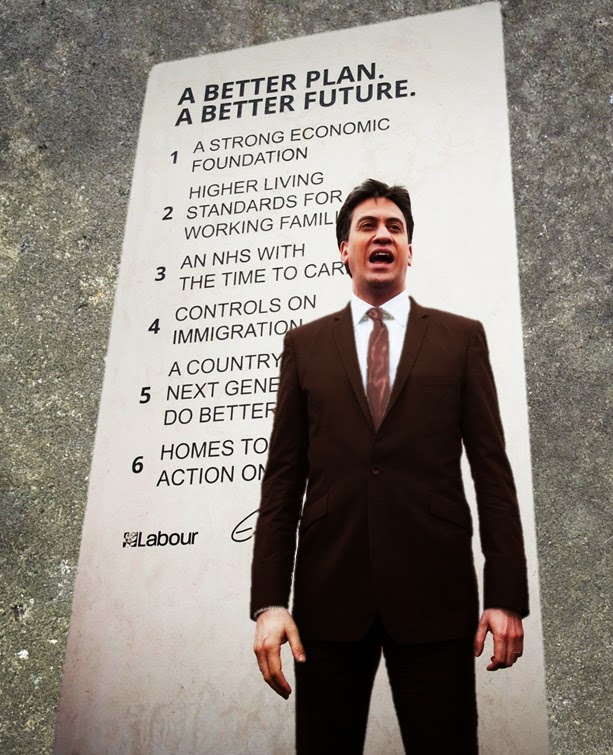
And since we don't believe these silly statements, however solemnly intoned they are, we then get the absurd spectacle of Cameron pledging to enshrine in law a promise not to increase income tax, VAT or national insurance. Followed by the even more absurd Miliband gimmick of having his vague, waffly pledges literally carved in stone.
I genuinely thought that this last one was a joke when I heard it. I still do.
But no matter how feverish the promises, how apocalyptic the denunciations of the other side(s), the electorate - as that Question Time audience illustrated - resolutely refuses to be convinced. We still think they're all lying. And they are.
Just to be clear: this was not always the case. There was a time when politicians told us grown-ups if things were going wrong. This is Edward Heath's message to the country in December 1973, telling us that we were in for the hardest Christmas since the war and that our standard of living was going to fall:
I'm not sure I can envisage Cameron or Miliband making that kind of broadcast.
Mind you, it didn't do Heath much good; two months later, he was thrown out of office. Maybe that's why telling the truth fell out of fashion. Or maybe it was John Smith as shadow chancellor in 1992, telling us that if we wanted better services - which we said we did - we would have to see tax rises, which we decided was beyond the pale. Or possibly it was Blair winning three consecutive elections by peddling his PFI fantasy of 'investment' on the never-never.
In any event, everyone now knows that there are serious problems coming, yet no politician is prepared to say so.
Despite all of which, I remain mostly optimistic about the future.
Primarily this is because I don't believe the current settlement can survive, since it is so clearly dysfunctional.
As many have pointed out, the principal justification for a first-past-the-post electoral system has always been that it provides strong, stable government. This no longer looks like a clinching argument.
The inherent distortions are about to be revealed in the starkest manner ever. It is almost certain that Ukip will win the third largest share of the vote, and yet could end up tenth in the share of seats (the position it was in at the dissolution of the last Parliament).
Similarly, Nicola Sturgeon has talked a great deal about 'shutting the Tories out of Downing Street' with an anti-Tory majority in the Commons. This may well be the result, but the majority of the popular vote is likely at the same time to be right-of-centre; the Conservatives, Ukip and the Liberal Democrats will probably get more than 50 per cent between them. (I'm assuming that the Lib Dems' more left-inclined supporters will have abandoned them.)
There is also the fact that we no longer have any national parties, just a fraying patchwork of regional and nationalist groups. Those that still pretend to be national are self-evidently not fit for purpose.
And then there's Scotland. Some commentators are berating the Conservatives for jeopardising the Union with their apparent encouragement of the Scottish National Party; others are berating the Labour Party for their complacency in letting the SNP outflank them on the left.
But it doesn't matter much who's to blame; the fact is that there aren't very many passionate Unionists left, on either side of the border. Those who do claim to believe in the Union seem incapable of making out a case for it that goes beyond sentiment and slogan.
Whatever happens tomorrow, large numbers of people are going to feel not merely unhappy - that's normal - but cheated.
Back in 2012, I wrote that 'things are about to change quite radically'. I think we're edging ever nearer a critical moment.
Wednesday, 29 April 2015
The Emperor's New Troosers
I've mentioned before (here and here) that the level of hyperbole in this general election campaign is getting a little silly on all sides. Sometimes this has become a story in its own right. Such was the case with Theresa May's claim in an interview with the Mail on Sunday that a post-election deal between the Labour Party and the Scottish National Party would provoke 'the biggest constitutional crisis since the abdication of Edward VIII'.
Now this is obviously over-the-top, and I'm disappointed that a politician of May's standing has clearly forgotten all about Gough Whitlam. (She must once have known about him; she was at Oxford University at the time of the Dismissal and surely even geography students were vaguely aware of what was happening in Australia.)
Nonetheless, there is a clear problem in the position adopted by the SNP. The party's manifesto is a mix (less charitably, a mess) of policies, some of which relate simply to Scotland, others to the whole of the United Kingdom.
So, for example, the SNP will 'seek an explicit exemption ... from the terms of the proposed Trans-Atlantic Trade and Investment Partnership' for Scottish Water. But not for Thames Water or any of the other suppliers. On the other hand, the very first page of the policy proposals (after the usual fatuous photographs of the leader) says that the party will 'vote for an increase in NHS spending across the UK of £24 billion by 2020-21'.
This seems to me to be at best impolite. Health is a devolved matter already, even without the additional shift of power to Holyrood that would presumably accompany the SNP having any say in the Westminster government. One doesn't have to accept the Conservative proposal of English votes for English laws to feel that a party with no candidates in England should not be announcing how much money they want to make England spend on its health service.
Nor, even if - as a voter in England - one believes in increased funding for the NHS, should one look to the SNP to deliver this.
Because it's not actually their business.
The manifesto of the Democratic Unionist Party, by contrast, has not a single word to say on the subject of the NHS, though it does mention the devolved health service. Instead the document is rooted entirely in the hope of a hung parliament, allowing 'an opportunity for Northern Ireland's voice to be heard in London like never before'.
The same bifocal approach runs through the whole of the SNP manifesto. The idea that the Scottish Parliament should be given the right to decide which sporting events are reserved for free-to-view television - that seems pleasingly parochial. Telling the rest of the UK how many houses we have to build is rude and wrong.
There is a constitutional issue here. Something to do with representation and taxation, since spending relies on taxes, whether now or in the future to pay today's borrowing.
And the problem is exacerbated by the voting system (which, incidentally, the SNP are proposing to scrap in favour of the Single Transferable Vote). The latest opinion poll, published yesterday, shows the SNP on 54 per cent in Scotland, which is predicted to translate into 96.5 per cent of Scottish seats.
Or, to put it another way, 1.3 million votes (assuming a similar turnout to last time) would yield 57 MPs. Meanwhile, as I've said before, Ukip - effectively the English equivalent of the SNP - will register over two-and-a-half times that vote for a total of maybe three MPs.
I don't think that, despite May's argument, the emergence of a minority Labour administration propped up by SNP votes will spark a constitutional crisis as such, since the rules of Parliament are perfectly clear about how governments are chosen by MPs. But it will provoke a crisis of confidence in the system of government. I don't know how that will manifest itself, but it cannot simply be wished away. Not in a country where there is already deep dissatisfaction with our version of representative democracy.
The answer, in the short term, can surely only be the introduction of proportional representation. The Lib Dems and Plaid Cymru, like the SNP, favour the Single Transferable Vote, while Ukip also support reform.
But whatever the outcome of this election - even if the Tories do get a majority in the Commons (a prediction to which I cling, despite all the evidence) - a reform of the voting system is an urgent necessity. It would be absurd to have another election fought like this.
Postscript: Since posting this three hours ago, a new poll has been published showing the SNP still on 54 per cent, but with Labour sliding still further - projections now suggest the SNP would win every seat in Scotland.
Monday, 27 April 2015
Who gets my vote: part 3
Moving on from the Green Party and the Liberal Democrats, I come to the right-wing parties who are fielding candidates in my constituency, Holborn & St Pancras.
Ukip are sticking with Maxine Spencer, a 51-year-old former immigration officer. She got all of 587 votes last time round, when she was beaten into sixth place by the BNP. (In an area not short of luvvies, it is possible that the BNP benefitted from having a candidate named Robert Carlyle).
Since the BNP aren't standing this time, and since Ukip have been receiving much more national media attention, Spencer will presumably improve on her 1.1 per cent share of the vote and might even (though it's unlikely) save her deposit.
I think it's fair to say that - even though Spencer claims she's getting less abuse than in the last campaign - this isn't natural Ukip territory. It's also fair to say that the party won't be getting my vote.
I've probably written too much about Ukip on this blog and its predecessor (most recently here), but I would just make one further point: I'm really rather glad that Ukip exist.
The ex-communist turned Tory MP Eric Forth used to say: 'There are millions of people in this country who are white, Anglo-Saxon and bigoted, and they need to be represented.' He was quite correct on both counts. Any decent democracy worthy of the name needs to allow minority voices to be heard, because the alternative - of suppressing dissent - is immoral and dangerous.
Just to be clear, I'm obviously not suggesting that the Ukip vote is solely comprised of bigoted white Anglo-Saxons: Spencer herself, for example, is the child of a Trinidadian mother and a Welsh father. But it would be daft to deny that there's a strong element of Forth's section of the Conservative Party in there, having been made to feel unwelcome by David Cameron. And, sadly, they're not going to be represented.
Because I think one of the big stories of the coming election may well be a wave of dissatisfaction with a system that rewards the Scottish National Party so disproportionately when compared to Ukip. On current polls, and assuming a similar turnout to 2010, the SNP are in line to secure around 1.1 million votes and are predicted to get somewhere around forty-five seats; Ukip, on the other hand, will receive twice that level of support and will be doing well to win three seats.
This is palpably unjust. But it still doesn't make me want to vote Ukip.
For the last general election, the Conservative Party had a very strong candidate in George Lee. His election address made great play of his back story: Hong Kong Chinese, born in a semi-converted pigsty, child labourer in a toy factory at the age of five, came to Britain, joined the Metropolitan Police, rose to rank of chief inspector, subsequently became vice-president of T-Mobile - this was compelling stuff. He had no hope of winning, of course, but he cut a convincing figure and he got the Tory vote back into five figures for the first time since 1992.
He was so good (the Labour Party had reportedly been chasing him as well) that I assumed he was working his political apprenticeship, and that he'd move on and get a winnable constituency this time to become Britain's first Chinese MP. Regrettably I can find no trace of him having done so.
Maybe Lee was a bit too exciting for the local Conservative Party, because this time they've got a much blander looking candidate:
I'm probably being unfair to judge him solely on his looks, but I know very little more about him, apart from what I read in his literature and in a single newspaper interview. He's thirty years old, he grew up in Dorset, he joined the Conservatives at the age of fourteen, he studied history at Oxford, he's worked for an MP, he lives in Kentish Town, he's gay, he looks pleasant enough.
Oh, and he's called Will Blair. That's Will Blair. Doesn't stand a chance with a name like that. But I bet he turns up in another constituency next time.
Sunday, 26 April 2015
Over-egging the pudding
In Peter Hitchens's Mail on Sunday column today, he makes a great deal of Norman Tebbit's contribution to the general election debate.
In case you missed Tebbit's comments, he argued that since the Conservative Party wasn't going to get anywhere in Scotland, then Tory supporters might have to choose between Labour and the Scottish National Party. And since he is in favour of the Union, the conclusion is obvious. So was he advising Tories to vote Labour in Scotland? 'I hesitate to say that. But it is logical from where I stand.'
This, Hitchens says, is 'the most amazing development in politics since another former Tory giant, Enoch Powell, urged his supporters to vote Labour in February 1974'.
Er, no, it's not. I fear that Hitchens's longstanding hatred of the Conservative Party is clouding his judgement a little.
In the first place, Powell did not 'urge' people to vote Labour in 1974. He hinted heavily that this was the best option, in order to secure a referendum on membership of the European Community, and he revealed - a few days before the day of the election - that he himself had already done so in a postal vote. But that's not the same thing as 'urging'.
More importantly, this is not Tebbit's first offence in this territory. Back in 1997 he was asked if he would support James Goldsmith's short-lived Referendum Party. 'I would not go that far,' he said. 'Not yet. But I can understanding why many people who do not have such a strong attachment to the Conservative Party are doing so.'
In more recent times, he has repeatedly implied in his blog on the Telegraph site that his heart is with Ukip and that it's only force of habit that keeps him in the Conservative Party.
Hitchens writes: 'Lord Tebbit's outburst was astonishing.' And he asks: 'why hasn't the Tory Party expelled, or at least suspended him, for this blatant defiance of his leader?'
Well, it's not really that astonishing - it's not out of character for Tebbit at all. It is. however, a good story, and Hitchens is right that it should have attracted more attention. But - just like Owen Jones - Hitchens damages his case with this kind of hyperbole.
Saturday, 25 April 2015
Kids are different today
When I was born, male homosexuality was illegal in Britain. So too was abortion, while hanging was still in use by our courts.
Happily, this situation has changed. And I wouldn't vote for a party that advocated turning the clock back. A group such as the Democratic Unionist Party, for example.
Even so, I find it disturbing when Owen Jones in the Guardian describes the DUP as 'bigoted throwbacks to several centuries ago'. Or, in another piece, when he calls them 'the political wing of the seventeenth century'.
Because that's simply not true; as someone with, say, a history degree from Oxford would be able to tell you. The opinions of the DUP - even the private opinions of individual members - were the basis of the law fifty years ago, and absolutely the norm much more recently. They're not entirely uncommon now.
That's why in the Parliament that has just ended, the DUP formed the fourth largest party. Admittedly the party only registered 168,000 votes in 2010 (fewer, remarkably, than Sinn Fein), but that's still a quarter of those who voted in Northern Ireland, and it's a fair number of people to denounce in such terms.
That share of the vote wouldn't translate to the rest of the United Kingdom. But if a party like Ukip - to take the most obvious choice - advocated the restoration of capital punishment, the introduction of new limits on abortion, and the freedom to override gay rights in the name of religious conscience, my guess is that they'd see a reduction in their vote share, but not by a huge amount. There is a sizeable (if dwindling) minority whose attitudes were shaped in the Britain that existed not in the seventeenth century, but in my lifetime.
It is surely possible to articulate the case against the DUP without resorting to such overblown rhetoric. Apart from anything else, it makes me feel so very old.
Friday, 17 April 2015
Ukip - thus far and no further
In an earlier post, I looked at the huge increase in immigration during the New Labour years, which facilitated the rise of Ukip. As a footnote to that, I feel I should point out that there are limits to the power even of this issue. I think Ukip enjoyed its greatest moment at the elections to the European parliament in May last year. It won't get that good again.
Indeed, I said as much at the time when I predicted on the day of the elections that Ukip had now reached its peak number of voters. 'If you don't vote Ukip this time,' I wrote, 'you're unlikely to do so at a general election next year.'
On that basis, I predicted that the party might reach a 14 per cent share of the vote in this general election, adding: 'And even that's being optimistic.' That was before the results had been announced. In retrospect, I think it was indeed a touch optimistic: according to the Poll of Polls on May2015.com, Ukip currently stand at 12.7 per cent.
In a subsequent blog post last May, I then put a figure on the number of votes Ukip would attract in this year's election: 2.5 million people. I think I'll stick with that.
Thursday, 16 April 2015
Why Ukip?
One of the most striking aspects of British politics in the last twenty years has been the absence of a left-wing party.
With both post-Thatcher Conservatives and post-Foot Labour gradually shuffling towards the centre, space has opened up on either flank for new political forces. But there has been nothing on the Left, save for George Galloway and a feeble little Green growth in the last few months. Meanwhile the right has been very handsomely served. First by the Nick Griffin incarnation of the BNP, and then by Nigel Farage's Ukip.
In one sense this is entirely predictable. The British left has been fixated on incoherent, internecine squabbling since the 1970s and is clearly incapable of finding a popular voice. It can mount the occasional single-issue campaign but only in response to initiatives on the right: Rock Against Racism and the Anti-Nazi League in response to the National Front, the anti-Poll Tax campaign, the Stop the War Coalition. When it tries anything with a broader frame of reference - the Socialist Alliance, say, or the TUSC - no one really notices.
But in another way, the lack of a left party is a bit odd. Because my impression is that there is a left-of-centre consensus in Britain, waiting to be expressed and not finding itself articulated by the Labour Party. (It was there in the mid-1990s, had Tony Blair only recognised it.)
What has been missing, maybe, is the one overarching issue, the thing that catches the attention and encapsulates a wider view of society. Which is where the right has been so successful, of course, since it has, at its core, a deep dislike of immigration.
Why have right-of-Tory parties done comparatively well in the last decade? Perhaps these figures tell the story:
That steep rise in non-EU immigration under New Labour, followed by the steep rise in EU immigration - combine that with a government that failed to defend its policies, and that's the reason for Ukip.
Put another way: If you add up the net migration figures for each of Margaret Thatcher's eleven years in power, you get a total of 26,000 people. If you do the same for each of the thirteen years of New Labour, you get 2.8 million.
But that's net migration. That might be relevant in terms of concerns about the capacity of the infrastructure to cope, but we all know that's not the real issue. The underlying concern is about culture and identity and about the number of foreigners. So, if you add up the total of the immigration figures in each of Thatcher's years you get 2.5 million people. And in New Labour years: 7.25 million.
These are not, of course, the numbers remaining at the end of each period. Many of those recorded entering the country (students, for example) stay for only a fixed time. But the figures have a certain, comparative function. The scale of immigration under the Labour government of Tony Blair and Gordon Brown really was quite exceptional, and - as far as I can see - there was, and has been, little attempt to explain the phenomenon.
Monday, 6 April 2015
Election predictions
This is, according to David Cameron, the most important election in a generation. And, according to all commentators, it's the most unpredictable election since 1945.
The first claim is simply wrong, at least in the sense that Cameron means. The second is undeniably true. But that merely invites the making of predictions. There's no fun in predicting the inevitable; much more entertaining to commit oneself when there's every chance of being completely wrong. So, to launch this new incarnation of my blog, here is my prediction for the result of the forthcoming election:
There will be a Conservative government with a small majority.
And some more predictions... After the election, things get really interesting. That Conservative majority will wither on the vine in the heat of the EU referendum, and Ukip - having won fewer than five seats in the election - will blossom, fed by a steady stream of Tory defectors. And that will skew the balance of power within Ukip towards Douglas Carswell and away from Paul Nuttall, to the ultimate detriment of the party's fortunes. The defections will sufficiently panic the Conservatives that when Cameron steps down (having won the referendum), they will opt for Boris Johnson as leader, thereby ensuring that they lose the subsequent election.
Meanwhile, the Labour Party will decide it ought to have a woman as leader, and will choose Rachel Reeves over Yvette Cooper, thereby ensuring that they also lose the subsequent election.
Also choosing a new leader will be the Liberal Democrats. They won't perform disastrously in the election (though they'll win fewer seats than the SNP), but - finding they're not needed in government - they will go for a change anyway. The new leader will be Tim Farron, thereby ensuring that they do rather well in the subsequent election.
PS I would like to point out that on the day of the 2001 general election, I correctly predicted - against all conventional wisdom - that Iain Duncan Smith would take over as Tory leader. Since then, however, I've been wrong on almost every occasion. So if any of this turns out to be correct, I'll be trumpeting it for years to come.
Subscribe to:
Posts (Atom)