Showing posts with label Grant Shapps. Show all posts

Tuesday, 11 August 2015

Window dressing: a portrait of Caroline Flint

One of Caroline Flint's earliest appearances in the national press came in a piece by Peter Tory of the Daily Express. Writing about the 1990 Labour Party conference, he cited her as an example of there being 'so little wit in today's politics'.

Twenty-five years on, she is now a candidate for the deputy leadership of the party, but in all that time there has been little to dispel that initial impression.

Born in 1961, Caroline Flint studied American Literature and History at the University of East Anglia. While there, she later revealed, she smoked a cannabis joint, but, as the papers reported: 'she didn't like the taste and the fact that it was illegal acted "as a brake", she told journalists over drinks at the Home Office.' (This, it appears, is the one infallible sign of a politician of the future: they're the students who only tried cannabis once and found that it brought them no pleasure.)

Her early jobs included stints as head of the women's unit of the National Union of Students, as an equal opportunities officer with Lambeth council, and as a senior researcher for the GMB union, before being elected to Parliament to represent the ultra-safe Labour seat of Don Valley in 1997.

This was the era, of course, of 'Blair's Babes': the disparaging term used to refer to the 101 women who became Labour MPs in the landslide victory. Of the new members in this company, Flint was soon talked of as one of the future high-fliers, along with Yvette Cooper, Charlotte Atkins, Valerie Davey, Judy Mallaber and Candy Atherton.

Perhaps a clue to the conduct of her career could be found when she was asked, along with the other women MPs, to contribute some inspiring lines for a book that was to raise money for a breast cancer charity. Flint chose lyrics from the Bruce Springsteen song 'The Ghost of Tom Joad':
Wherever there's somebody fightin' for a place to stand
or decent job or helpin' hand,
wherever somebody's strugglin' to be free,
look in their eyes Mom, you'll see me.
(One of her current rivals for the deputy leadership, Angela Eagle, incidentally, went with a Barbara Castle quote: 'In politics, guts is everything.')

Or perhaps a clue could be found in the photo-shoot she did for Elle magazine, declaring that it was 'time to get some glamour into politics'.

Inside Parliament she became known for her almost obsequious loyalty to the leadership. The ghost of Tom Joad might not have been impressed, for example, to see her dutifully lined up to support the cuts in benefits to single parents in December 1997, the first great controversy of Tony Blair's government. She was, wrote Nick Cohen, 'a thoroughly New Labour MP', while Simon Hoggart thought she was 'the most egregiously greasy Labour backbencher'.

By the end of 1998 she was to be heard proudly proclaiming: 'Of course New Labour's radical. Tony Blair is the first Labour prime minister to declare war!'

Re-elected in 2001, she remained loyal, while also displaying the most progressive of attitudes, coming together with David Miliband, Jim Murphy and other Labour MPs to form a group campaigning for Britain to adopt the euro.

In 2003 she did finally vote against Tony Blair's expressed wishes, but it was only on the subject of fox-hunting. She was one of more than three hundred Labour MPs who voted for a complete ban on the sport, and since seven members of the cabinet were in that number, it was perhaps not as great a risk as it might have been.

Promoted into government, she was the home office minister responsible for drugs policy when cannabis was downgraded from class B to class C in 2004, and steered through Parliament the Drugs Bill that made magic mushrooms illegal. Both those were controversial moves, though controversial in different quarters.

Primarily associated with the Blairite camp in the petty wars of New Labour, she was nonetheless promoted by Gordon Brown when he became prime minister.

As housing minister in 2008, she attracted enormous criticism with a suggestion that unemployed people should have to sign 'commitment contracts', whereby they promised to seek work before they could become social housing tenants. 'The link between social housing and worklessness is stark,' she said, and she was prepared to break it.

Her proposals were promptly attacked by charities such as Crisis, the National Housing Association and Shelter. 'The government wants to return Britain's unemployed to the workhouse by throwing them onto the streets,' commented the chief executive of the latter, perhaps a little histrionically, while Labour MP Austin Mitchell remarked: 'She must have flipped.' In fact, everyone attacked the plans, said the Morning Star, 'even the Tory Party, whose housing spokesman Grant Shapps showed a better understanding of councils' legal obligations to the homeless than Flint did.'

Clearly disturbed by the hostile response, Gordon Brown refused to come out in public to support the idea. His spokesperson said only that the prime minister thought 'in principle it's a good idea to be debated'.

The incident didn't impede her career, however, and her enthusiasm for the European Union saw her promoted to minister for Europe in October 2008. She was not quite in the cabinet, yet somehow not quite outside it either, since she was allowed to attend some meetings.

Hew new role came at a time when the whispering campaign against Brown was growing in volume, and Flint - as a Blairite - was assumed to be part of the conspiracy to force him out of office. The crunch moment came in June 2009 when James Purnell became the third cabinet minister in a week to resign, following Hazel Blears and Jacqui Smith. His resignation statement said in public what everyone already knew: that the party stood no chance of being re-elected while Brown remained leader.

(This, it will be remembered, was the occasion when David Miliband was expected to lead a coup, but proved not to have the bottle for the job.)

Flint responded immediately to Purnell's resignation, issuing an unequivocal statement to say that she would not be following her colleague's lead. 'I am very proud to be a member of Gordon Brown's government,' she insisted.

This display of loyalty came as a surprise to some, including perhaps to her. For within twenty-four hours, she had handed in her own resignation letter to Brown, denouncing his 'two-tier government', and adding: 'several of the women attending cabinet - myself included - have been treated by you as little more than female window dressing. I am not willing to attend cabinet in a peripheral capacity any longer.'

That phrase - 'female window dressing' - became her best known utterance, though another line was perhaps more accurate: 'I am a natural party loyalist.'

In 2010 there was some half-hearted speculation in the press that she might herself run for the leadership, but she chose not to do so. Instead she followed her Blairite instincts and voted for David Miliband. Even so, she was given a senior job in Ed Miliband's shadow cabinet. 'Ed,' she declared, 'will have my full backing.'
This is the second in a series of posts in which - unless I fall by the wayside - I shall be looking at each of the candidates in the current Labour Party elections for leader and deputy leader, with portraits drawn entirely from their media coverage.

Wednesday, 6 May 2015

The general election campaign, 2015

Just in case my publishers are reading this (which they're not - they don't talk to me anymore), I should stress that I'm not intending to write a history of these times. But if I were, who and what would I take out of this election campaign as being worthy of note?

Possibly the sheer resilience of Nick Clegg, the thickest-skinned politician ever. Probably Natalie Bennett, with her brain-fades and advocacy of polyamorous marriages. Definitely Grant Shapps in all his gormless glory.
What else? Russell Brand would be in there. Maybe Ed Miliband and the hen party? Maybe David Cameron forgetting which football club he's supposed to support? That's the kind of thing I normally record.

The one event that would certainly be included - even though it'll fade from the collective memory - would be the BBC Question Time last week, in which the audience accused successively Miliband, Cameron and Clegg of being liars. More than anything else, that seemed to nail this campaign and the state of modern politics.

Before, during and after the manifesto launches, we've had - from all parties - a relentless series of what columnists nowadays like to call 'offers', but which we used to call policies. Or bribes, to be more precise. Each day there's been a new proposal to reduce tax or to increase spending or, more frequently, to tell other people what things they should be doing differently.

Employers, housing associations, landlords, fuel companies, rail operators, bankers, tobacco firms: all of them, ministers manqué claim, could be regulated more stringently or made to reduce their profitability. This is all perfectly fine and legitimate - only the libertarian fringes object on principle to all intervention in 'the market' - but it's hard not to see it as being an alternative to government action.

One party suggests they'll build x number of houses, and another chips in with x x 2 (or x x 3, if x x 2 has already been taken). None of the contenders actually intend to build any houses themselves, of course: these are just figures plucked out of thin air and magically transformed into targets.

Because we are still, sadly, in a political world of targets. Lord know it's not as bad as during the first government of Tony Blair when, as I wrote in my book A Classless Society:
There were targets for the quantity of cars, cycles and pedestrians on the road, as well as for traffic casualties and dog mess; for the numbers of smokers, heroin addicts and pregnant teenagers; for the incidence of robberies and building-fires; for how many children visited museums and galleries, and for the proportion of school-leavers going on to higher education. There was even a target for the number of otters to be found in the wild...
But even without this excess of zeal, the thinking behind the target culture still dominates political thinking; the stated intention to do something is believed to be just as good - and certainly much easier - than actually doing it. As Blair himself once put it: 'It's the signals that matter, not the policy.'

This time the signals extend to cover the behaviour of foreigners.

The Tory manifesto promises to deliver '100,000 more UK companies exporting in 2020 than in 2010' with a 'target of £1 trillion in exports' - presumably whether or not people want to buy our stuff.

It also says: 'We will set challenging targets for Visit Britain and Visit England to ensure more visitors travel outside the capital' - whether or not that was in the holiday plans made by those tourists.

Meanwhile, the Labour manifesto promises to 'push for global targets to tackle inequality and promote human rights' - whether or not... well, you get the idea on that one.

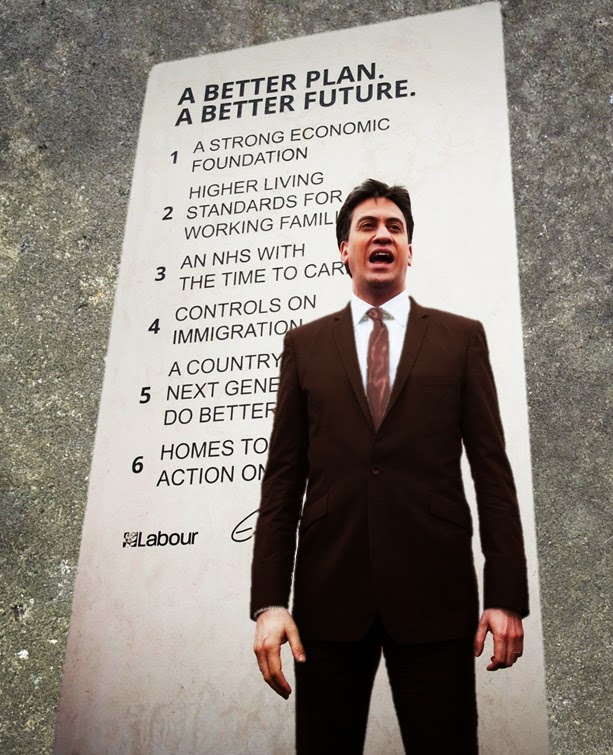
And since we don't believe these silly statements, however solemnly intoned they are, we then get the absurd spectacle of Cameron pledging to enshrine in law a promise not to increase income tax, VAT or national insurance. Followed by the even more absurd Miliband gimmick of having his vague, waffly pledges literally carved in stone.

I genuinely thought that this last one was a joke when I heard it. I still do.

But no matter how feverish the promises, how apocalyptic the denunciations of the other side(s), the electorate - as that Question Time audience illustrated - resolutely refuses to be convinced. We still think they're all lying. And they are.

Just to be clear: this was not always the case. There was a time when politicians told us grown-ups if things were going wrong. This is Edward Heath's message to the country in December 1973, telling us that we were in for the hardest Christmas since the war and that our standard of living was going to fall:


I'm not sure I can envisage Cameron or Miliband making that kind of broadcast. 

Mind you, it didn't do Heath much good; two months later, he was thrown out of office. Maybe that's why telling the truth fell out of fashion. Or maybe it was John Smith as shadow chancellor in 1992, telling us that if we wanted better services - which we said we did - we would have to see tax rises, which we decided was beyond the pale. Or possibly it was Blair winning three consecutive elections by peddling his PFI fantasy of 'investment' on the never-never. 

In any event, everyone now knows that there are serious problems coming, yet no politician is prepared to say so.

Despite all of which, I remain mostly optimistic about the future. 

Primarily this is because I don't believe the current settlement can survive, since it is so clearly dysfunctional. 

As many have pointed out, the principal justification for a first-past-the-post electoral system has always been that it provides strong, stable government. This no longer looks like a clinching argument. 

The inherent distortions are about to be revealed in the starkest manner ever. It is almost certain that Ukip will win the third largest share of the vote, and yet could end up tenth in the share of seats (the position it was in at the dissolution of the last Parliament).

Similarly, Nicola Sturgeon has talked a great deal about 'shutting the Tories out of Downing Street' with an anti-Tory majority in the Commons. This may well be the result, but the majority of the popular vote is likely at the same time to be right-of-centre; the Conservatives, Ukip and the Liberal Democrats will probably get more than 50 per cent between them. (I'm assuming that the Lib Dems' more left-inclined supporters will have abandoned them.)

There is also the fact that we no longer have any national parties, just a fraying patchwork of regional and nationalist groups. Those that still pretend to be national are self-evidently not fit for purpose.

And then there's Scotland. Some commentators are berating the Conservatives for jeopardising the Union with their apparent encouragement of the Scottish National Party; others are berating the Labour Party for their complacency in letting the SNP outflank them on the left.

But it doesn't matter much who's to blame; the fact is that there aren't very many passionate Unionists left, on either side of the border. Those who do claim to believe in the Union seem incapable of making out a case for it that goes beyond sentiment and slogan.

Whatever happens tomorrow, large numbers of people are going to feel not merely unhappy - that's normal - but cheated.

Back in 2012, I wrote that 'things are about to change quite radically'. I think we're edging ever nearer a critical moment.