Showing posts with label general election. Show all posts

Thursday, 30 July 2015

Up the hill backwards

The Labour Party has 232 MPs. To form a majority in the House of Commons, a party needs to have 326 MPs. So if Labour is to win the next election outright, it needs to take an additional ninety-four seats.

Of the ninety-four marginal constituencies where Labour missed out most narrowly this year, eight are currently held by the SNP, three by the Liberal Democrats, two by Plaid Cymru and one by the Greens. The other eighty are all Conservative.

It would be simplistic to say that the party needs to win these ninety-four seats to form a majority government, because it assumes that there will no boundary changes (which there will be), and that Labour should target its efforts purely on existing numbers (which isn't necessarily the case). But still, it's a rough guide to the task ahead.

So the question is: How is Labour going to take a seat like Gravesham in Kent (no. 91 on the list), where the Tories currently have a majority of over 8,000? The Lib Dems and the Greens are irrelevant here - there are no votes to be squeezed out of them. So Labour would need to take votes either directly from the Conservatives or from Ukip, who are in a strong third place with a 19 per cent share.

The same pattern is found right across the country. Not just the obvious southern constituencies of Crawley (no. 71), Milton Keynes South (83) and Thurrock (8). But also seats in the Midlands, such as Dudley South (55), Erewash (30) and Telford (11). And in the North as well: Morley & Outwood (6), Pendle (65) and Stockton South (47).

All of these and many others - most of those on the list - are held by the Conservatives, with Labour second, Ukip third, and no one else in sight. Winning these seats is Labour's only path to power.

By comparison, the general election this year was so much easier. Some four-and-a-half million Lib Dem votes went missing from the party's 2010 total. Which makes it all the more shocking that Labour's popular vote only increased by around three-quarters-of-a-million. Next time it'll be far harder.


Some things will change before 2020, of course. Ukip support may well fall away in the next couple of years, depending on how the referendum goes, which would make their votes more easily available for someone. But this is far from certain. It may be that Ukip actually increases its strength. Or it may split. Their vote is the great unknown in electoral arithmetic, but my assumption is that there's a stubborn protest vote in there that's not going to end up with either of the major parties.

Somewhat clearer than the fate of Ukip is the fact that surely the Lib Dems will do better in the next election than they did this year. In a very marginal seat, this might help Labour, since it could reduce the Tory share. But more generally, the Lib Dems will be on the rise and will be competing with Labour for new votes.

Maybe majority government is too ambitious a target for Labour right now. Maybe a minority administration, with support from other parties, is as good as it could get. But the challenge is still the same: How does the Labour Party take votes from the Conservatives and from Ukip?

Saturday, 25 July 2015

Gradually learning?

Good news from Tristram Hunt on the state of the Labour Party. Writing in the Daily Telegraph, the shadow education spokesperson says that Labour has already 'learnt some early lessons' from the 'catastrophic' election results.

And those lessons are: 'We are no longer in favour of a 50p higher tax rate; we support a referendum on our continued membership of the EU; we back the expansion of Heathrow; and we did not - despite the rebellion of some - vote against welfare reform.'

Yes, well, I'm not entirely sure that these are necessarily the lessons that the electorate were hoping would be learnt, but there we are. At least Hunt's proud of them.


Of these achievements, the new position on the EU referendum is irrelevant - the vote's going to happen, whether Labour 'support' it or not. And the reconsideration of the top tax rate and the welfare reform is supposed to wave a white flag, to send out signal that the Tories have won the arguments about wealth creators and deficit reduction.

The one that I find a bit odd, though, is the Heathrow business. Because that's a huge commitment for a temporary leadership to make. And it's one where the Labour position actually does matter. If for example, the party said that it would never support a third runway at Heathrow and would cancel the project without compensation if they were to be elected, that would cause the government serious problems. I'm not saying they should say that, merely pointing out that this is a long-term undertaking. Why worry about it now?

More broadly, there's something I don't entirely follow with this approach that the interim leadership of Harriet Harman is taking, this attempt 'to show the party has listened to the electorate'.

I know Labour didn't win, but a lot of people voted for the party, and their voice is being ignored. If they'd wanted to vote for MPs who agreed with the Conservative manifesto, presumably they would have voted Tory. Surely they didn't return Labour MPs in the hope that all policies would be abandoned on entering Parliament?

The lessons that can be learnt from the electorate should be about areas of policy, not the policy itself. If, for example, people are worried about the benefits bill (and I think they are), then it's Labour's job to address those concerns. But not simply by adopting Tory proposals. That's silly.

Similarly if they're concerned about immigration (and I think they are), then Labour needs to engage with that issue. Which could mean defending open borders, if that's what they believe in. But the lesson is that the party should talk about it. Hunt mentions in passing that Labour were seen as being 'lax on immigration', but sadly he has no good news to impart on this subject.

One other point that annoyed me in Hunt's piece. (He's always capable of annoying me.) He writes: 'a vote for the SNP did what it has always done: let in a Tory government.'

I know this is a standard Labour line, but I wondered: is it true? So I did what any concerned citizen would do, and looked up the figures on Wikipedia. This graph shows the share of the vote won by the four main parties in Scotland between the election of October 1974 and that of this year.


The purple line is the SNP vote. They did well in 1974, coming second in an election that was won nationally by Labour. Then their vote slumped for the three elections won by Margaret Thatcher. The share didn't change between 1992 (narrow Tory victory) and 1997 (Labour landslide), but fell a little for Labour's two successes in 2001 and 2005.

In other words, there's no truth whatsoever in the idea that an SNP vote helps the Tories. It makes no difference at all. Presumably Hunt is speaking here in his capacity as party hack, rather that of historian.

Wednesday, 22 July 2015

And the winner is...

I'm more than two months late, I know, but I think I should put on record the results of the Holborn and St Pancras constituency in the general election. This is where I live and I wrote about the candidates in several blog posts (links to the various entries are here).

And the results are (with number of votes and percentage change, where applicable):

  1. Sir Keir Starmer (Labour): 29,062 votes (+6.8%)
  2. Will Blair (Conservative): 12,014 votes (+1.5%)
  3. Natalie Bennett (Green): 7,013 votes (+10.1%)
  4. Jill Fraser (Liberal Democrat): 3,555 votes (-21.4%)
  5. Maxine Spencer (Ukip): 2,740 votes (+3.9%)
  6. Shane O'Donnell (Cannabis Is Safer than Alcohol): 252 votes
  7. Vanessa Hudson (Animal Welfare): 173 votes
  8. David O'Sullivan (Socialist Equality): 108 votes

So no great surprises there, then. Except that I really expected Jill Fraser, who I still maintain was a very good candidate, to do a whole lot better. But she was crushed in the anti-Lib Dem landslide and - this being Camden - her votes were split mainly between Natalie Bennett and Sir Keir Starmer. This offset any loss that Sir Keir may have suffered as a result of being a new candidate; presumably our departing MP, Frank Dobson, had built a personal following over the years.
Whether Sir Keir will be a good constituency MP we shall see. I wrote to him ten days ago, asking for his help, and I haven't heard back from him. But maybe he's busy abstaining at the moment. I certainly expect him to be a prominent member of the new Labour front-bench once the leadership question has been sorted out.

Of the others, I'd hope that Jill Fraser will get back onto Camden Council in due course, because she ought to be there, and I hope that Natalie Bennett eventually does the decent thing and resigns as leader of the Green Party of England and Wales.

And I wish Will Blair well. I suggested before the election that this was just a trial run for him and that he'd end up with another constituency, one where he might stand a chance of winning. I hope he does, if only because I was told yesterday that he was given a copy of my book Rejoice! Rejoice! for Christmas, so he's clearly a man who's blessed with fine family and friends.

Friday, 17 July 2015

I wish it could be 1983 again

The longest suicide note in history. Gerald Kaufman's description of the Labour Party's 1983 election manifesto is one of the great modern political cliches. And like so many cliches, it's become so familiar that it can sometimes conceal the truth.

So it's worth asking: Was that manifesto really the most ludicrously left-wing platform ever put to the British electorate? What did it actually say?

Obviously, there's the famous stuff about nuclear disarmament, withdrawal from the European Economic Community (as it then was), and abolition of the House of Lords, but what else was in there?

Well, the document starts with what it calls 'an emergency programme of action', centred on these pledges:
  • to make 'a major increase in public investments, including transport, housing and energy construction';
  • to 'begin to rebuild British industry, working within a new framework for planning and industrial democracy'
  • to raise child benefits and pensions, 'and give special help to one-parent families and families with disabled dependents';
  • to 'promote women's rights and opportunities, and appoint a cabinet minister to promote equality between the sexes';
  • to 'act to improve the environment and deal with pollution'.
It's not perfect, and you or I may not agree with everything, but it's a coherent and reasonable set of priorities. (It helps, of course, that thirty years have passed, and ideas like having an equalities minister no longer sound like the loony left nonsense they were depicted as at the time.)

Also quite reasonable is the call for greater investment in industry, partially funded by North Sea oil, and the threat that if the major banks did not play their part, 'we stand ready to take one or more of them into public ownership'. That was considered extreme at the time; not so much now.

The document goes on to say that:
Our proposals add up to a considerable increase in public spending. Our programme is thus heavily dependent upon the achievement of our basic objectives: namely, a large and sustained increase in the nation's output and income and a matching decline in the numbers out of work. It is this that will make the resources available for higher public spending programmes and cut the enormous cost of unemployment.
Elsewhere it explains that 'It would be wrong to finance the initial boost to spending by increasing taxation', and that therefore: 'Like any other expanding industrial enterprise, we shall borrow to finance our programme of investment.'

(It's probably worth noting that at the time it didn't seem so heinous to say you were in favour of borrowing; Keynesian economics was still a plausible option.)

And it goes on. And on, and on. For there was a major problem with the document in that it didn't confine itself to the big themes. By attempting to shoe-horn everything in, it lost focus. (Perhaps, on sober reflection, a policy on angling wasn't entirely necessary.) Kaufman's use of the word 'long' wasn't entirely inappropriate: it's not the word count, so much as the number of subjects covered.

But I would suggest that perhaps Kaufman's phrase was simply too memorable, and that it has misshaped our perceptions of the time. It lays the blame in the wrong place. Because - and I don't think this is simply in retrospect - it wasn't the manifesto alone that resulted in Labour's worst electoral performance since the war.

Not when there was so much else that was wrong.

Austin Mitchell's excellent book on the 1983 election, Four Years in the Death of the Labour Party, for example, documents some of the appalling incompetence that marred Labour's campaign that year. There was no organisation, no planning, no idea what the hell was going on. The party leadership, lacking strategy, just lurched from one day to the next.

And at the supposed head of this dysfunctional operation was Michael Foot, a good and gracious man who should never have been chosen by Labour MPs to be their leader. It wasn't a role for which he had any qualities.

The press, of course, were merciless. Clive James in the Observer called Foot 'a floppy toy on Benzedrine,' the Sunday Telegraph referred to him as 'an elderly, ranting pamphleteer waving a stick in Hampstead,' the Sun said he was 'an amiable old buffer, his jacket buttoned too tight, his collar askew, his grey hair falling lankly'. The Sun also ran a cruel and devastating headline: 'Do you seriously want this old man to run Britain?'
With all the excited froth at the moment about Jeremy Corbyn's chances of winning the Labour leadership election, there are repeated references back to 1983 (when, as it happens, Corbyn first entered Parliament). The Labour Party took such a beating that year that its soul was scarred, and it's been living in fear of being labelled 'left wing' ever since. The longest suicide note in history casts an even longer shadow.

I'm not sure that the party should be so afeared. There were many other reasons why Labour lost in 1983.

There was the split that produced the SDP, there was the Falklands factor, there was the start of economic growth (after monetarism had been quietly buried in an unmarked grave). And, above all, there was a lack of unity in the higher reaches of the party, no sense that any of Foot's senior colleagues were interested in following him or agreeing with each other.

Oh yes, and there were the policies. But they only come in at about number five or six in the list of reasons why it all went so horribly wrong. They need to be kept in proportion.

Probably the one huge strategic mistake in the manifesto was the commitment to leave the EEC without a further referendum. Allow for that  - admittedly major - change, and then imagine that this manifesto had been presented to the British public in 1997 by Tony Blair, when he was at the peak of his persuasive powers and the Tories were on the ropes. I believe Labour would have won handsomely.

This is not to say that it's all about presentation. But it is to say that, when it comes to winning elections, policy isn't anywhere near as important as politicians and commentators believe it to be. Broad positions count, leadership and unity count, detail doesn't.

And concepts of 'left' and 'right' don't matter much either. Most people don't think of themselves in those terms. At various times, Labour voters will switch to Ukip, Conservative voters to Labour, and Lib Dem voters to just about anybody...

There are other lessons Labour needs to learn from the 1980s, and I shall return to the subject. I think it might lead somewhere.

Friday, 15 May 2015

The challenge for the next Labour leader (in 1992)

The general election last week is widely said to be reminiscent of 1992. So what were the papers saying at the same stage back then, eight days after John Major's shock result, when the Labour Party was looking for a new leader?

This is how The Times started its editorial on 17 April 1992:
Can Labour Win? and Must Labour Lose? were the titles of two bleak books published in 1960, after Labour had lost three elections in a row. Now the same questions are being asked after a run of four defeats.
In language that might well sound familiar, the editorial continued:
Labour has failed to respond to the changing aspirations of the British. In the 1980s the Conservative achievement was to make those born working class feel comfortable about wanting to move up in society. Britain may not yet be as socially fluid as America, but the class system is no longer frozen in ice.
And it concludes:
Whoever wins the Labour leadership election must prepare his party for the next general election by recognising that the world has changed. The politics of envy have lost their potency. Labour need not lose, but it has to find new friends all over the country, and across all social classes and income groups, before it can win.
What actually happened, of course, is that Labour chose John Smith. At the time he was considered to be on the right of Labour, though his enthusiasm for higher taxes was partially blamed for losing the 1992 election.

In today's world, that belief in public spending would have him condemned as a left-wing extremist. So too would the trade union support he enjoyed; asked why he hadn't joined the SDP during the Great Schism of the 1980s, he replied: 'I am comfortable with the unions.' And his Scottishness would be regarded with some suspicion.
I'm not sure that any of this represented a response to 'the changing aspirations of the British'. Nonetheless, Black Wednesday came along a few months later, and by the time Smith died in 1994, he had a 20 per cent lead in the polls over the Tories.

Tuesday, 12 May 2015

The priest and the pronoun

Like everyone who reads the Guardian website, I try to avoid the writings of certain contributors, safe in the knowledge that they're just trying to annoy me. In my case it's primarily Jonathan Jones and Giles Fraser. And then last night - for reasons I can't fathom - I found I'd clicked on a piece by Fraser for the first time in months.

He hasn't got any better in the interim. He still annoys me. And he still specialises in the kind of hand-wringing smugness that helped to drive the congregations out of the Church of England.

Writing on Friday, in the immediate aftermath of the election, he says he's 'ashamed to be English', to be living in a country 'that has clearly identified itself as insular, self-absorbed and apparently caring so little for the most vulnerable people among us'. And he wonders: 'Did we just vote for our own narrow concerns and sod the rest?'

Obviously no one's fooled for a second by that 'we'. This is no mea culpa. Readers are expected to understand that the fault lies with others; Fraser, and all decent-minded folk, are motivated solely by concern for 'the most vulnerable people' in our society.

This is part of an all-too-common narrative that anyone who didn't vote for an approved 'progressive' party was merely 'tick[ing] the box of our own self-interest'. (Again, that fraudulent first-person pronoun.) Apparently 'we' sold out the poor on the promise of a mess of pottage some way down the road.

By the same token, I suppose, one could argue that those in receipt of benefits, or those employed by the state, might have voted Labour in the expectation that their income would thus be better protected. They were sufficiently selfish that they demanded others pay higher taxes on their behalf.

Both positions are nonsense, of course. When casting a vote, most people (I believe) find that self-interest co-exists with other considerations, including an assessment of which of the limited alternatives on offer might be in the national interest.

And last week around half of those who voted in the United Kingdom opted for the Conservative Party or for Ukip, parties with whom Fraser has little sympathy, and of which he has little understanding.

One would have to be very arrogant indeed to conclude that - unlike oneself - those voters don't care about anyone else. It may well be that they believe 'the most vulnerable' can be better helped in a wealthy country than in a poor one, and therefore opted against parties who they felt would harm the economy. Even if you think their judgement is wrong, that doesn't mean it was made in bad faith.

Nor do people vote for the totality of a party's programme. Many, perhaps millions, who voted Conservative will have done so despite disagreeing with proposed cuts to disability benefits. Just as many, perhaps millions, will have voted Labour despite disagreeing with their promise to 'control immigration'.
Why am I bothering with Fraser, the kind of Christian who believes that the existence of charity is an indictment of society?

Well, because I've had a couple of people tell me that my post-election pieces on this blog are unnecessarily harsh on Labour and the Greens, and unreasonably positive about the Conservatives and Ukip. Which may be true but, unlike Fraser, I'm not interested in seeking comfort by denouncing all those who stray beyond the 'progressive' pale.

The truth is that the Left lost very badly last week, and the Right won. Even if you put together the Labour and the SNP votes, they still didn't reach the total cast for the Conservatives. That needs examining and, if possible, explaining. And in pursuit of that, one should strive for objectivity, rather than settle for accusations.

To misquote Karl Marx: Some historians have tried to change the world in various ways; the point is to understand it.

Monday, 11 May 2015

David Cameron: chillaxing to victory

In 2005, following a third successive election defeat, the Conservative Party staged a beauty contest for those who wished to succeed Michael Howard as leader. Up until that morning, the front-runner had been David Davis, but by the time all five candidates had made their 20-minute speeches, he'd been overtaken by David Cameron.

Amongst those who had their minds changed was me. I rated Davis highly at this stage, largely on the strength of a gig he did with Tony Benn at the Royal Albert Hall in 2002. Benn was then at the peak of his popularity as a lovable elder statesman, and for a Conservative to have the nerve to go head-to-head with him in front of an audience that was guaranteed to be 99 per cent anti-Tory showed, I thought, considerable bottle and self-confidence. He was also very good on the night.

Unfortunately he wasn't very good at that 2005 conference, while Cameron was brilliant. Maybe - I've often had cause to think in the last ten years - I was dazzled by a smoke-and-mirrors act, but my immediate response was to predict to the person with whom I was watching on TV that Cameron would win the leadership and would go on to win the next two general elections.

As I say, maybe I was caught up in the heat of the moment. In the final poll, the party members voted for Cameron over Davis in a ratio of two to one, but come 2010 the country did not. He failed to win the election, despite facing only a badly wounded Gordon Brown, a man whose most noteworthy contribution to the campaign was to insult a supporter for her alleged bigotry.

Now, however, Cameron has actually won an election, and I feel my original judgement was sort of vindicated.

This has been a spectacular victory, though not quite as wondrous as some are claiming. The Conservatives' share of the vote went up, but turnout was still poor and Cameron persuaded just 24.4 per cent of the registered electorate to vote for him. This was, however, better than the 23.5 per cent he achieved last time round (itself an improvement on Labour's 21.6 per cent in 2005).

So I wanted to make a couple of points about Cameron.

The first is something that I explored at greater length in an article on the twenty-first anniversary of Black Wednesday. This is a photograph of Norman Lamont, then chancellor of the exchequer, announcing Britain's humiliating withdrawal from the exchange rate mechanism in September 1992:
And there, off to one side, is his 25-year-old adviser and speech writer, David Cameron.

Cameron, I wrote, 'witnessed at close quarters the spectacular implosion of a party that once believed it was predestined to power'. I suggested that this is perhaps why he always seems so relaxed in a crisis. Similarly George Osborne, who was at Douglas Hogg's side in the BSE disaster of 1996. These people had experienced such dreadful political depths in their early years that very little was going to faze them.

Ed Miliband and Ed Balls, on the other hand were New Labour advisers in the 1990s, at a time when the party was already coasting into government. They had no such baptism of fire.

When Cameron became leader in 2005, it was clear that his job was, in the cliché of the time, to 'decontaminate the Tory brand'. The early efforts were clumsy and gimmicky: hugging hoodies and huskies, demonstrating his green credentials by installing a windmill on his roof and cycling to work (followed by a car, carrying his papers).

Then he got blown off course by the bankers' recession. No longer, it appeared, was sunshine going to win the day. The concept of the Big Society withered on the vine (though it's actually very good and the Labour Party should take it back).

Instead, the attempt to modernise the party seemed to consist of little more than the sudden, unpromised introduction of same-sex marriages. It didn't seem like very much - essentially a new name for civil partnerships - but actually it turned out to do the job really rather well.

Because the success of same-sex marriages lay not in the legislation itself, but in the way that it provoked a mass exodus from the party. Some constituency organisations claimed to have lost up to half their members as a result of the policy.

This was, most commentators agreed, disastrous for Cameron. But it wasn't. In one fell blow he'd cleared out large numbers of the 'fruitcakes, loonies and closet racists', as he'd described Ukip back in 2006. Many of them, of course, went straight over to Ukip, giving that party a huge boost in membership and popularity.

Less noticed was the effect on the Conservative Party itself, now smaller but - from Cameron's perspective - much better looking. It has become difficult to denounce the Tories as racist, sexist, homophobic and still retain any credibility as a political observer. The party that embraced economic liberalism in the 1980s has accepted the social liberalism that spread across Britain in the 1990s.

The election results this week saw Cameron increase the Conservative share of the vote, largely at the expense of the Liberal Democrats. All those right-wing commentators like Simon Heffer and Charles Moore who had insisted that the Cameron project was misguided, that he shouldn't be trying to appeal to the liberal vote (sometimes even suggesting he form an electoral pact with Ukip) - they turned out to be completely wrong.

There are many other commentators for whom the Tory brand cannot ever be sufficiently decontaminated, but it turns out that he's done enough. Not enough for those in the long-derided 'metropolitan elite' of course, those who follow in the pioneering footsteps of the delegate to the 1982 SDP conference, excitedly proclaiming: 'There may be minorities we have not yet discovered.' But enough for the rest of the country.

The achievement of Tony Blair in the mid-1990s was to make the Labour Party a safe home for ex-Tory voters. If Cameron hasn't quite reciprocated that achievement, he has gone some way towards it. There were many disillusioned Liberal Democrats, and even some lifelong Labour supporters, who simply couldn't countenance Ed Miliband and who felt just about safe enough to turn to vote Conservative for the first time ever, despite grave reservations over Tory policy.

As all the polls showed, Cameron's ratings outstripped his party's; Miliband's trailed his.

The Left need to get used to the idea that Cameron and Osborne have changed the Conservative Party for good. A new line of attack is needed.

One final thought. There is much talk of this election resembling 1992 when John Major won a slender majority and then ran into trouble with his own party over Europe. And look what's coming next, say the columnists: it's a European referendum and history could repeat itself.

I think this unlikely. If Ukip had got, say, five MPs they might have formed a rival pole of attraction for Eurosceptic Tory members, and there might have been defections over the referendum arrangements. Then Cameron would have had trouble. That might still happen if there are a few by-elections that allow Ukip to boost their numbers, but I doubt it. And Douglas Carswell does not in himself constitute a rival pole of attraction.

In any event, Cameron is much more in tune with the mood of his party than Major was. He remembers all too well the damage that Europe did to the Tories in the 1990s. Most importantly, he doesn't face the same problem that afflicted his predecessor.

Because Major's real grief over Europe was not to be found amongst the 'bastards' on his own backbenches; it lay in the House of Lords. There lurked the malign influence of Margaret Thatcher, the deposed but still powerful ex-leader, constitutionally unable to keep herself from interfering, from stirring up trouble, from seeking to undermine her successor as he tried to get the Maastricht Treaty through Parliament.

As I wrote in my book A Classless Society:
Thatcher's behaviour during Major's premiership was even worse than that of Edward Heath during her own time in office. Heath had been unstinting in his disapproval as he remained stubbornly on the backbenches ('like a sulk made flesh,' in the words of journalist Edward Pearce), but he hadn't actively engaged in plotting against her. But then, as a minister told the BBC's John Cole: 'She was always criticising the government when she led it, so why expect her to change now?'
The EU referendum won't all be smooth sailing, but it'll be less choppy than Major's trip back from Maastricht. And easier than Cameron's rite of passage on Black Wednesday.

Sunday, 10 May 2015

A tale of some minor parties

A week or so back, I predicted that one consequence of the election would be the resignations of Nigel Farage and Nick Clegg as the leaders of, respectively, Ukip and the Liberal Democrats. I also predicted that Natalie Bennett would not resign as leader of the Green Party of England and Wales.

These things having now come to pass, it's time to evaluate them.

Starting with the last first, Bennett should have the decency to go immediately. She has proved herself to be completely useless as a leader. The Greens had a dreadful election, and much of the blame for that rests with her.

The party achieved less than 4 per cent of the vote. Under most sensible forms of proportional representation, the bar for securing seats is set at 5 per cent. Frankly they're fortunate that first-past-the-post came to their rescue and gave them an MP.

Yet the opportunity was unquestionably there for the Greens: lots of airtime and visibility, a weak Labour leadership, a widespread dissatisfaction with mainstream politics. A breakthrough of sorts was possible. Obviously not in terms of winning large numbers of seats, but even without representation, a minor party can still have an influence, can help to shape the political agenda.

You only need look to Ukip. At a time when they had no MPs at all, they were still capable of scaring the British prime minister into promising a referendum when he didn't want one, and panicking the Labour Party into saying they'd 'get tough' on immigration, when we knew they wouldn't.
So what did Bennett do? She joined in the chorus of 'the Tories are mean and nasty'. Well, if you believed that, then you should have done the sensible thing and voted for a party capable of removing the Conservatives from office. Which is, indeed, what the vast majority of those opposed to the Tories actually did.

At a constituency level, things may have been different, but on the national stage Bennett offered nothing at all that was distinctive. One brief mention in a leaders' debate of climate change and vanishing species, and that was it. At a time when fracking offers a perfect way of linking the local with the global, there was only silence.

It is, of course, more difficult to get attention for environmental issues at a time of economic hardship, but this is far from a new problem. I wrote about it in Crisis? What Crisis?, my book on the 1970s. There's been plenty of time to work out a strategy for such a situation.

The Greens are one of the few parties who actually have a USP. Yet they didn't exploit it. Instead there was a manifesto and a platform full of policies on an absurd range of issues that were entirely irrelevant, including the stupidity over copyright, to which I drew attention a while back. (And which subsequently annoyed the hell out of a lot of creative people who were sympathetic to the party.)

Why? Where's the benefit in burying your brand? Why allow your core message to be lost amidst a welter of questions about a tax policy you will never have a chance to implement?

One other point, which most people are (quite rightly) too polite and decent to say out loud: the voice was wrong. The British public didn't warm to being waffled at in an Australian accent. Obviously it shouldn't matter, but it does.

In short, Bennett should go.

So too should Farage. He's left open the possibility of coming back from his holidays and standing again for the Ukip leadership, but he should resist the temptation. The party is better off without him now.

He has been an extraordinary figure who has over-achieved on a spectacular scale. In many ways, he was the story of the Coalition years, conducting a brilliant guerrilla campaign against Westminster. (Do I need to point out that I'm talking about technique not policies? I do hope not.) I went to one of his EU debates with Nick Clegg and he was a superb performer - committed Europhiles were coming out of the hall saying how good he was.

But he still has to go.

When Ukip won the elections for the European Parliament a year ago, I wrote that they'd reached their high-water mark. If they were ever to go any further, I suggested, they needed to thank Farage for all his work and ask him to step down. He'd taken them as far as he possibly could. My comparison was with Ian Holloway, a colourful, charming and competent manager who got Blackpool Football Club to the Premier League, but couldn't keep them there.

My argument was that if Ukip wanted to secure - let alone go beyond - the 4.4 million votes they achieved last year, they had to make serious inroads into Labour heartlands, and Farage was probably not the man for that. He did pretty well this week, but the party fell to 3.9 million votes on a far higher turnout. It could have been better if he'd gone last year. Now it's probably too late, and decline is (I think) inevitable.

Ukip are, as normal with third parties, an odd coalition of the disgruntled and the idealistic from all points of the political compass.

There are two broad bases of support: the Eurosceptic deserters from the Conservative Party and the disillusioned white working-class who feel abandoned by Labour. These are represented by Douglas Carswell and Paul Nuttall respectively, and I assume that they will be the two candidates in a leadership election. I also assume that Carswell will win, to the detriment of the party's electoral interests.

The alternative is Suzanne Evans, currently the acting leader, who would be their best choice of all. And since I think that, I don't expect her to get the job on a permanent basis.

Their moment has passed, but they leave behind an example of how to make a difference. Why is there no Left party that can do this?

And so, finally, to Nick Clegg.

What can one say? Well, firstly, that he made exactly the right decision in 2010. The Lib Dems, and before them the Liberals, had always banged on about coalition government being a good thing. They were offered it, and they accepted. To do otherwise would have been foolish.

Some people complained that Clegg would have sold his own mother to get power, but that judgement seemed a little harsh. After all, he did join the Lib Dems, which isn't traditionally the way to achieve high office. Given the state of modern politics, he could have fitted perfectly comfortably into the modern Conservative or Labour Parties, but he chose the road less travelled.

As the junior partner in the Coalition, the Lib Dems proved surprisingly effective at government. They got through key policies like the pupil premium and raising the threshold for income tax; even the tuition fees increase - damaging though it was - had a logic, if they'd only had the sense to call it a time-limited graduate tax.

Most of their members and (probably) their supporters would have preferred a coalition with Labour, but that wasn't available in 2010. In the circumstances, I thought they played a difficult hand rather well and could justifiably be proud of their record.

But over recent months, and particularly during the campaign itself, they decided to distance themselves from their Coalition partners and, in so doing, they thoroughly ruined the good story they had to tell.

The final straw came when Danny Alexander decided to reveal the contents of private government papers in an attack on the Tories. The effect was to make the party look incompetent and untrustworthy. Who would want to work with people who go telling tales out of school? The first rule of Coalition Club is you don't talk about what goes on behind the scenes at Coalition Club.

Before the election, it was widely assumed that Tim Farron would become the next leader. Now that looks like such a nailed-on certainty that the party's going to have to twist someone's arm to stand against him, so that it least has the formal structure of a contest. Norman Lamb, possibly; or that bloke up in Scotland, whose constituency is so remote that not even SNP canvassers could find it.

Farron is the obvious and correct choice. He's as close as they've got to an old-fashioned Liberal, and since the parliamentary party is down to the numbers last seen under Jeremy Thorpe, they might as well adopt an old-fashioned approach.

But it's an absurdly uphill struggle now. The thing is this: if the Lib Dems didn't exist, who would bother to invent them?

Friday, 8 May 2015

Ed Miliband: an obituary

In early 2013 I was part of a panel event under the banner of Crunch the News, alongside the excellent New Statesman writer Helen Lewis and the equally excellent comedian Josie Long.

The country was then just about halfway through the Coalition parliament, but already it was evident that an initial burst of activism - centred on tuition fees and UK Uncut - was flagging a little. Indeed Long had written a piece on precisely this subject only a month or so earlier, talking about how 2012 has been 'tiring and saddening'.

I was there to plug Things Can Only Get Bitter, an e-book I'd written about the devastating impact of the 1992 general election, and my message that day was that the anti-Tory opposition needed to learn from the crushed hopes of my generation. It had to recognise that it was in for the long haul, because in 2015 the Conservative Party was going to win a majority in the election.

Despite my best intentions, I'm sure I came over as irritating, pompous and patronising. And none of that will have been ameliorated by the fact that I turned out to be right.

There were two main reasons why I was always convinced that the Conservatives would win: one of them was David Cameron, to whom I shall return in a future post, and the other was Ed Miliband.

In 2010 I went to the first hustings for the Labour leadership, having been invited by Sam Harrison (the best editor a boy could have). As we were coming out of the hall, I ended my assessment of the five candidates with the words: 'What's the point of Ed Miliband?' and Sam dug me in the ribs. A couple of paces in front of us was the man himself with a sidekick.

My immediate feeling was: 'Oh no, I hope I haven't upset him.' And my second feeling was: That's not the response one ought to have for a man who wants to be prime minister. Fear possibly, respect certainly, but not concern over hurting his feelings.

Nothing I saw subsequently convinced me that he was up to the job. In July 2011, I wrote: 'Ed Miliband was - to be generous - only the third best candidate in the leadership election last year, and he's been going downhill ever since he won.' Later that year, I pointed out that the Labour Party's poll ratings of 40 to 42 per cent were inadequate, that at a similar point in Margaret Thatcher's first term, Labour was touching 50 per cent.

In 2012 I wrote that Miliband 'still doesn't look like a serious candidate to be prime minister', and a year ago, I returned to the theme: 'I've never believed Ed Miliband was capable of winning the general election. I still don't believe he will.'

The key problem, I argued in August last year, was nothing to do with his image as being a nerdy policy wonk. Precisely the opposite, it was that his appeal was purely to the emotions. His line on the economy (all his early forecasts of mass unemployment having proved wrong) was simply that Cameron didn't 'get it' and wasn't listening to 'hard working families' and 'the most vulnerable in our society'. My point was: 'A potential prime minister should aspire to being more than a sympathetic ear in times of trouble.'

Policy did come eventually, but it was piecemeal, on a small scale, and it didn't hang together, except by that thread of 'the Tories are out of touch'. And that was pathetically inadequate, just like everything else about Miliband's ill-fated leadership.

And again I'm experiencing that same sensation from 2010. How can I be so mean to a nice young man like Ed Miliband? It feels almost as if I were bullying him, even though I so obviously don't have the power, status or ability so to do.

My criticism, however, is not really of him at all. I thought - like everyone else - that he fought quite a good election campaign, given that he's Ed Miliband. But he was trying to make bricks without straw. The real criticism is of a Labour Party that was stupid enough to elect him leader in the first place.

Beyond that, the sadness is that the vacuity of Miliband's leadership was perfectly in tune with Labour in recent times.

One of the great mistakes of the Left in the years since 1992 has been the belief that the Conservative brand was fatally and permanently toxic.

In some circles, of course, this is how it appears. In Scotland, for example, where Nicola Sturgeon's call to 'lock the Tories out of Downing Street' was so successful over the last month. More significantly, this is the perception in London, that multicultural, cosmopolitan city of the world that has so little to do with the rest of England, let alone the United Kingdom.

There was a certain irony that the day before Cameron's great triumph, the death was announced of the Hot Chocolate singer Errol Brown. Apart from anything else, Brown was famous for having sung John Lennon's 'Imagine' at a Tory rally during the 1987 election campaign. In my book Rejoice! Rejoice! I joked that this 'might well have been an act of subversive irony', but the truth is that Brown was perhaps the last credible celebrity honest enough to admit in public that his interests were best represented by the Conservatives.

Nowadays musicians and writers, actors and comedians, in fact almost everyone who wants to hang on to a showbiz career, is careful to let us know that their sympathies are with the Left. Since this doesn't match their material interests, one can only assume that there are an awful lot of 'shy Tories' in Luvvie Land.

But the anti-Tory attitude that is common currency in the cultural, broadcasting and new media circles of London is not universal. The fury that has been directed at newspapers like the Sun, the Mail and the Telegraph over the last week or so, as the election campaign got personal and unpleasant, never quite acknowledged just how successful these titles are.

Listen to phone-in programmes on the radio and a different picture emerges. One in which the Conservative Party can persuade two million more people to cast a vote than can the Labour Party. One in which Ukip can out-poll both the Liberal Democrats and the Scottish National Party put together, attracting more than three times the support of the Green Party.

In short, the United Kingdom is still a conservative-minded country.

If the Labour Party is to get over this setback in England and Wales, it needs to recognise this fact. Being against the evil Tories is simply not enough. Admittedly, that feeling sustained Tony Blair through three election victories (albeit with terribly diminishing returns), but that moment has passed, killed by Cameron.

The pre-Blair Labour Party was essentially built on power. It understood that there was a class war (even if the conduct of the conflict was often quite civilised) and it took its stand alongside the power of the organised working class. That tradition died in the miners' strike of 1984-85.

A new Left emerged at the same time, symbolised by the Greater London Council under Ken Livingstone: an inclusive rainbow coalition of interest groups and identity politics. Primarily this socially liberal tendency had its great successes in the cultural field, though Blair was more than happy to hitch a ride on the bandwagon. So too was Cameron.

With success came obsolescence. There are obviously battles still to be fought on the grounds of gender, disability, race and so on. But compared with the culture wars of thirty years ago, these feel more like mopping-up operations than a fight to the death.

So what remains for the Left? A residual rant against 'the hated Tories' does not constitute a philosophy. And nor, it is clear from yesterday, is it effective, Even against an Old Etonian prime minister with an agenda of cutting the welfare state, the charge of being out of touch, irrelevant in modern Britain, simply didn't work.

To put it another way, the old Clause IV of the Labour Party constitution - the one demanding 'the common ownership of the means of production, distribution and exchange' - was a call to arms.

The new version, introduced by Blair in 1995 is not. There's vague waffling about 'the strength of our common endeavour', there's talk of 'duties' as well as 'rights', there's an espousal of 'solidarity, tolerance and respect'. There is literally nothing here with which Cameron would disagree, save for the unsubstantiated claim that Labour is 'a democratic socialist party'.

As long ago as the 1950s, of course, people had stopped believing that the old Clause IV would ever be implemented by Labour. But it remained as a statement of ultimate faith. Its removal left a great gaping hole where once there had been the heart of the movement.

That absence is what the Labour Party has now to address. It's what Miliband failed so comprehensively to do. He did try from time to time, but it was unconvincing and half-hearted. At the 2012 conference, for example, he tried out the slogan 'One-Nation Socialism' (as used by John Prescott in 1995), but who remembers that now?

The consequence was Miliband took the party down to a humiliating defeat. It was a dreadful performance. Forget the parallels with 1992, Labour yesterday secured fewer votes and a smaller share of the vote than did Neil Kinnock when losing to Margaret Thatcher in 1987. That was when the SDP-Liberal Alliance was still a major force, splitting the Left. This time it was supposed to be the Right that was split.

The Miliband leadership has been a complete waste of five years, and still the question has yet to be answered: What is the Labour Party for?
General Election results

With a large number of seats still to be declared, it's clear that all the opinion polls were wrong. But I would like to point out my own prediction just over a month ago: 'There will be a Conservative government with a small majority.' This may yet prove to be accurate.

Thursday, 7 May 2015

Who gets my vote: the final verdict

Having checked out the claims of the various candidates in my constituency - Labour, Tory, Lib Dem, Green and others - I find I still have to make a decision about who to vote for.

Ed Miliband tells me to put my family first when voting. Well, my parents are retired and have had a better deal on their pensions from the coalition than from the last Labour government. (You may remember Peter Mandelson saying there was 'no mileage' to be gained from chasing the pensioner vote.) And my brother will be hit by the mansion tax.

Personally, I won't be affected (now or ever) by a mansion tax. Nor will I be affected (now or ever) by an increase in the top rate of tax to 50 per cent. Or by a levy on bankers or tobacco companies.

On the other hand, Miliband adds that, as prime minister, he would 'put working families first'. So it doesn't sound as though there's much there for those of us who are childless.

And indeed I know perfectly well that my taxes will go up. But that's regardless of who gets in. Even before we get round to paying for those election bribes, current expenditure has to be funded and no one really believes that the shortfall is going to be made up by investment bankers and Starbucks.

I like the argument put forward by Russell Brand and, more coherently, by Owen Jones that: 'Campaigners can put pressure on the Labour leadership, and they can extract concessions that could transform lives'. But that does assume that campaigners are on the 'right' side. And photographs of a gender-segregated public meeting for the Labour Party (in Britain, in 2015) suggest that that's not necessarily to be taken for granted. Miliband's susceptibility to pressure may simply be weakness.

In any event, this position implies that 'this time' we must vote Labour in order to keep out the evil Tories.

I've heard this argument in every general election since I became entitled to vote. But this time it feels as though the two-party state is teetering on the brink of collapse, and I'm inclined to think that this is the key issue, since most of the parties as they currently stand are close to being meaningless.

The existence of the SNP and Plaid Cymru make sense; none of the others do. It's time to change the system of representative democracy, and to start again. Proportional representation would at least be a start.

Maybe this isn't an occasion for short-term calculation.

I should add that I'm not a card-carrying member of any political party (though back in the 1980s I did once stand in a council election for the Humanist Party), so I have no direct calls on my allegiance. As a pompous self-proclaimed historian, I think this is probably a good thing.

I do, however, have a loyalty, an interest that I ought to declare. I once wrote the election manifesto for one of the established parties. But not because I was a member - just because I was a jobbing writer.

So - full disclosure, as journalists like to say - back in 1996 I was asked to write As Sutch: The Political Manifesto of the Official Monster Raving Loony Party.
Much of this was based on Screaming Lord Sutch's previous press releases, and with the passage of time I've now lost track of which bits were mine and which were existing pledges. The Flying Squad being equipped with Space Hoppers - was that my idea? The introduction of selection and streaming to evening classes? The building of pram lanes?

I'm fairly sure that the abolition of Jeffrey Archer, Damien Hirst and Mystic Meg were my suggestions. And fixing the minimum wage and the state pension at 100 per cent of an MP's salary. And making it illegal for adverts to use the sound of doorbells and telephones ringing.

Certainly the running gag about Tony Blair going bald, the questioning of whether Vinnie Jones really was Welsh, and the jokes based on scurrilous (and untrue) rumours about Michael Portillo and Peter Lilley - I'll hold my hand up to those ones.

The idea of the publisher, McNaughty Books, was to exploit the coming general election campaign to get some sales on a joke gift-book. It didn't work. Lord Sutch's beloved mother fell and broke her hip in March 1997, and he withdrew from the election in order to nurse her. 'The is the first time I have missed a general election,' he said, 'but when you have family, they come first.'

He did contest two further by-elections later in 1997, taking his total number of candidacies to forty, but his heart wasn't really in it. His mother died the following year and, unable to cope with the ensuing depression, Sutch committed suicide in 1999.

The Official Monster Raving Loony Party survives, but it's not fielding any candidates in my constituency, so I can't vote for them. Unless I spoil my ballot paper by adding their name to it...

Wednesday, 6 May 2015

The general election campaign, 2015

Just in case my publishers are reading this (which they're not - they don't talk to me anymore), I should stress that I'm not intending to write a history of these times. But if I were, who and what would I take out of this election campaign as being worthy of note?

Possibly the sheer resilience of Nick Clegg, the thickest-skinned politician ever. Probably Natalie Bennett, with her brain-fades and advocacy of polyamorous marriages. Definitely Grant Shapps in all his gormless glory.
What else? Russell Brand would be in there. Maybe Ed Miliband and the hen party? Maybe David Cameron forgetting which football club he's supposed to support? That's the kind of thing I normally record.

The one event that would certainly be included - even though it'll fade from the collective memory - would be the BBC Question Time last week, in which the audience accused successively Miliband, Cameron and Clegg of being liars. More than anything else, that seemed to nail this campaign and the state of modern politics.

Before, during and after the manifesto launches, we've had - from all parties - a relentless series of what columnists nowadays like to call 'offers', but which we used to call policies. Or bribes, to be more precise. Each day there's been a new proposal to reduce tax or to increase spending or, more frequently, to tell other people what things they should be doing differently.

Employers, housing associations, landlords, fuel companies, rail operators, bankers, tobacco firms: all of them, ministers manqué claim, could be regulated more stringently or made to reduce their profitability. This is all perfectly fine and legitimate - only the libertarian fringes object on principle to all intervention in 'the market' - but it's hard not to see it as being an alternative to government action.

One party suggests they'll build x number of houses, and another chips in with x x 2 (or x x 3, if x x 2 has already been taken). None of the contenders actually intend to build any houses themselves, of course: these are just figures plucked out of thin air and magically transformed into targets.

Because we are still, sadly, in a political world of targets. Lord know it's not as bad as during the first government of Tony Blair when, as I wrote in my book A Classless Society:
There were targets for the quantity of cars, cycles and pedestrians on the road, as well as for traffic casualties and dog mess; for the numbers of smokers, heroin addicts and pregnant teenagers; for the incidence of robberies and building-fires; for how many children visited museums and galleries, and for the proportion of school-leavers going on to higher education. There was even a target for the number of otters to be found in the wild...
But even without this excess of zeal, the thinking behind the target culture still dominates political thinking; the stated intention to do something is believed to be just as good - and certainly much easier - than actually doing it. As Blair himself once put it: 'It's the signals that matter, not the policy.'

This time the signals extend to cover the behaviour of foreigners.

The Tory manifesto promises to deliver '100,000 more UK companies exporting in 2020 than in 2010' with a 'target of £1 trillion in exports' - presumably whether or not people want to buy our stuff.

It also says: 'We will set challenging targets for Visit Britain and Visit England to ensure more visitors travel outside the capital' - whether or not that was in the holiday plans made by those tourists.

Meanwhile, the Labour manifesto promises to 'push for global targets to tackle inequality and promote human rights' - whether or not... well, you get the idea on that one.

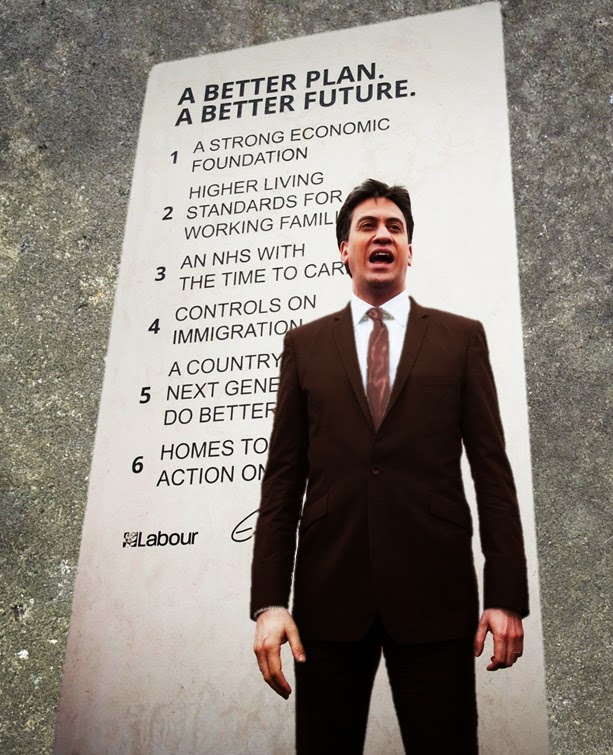
And since we don't believe these silly statements, however solemnly intoned they are, we then get the absurd spectacle of Cameron pledging to enshrine in law a promise not to increase income tax, VAT or national insurance. Followed by the even more absurd Miliband gimmick of having his vague, waffly pledges literally carved in stone.

I genuinely thought that this last one was a joke when I heard it. I still do.

But no matter how feverish the promises, how apocalyptic the denunciations of the other side(s), the electorate - as that Question Time audience illustrated - resolutely refuses to be convinced. We still think they're all lying. And they are.

Just to be clear: this was not always the case. There was a time when politicians told us grown-ups if things were going wrong. This is Edward Heath's message to the country in December 1973, telling us that we were in for the hardest Christmas since the war and that our standard of living was going to fall:


I'm not sure I can envisage Cameron or Miliband making that kind of broadcast. 

Mind you, it didn't do Heath much good; two months later, he was thrown out of office. Maybe that's why telling the truth fell out of fashion. Or maybe it was John Smith as shadow chancellor in 1992, telling us that if we wanted better services - which we said we did - we would have to see tax rises, which we decided was beyond the pale. Or possibly it was Blair winning three consecutive elections by peddling his PFI fantasy of 'investment' on the never-never. 

In any event, everyone now knows that there are serious problems coming, yet no politician is prepared to say so.

Despite all of which, I remain mostly optimistic about the future. 

Primarily this is because I don't believe the current settlement can survive, since it is so clearly dysfunctional. 

As many have pointed out, the principal justification for a first-past-the-post electoral system has always been that it provides strong, stable government. This no longer looks like a clinching argument. 

The inherent distortions are about to be revealed in the starkest manner ever. It is almost certain that Ukip will win the third largest share of the vote, and yet could end up tenth in the share of seats (the position it was in at the dissolution of the last Parliament).

Similarly, Nicola Sturgeon has talked a great deal about 'shutting the Tories out of Downing Street' with an anti-Tory majority in the Commons. This may well be the result, but the majority of the popular vote is likely at the same time to be right-of-centre; the Conservatives, Ukip and the Liberal Democrats will probably get more than 50 per cent between them. (I'm assuming that the Lib Dems' more left-inclined supporters will have abandoned them.)

There is also the fact that we no longer have any national parties, just a fraying patchwork of regional and nationalist groups. Those that still pretend to be national are self-evidently not fit for purpose.

And then there's Scotland. Some commentators are berating the Conservatives for jeopardising the Union with their apparent encouragement of the Scottish National Party; others are berating the Labour Party for their complacency in letting the SNP outflank them on the left.

But it doesn't matter much who's to blame; the fact is that there aren't very many passionate Unionists left, on either side of the border. Those who do claim to believe in the Union seem incapable of making out a case for it that goes beyond sentiment and slogan.

Whatever happens tomorrow, large numbers of people are going to feel not merely unhappy - that's normal - but cheated.

Back in 2012, I wrote that 'things are about to change quite radically'. I think we're edging ever nearer a critical moment.

Monday, 4 May 2015

Those we have loved: Lib Dem leavers

Compared to the Labour and Conservative Parties, there are fewer Liberal Democrats of note retiring voluntarily, but there are some. To start with, completing a triumvirate of departing leaders, Gordon Brown and William Hague are joined on the post office queue for pensions by Menzies 'Ming' Campbell.

Of course, Ming's stint as leader was less successful than that of Hague: he wasn't even allowed to contest a general election, being knifed by his colleagues in 2007 after just nineteen months.
A bit like the Lib Dem equivalent of Iain Duncan Smith, then, except that Smith never beat O.J. Simpson in a sprint race. Mind you, Campbell wasn't given reform of the benefit system as a consolation prize following his political assassination. As they used to say in Grimsby, what you lose on the hake, you gain on the herring.

Also leaving are Alan Beith and Malcolm Bruce, who both seem to have been around for ever, having been first elected in 1973 and 1983 respectively. They were like the boring, elder statesmen of the party (the men in grey sandals) though Bruce did once impress with an outbreak of honesty: 'A lot of people who vote for us vote for negative reasons,' he told the 1994 conference; 'what David Penhaligon used to call the "stuff 'em all vote".'

Regrettably for the Lib Dems, they can no longer count on the stuff 'em all vote.

I'll be sorry to see the last of David Heath, MP for Somerton and Frome since 1997. He shares his name with an American wrestler (you may be familiar with his character, Gangrel), and he always looked as though he might be a bit handy at the grappling game himself, somewhat in the tradition of Big Pat Roach:
Rather confusingly, for a while in the 1990s Heath was the parliamentary consultant for the WWF, though in his case it was the World Wildlife Fund.

And finally - inevitably - there's Sarah Teather, who took Ken Livingstone's old seat of Brent East in a 2003 by-election and has hung on to it, and its successor constituency Brent Central, ever since. (Good luck to the Lib Dems in keeping hold of that one.)

Despite twelve years in parliament, including a brief stint in government, she will surely be best remembered for her Strictly Come Dancing routine that wowed the party faithful in 2011:

Saturday, 2 May 2015

Those we have loved: Labour leavers

It's at this stage of a election campaign that my thoughts turn to the dear departed. There are two categories of MPs who don't return to the Commons after a general election: those who have decided to step down, and those who've been kicked out on their ear by the electorate.

We'll have to wait to see who falls into the latter category, but looking through the list of the voluntary redundancies, it is striking how many big (or biggish) names are leaving from the Parliamentary Labour Party.

At the top of the list is obviously Gordon Brown, accompanied by a clutch of former cabinet ministers: David Blunkett, Alistair Darling, Jack Straw, Tessa Jowell, Hazel Blears, Frank Dobson and Peter Hain. (The latter was the man on whom I once placed a bet that he would become Labour leader.)

Oh yes, and there's Bob Ainsworth, remembered as the defence secretary who was humiliated by Joanna Lumley into treating retired Gurkhas a little bit better. (Many would pay good money to be humiliated by Joanna Lumley.)

Then there some less elevated but still significant figures - Glenda Jackson (my original choice for London mayor), 'Red' Dawn Primarolo, Nick Raynsford, Joan Ruddock and my own favourite Austin Mitchell, whose book Four Years in the Death of the Labour Party is still the best account of the 1983 election campaign.

This is a hell of a lot of experience that's being lost, particularly in the event that Labour form the next government. Not that any of these would have served in such an administration, but it doesn't do any harm to have some people in the vicinity who've knocked around a bit. And, more widely, there's a loss to the Commons more generally.

That's in the world of politics, of course. Outside, the truth is that hardly anyone has noticed any of this lot, as a 2013 episode of Pointless made clear; asked to name cabinet ministers who served under Tony Blair or Gordon Brown, only seven in a hundred people named Straw, seven Darling and four Blunkett.

But mostly I wanted to take this opportunity to note the passing of Shaun Woodward, sometime secretary of state for Northern Ireland and one of the oddities of modern politics.

He was the Conservative Party's director of communications during the shock election victory of 1992, and was briefly a Tory MP for Witney, though he was sacked from the frontbench for supporting the repeal of Section 28. He then re-emerged as a Labour MP for the safe seat of St Helens South, despite attracting much mockery when the story got out that he retained the services of a butler.

His successor as MP for Witney was David Cameron who paid tribute to his predecessor in his maiden speech in 2001. 'He remains a constituent and a most significant local employer, not least in the area of domestic service,' Cameron said on that occasion. 'We are in fact quite close neighbours and on a clear day, from the hill behind my cottage, I can almost see some of the glittering spires of his great house.'

I think this makes Woodward the only Labour MP to be derided by Cameron for being too posh. We may not see his like again.

Friday, 1 May 2015

...like the leaving of it

Seven days from now, we may well be getting the first resignation of a party leader. Presumably the Scottish National Party, Plaid Cymru and the Green Party of England and Wales will stick with their incumbent leaders, but for the others, nothing is certain. Quite possibly Nigel Farage and/or Nick Clegg will fail to be elected in the first place, while either David Cameron or Ed Miliband - whichever doesn't get to be prime minister - won't be long for the leadership.

As an object lesson in how not to leave the job of party leader, you'd have to go a long way to beat Gordon Brown.

Following the indecisive result of the general election in 2010, he hung around in Downing Street for a few days - as he was constitutionally bound to do, since he was still prime minister - but then abruptly walked out, a few hours before the deal between Cameron and Clegg was concluded: and on that he was constitutionally wrong.

The real problem, though, was what followed. Brown resigned the Labour leadership and sulked off to Scotland, leaving Harriet Harman to mind the shop for the next few months while the long process of choosing a new leader played itself out. It was during that period that the narrative of the financial crash and crisis was firmly fixed in the public consciousness by the coalition government.

Brown was badly damaged by then, but he should still have been capable of articulating an alternative view, of defending the economic growth figures bequeathed to the new government. He didn't do so. And the legacy of Brown's self-indulgence could be seen on Question Time last night, as Ed Miliband squirmed in the face of questions on Labour's economic record. The ground lost in 2010 has never been recovered.

Compare and contrast Michael Howard departure from the Conservative Party leadership in 2005. He announced immediately after losing the election that he would be standing down, but not for another six months, not till a new leader had been chosen. He then reshuffled his front-bench team and promoted George Osborne to shadow chancellor and David Cameron to shadow education secretary, thereby setting up the new generation to inherit the leadership. It worked perfectly (though Howard would probably have preferred Osborne).

It is possible in retrospect to conclude that Howard didn't ultimately do his party any favours in the short term, that David Davis would have been a sounder choice in 2005 and might well have won a majority in 2010. But even if one accepted this, Howard was at least doing what he genuinely believed was in his party's interests. Unlike Brown, who simply abandoned his party.

Thursday, 30 April 2015

Who gets my vote: part 4

As I explore the outer reaches of the ballot paper that has been assembled for the Holborn & St Pancras constituency in which I live, I'm terribly excited to find that Natalie Bennett is not the only party leader standing. 
Because look, here's Vanessa Hudson of the Animal Welfare Party. She may not get invited onto the leaders' debates on television, but she's the big boss of the AWP. And she can call on the endorsement of 1960s model Celia Hammond. Unfortunately most of the policies that the party are putting forward relate to animals - apart from calling on the government to promote 'plant-based diets', there doesn't seem to be anything aimed at us humans.

The AWP is fielding candidates in a total of four constituencies, which is twice as many as the Socialist Equality Party. I'm not fully up to speed with developments in the world of Trotskyism, and the SEP is a new name to me. but - having checked - they turn out to be a rebranded version of the International Communist Party, who split from the Workers Revolutionary Party back in the 1980s.

They are also - as their leaflet boasts - the British section of the International Committee of the Fourth International. Not the actual Fourth International, of course (in which we are represented by Socialist Resistance), nor the Fourth International (ICR) nor the Fourth International Posadist. And certainly not the International Trotskyist Committee for the Political Renegeneration of the Fourth International, the Liaison Committee for the Reconstruction of the Fourth International or the Workers International to Rebuild the Fourth International. And, just while I'm clearing up these confusions, there is another rival International Committee of the Fourth International as well, but that's not the one that the SEP are part of. Don't be fooled by the name.
Despite all of which, their election leaflet insists: 'Only the SEP speaks for the working class.' But only in two constituencies, apparently. And one of them, happily, is mine, with a candidate named David O'Sullivan.

These are minor parties, though. Just six candidates between the two of them across the whole nation. Much more substantial is the list of 32 constituencies being contested by Cannabis Is Safer Than Alcohol. That's a statement of intent. Somewhat peculiarly, however, the central demand of CISTA is not the immediate legalisation of cannabis, but merely the setting up of a Royal Commission to look into drug laws. They want government drug policy to be 'evidence-based, cross-party, humane and non-partisan'.

I think they're underselling themselves. They're not even competing properly with the Green Party of England and Wales, whose manifesto promises 'Radical reform of our drug laws'. No mention there of a Royal Commission. And as Peter Lilley pointed out back in 2001: 'Royal Commissions are just a way of playing issues into the long grass.' He added: 'Perhaps appropriate for cannabis.'

Still, good luck to Shane O'Donnell of CISTA. If all the potheads in Camden could get themselves together to vote for him, he'd do alright.
And that's it. The English Democrats and the British National Party - both of whom fielded candidates last time - have abandoned us. And there are no independents like we had in 2010. Still, no doubt we'll survive somehow.

Wednesday, 29 April 2015

The Emperor's New Troosers

I've mentioned before (here and here) that the level of hyperbole in this general election campaign is getting a little silly on all sides. Sometimes this has become a story in its own right. Such was the case with Theresa May's claim in an interview with the Mail on Sunday that a post-election deal between the Labour Party and the Scottish National Party would provoke 'the biggest constitutional crisis since the abdication of Edward VIII'.

Now this is obviously over-the-top, and I'm disappointed that a politician of May's standing has clearly forgotten all about Gough Whitlam. (She must once have known about him; she was at Oxford University at the time of the Dismissal and surely even geography students were vaguely aware of what was happening in Australia.)

Nonetheless, there is a clear problem in the position adopted by the SNP. The party's manifesto is a mix (less charitably, a mess) of policies, some of which relate simply to Scotland, others to the whole of the United Kingdom.

So, for example, the SNP will 'seek an explicit exemption ... from the terms of the proposed Trans-Atlantic Trade and Investment Partnership' for Scottish Water. But not for Thames Water or any of the other suppliers. On the other hand, the very first page of the policy proposals (after the usual fatuous photographs of the leader) says that the party will 'vote for an increase in NHS spending across the UK of £24 billion by 2020-21'.

This seems to me to be at best impolite. Health is a devolved matter already, even without the additional shift of power to Holyrood that would presumably accompany the SNP having any say in the Westminster government. One doesn't have to accept the Conservative proposal of English votes for English laws to feel that a party with no candidates in England should not be announcing how much money they want to make England spend on its health service.

Nor, even if - as a voter in England - one believes in increased funding for the NHS, should one look to the SNP to deliver this.

Because it's not actually their business.

The manifesto of the Democratic Unionist Party, by contrast, has not a single word to say on the subject of the NHS, though it does mention the devolved health service. Instead the document is rooted entirely in the hope of a hung parliament, allowing 'an opportunity for Northern Ireland's voice to be heard in London like never before'.

The same bifocal approach runs through the whole of the SNP manifesto. The idea that the Scottish Parliament should be given the right to decide which sporting events are reserved for free-to-view television - that seems pleasingly parochial. Telling the rest of the UK how many houses we have to build is rude and wrong.

There is a constitutional issue here. Something to do with representation and taxation, since spending relies on taxes, whether now or in the future to pay today's borrowing.

And the problem is exacerbated by the voting system (which, incidentally, the SNP are proposing to scrap in favour of the Single Transferable Vote). The latest opinion poll, published yesterday, shows the SNP on 54 per cent in Scotland, which is predicted to translate into 96.5 per cent of Scottish seats.

Or, to put it another way, 1.3 million votes (assuming a similar turnout to last time) would yield 57 MPs. Meanwhile, as I've said before, Ukip - effectively the English equivalent of the SNP - will register over two-and-a-half times that vote for a total of maybe three MPs.

I don't think that, despite May's argument, the emergence of a minority Labour administration propped up by SNP votes will spark a constitutional crisis as such, since the rules of Parliament are perfectly clear about how governments are chosen by MPs. But it will provoke a crisis of confidence in the system of government. I don't know how that will manifest itself, but it cannot simply be wished away. Not in a country where there is already deep dissatisfaction with our version of representative democracy.

The answer, in the short term, can surely only be the introduction of proportional representation. The Lib Dems and Plaid Cymru, like the SNP, favour the Single Transferable Vote, while Ukip also support reform.

But whatever the outcome of this election - even if the Tories do get a majority in the Commons (a prediction to which I cling, despite all the evidence) - a reform of the voting system is an urgent necessity. It would be absurd to have another election fought like this.

Postscript: Since posting this three hours ago, a new poll has been published showing the SNP still on 54 per cent, but with Labour sliding still further - projections now suggest the SNP would win every seat in Scotland.