One of the things I write is a game called Who's in the Bag?, which is a simple - but effective - little thing. There's a bag full of cards, on each of which there are three names and, without actually speaking the names themselves, you have to get your team-mates to guess who they are. There's a timer as well. It sells well and has done for a couple of decades now.
Every few years, though, it has to be updated to allow for changing tastes and fashions. Some people - say, Winston Churchill, Jane Austen, Stevie Wonder - are likely to stay in every edition. But others pass their sell-by date and have to be dropped. Robert Kilroy-Silk, for instance: he was thrown out of the Bag some time ago. Liam Gallagher more recently. For other reasons, Max Clifford and Rolf Harris won't be in the Bag this time. And meanwhile some new people will have emerged since the last version, who need to be added.
I'm now working on a new edition of both the main game and the add-on pack of cards. Which means I have to come up with over 1,200 names that I can reasonably expect to be recognised, or that are possible to guess even if they're not recognisable. Donald Trump, for example, is an easy name to convey, even if you've never heard of him. (Lucky you.) Similarly, Mary Beard, Nicola Sturgeon and Paddy Power.
The other factor is that this will probably still be in print in 2020. So there's an element of prediction here. Will Ed Sheeran still be a thing in five years time, or will he have faded in the same way as - oh, I don't know - Jake Bugg seems to have done? What about Harry Kane? Jennifer Lawrence? Will Katie Hopkins become big enough to warrant being put in the Bag?
It's a bit like a low-budget version of Madame Tussaud's selection process. I mentioned in my book A Classless Society that we knew Iain Duncan Smith was doomed as Tory leader when Tussaud's said he wouldn't get an effigy. 'He is not in the papers very much and you never hear his name,' said a spokesperson. 'We are not sure if our visitors will recognise him.' It was a damning verdict.
And the question that's currently troubling me is the parallel case of the Labour leadership. Whoever wins gets put in the Bag, of course. But the losers? If Andy Burnham doesn't get to be leader, is he going to become a household name? How about Jeremy Corbyn? Flavour of the month now, but if he fails to win this election, how big will his public profile be in a couple of years? Politicians generally aren't instantly familiar, as Pointless discovered a couple of years ago.
Much safer is the process of discarding people. Amongst those who I've thrown out of the Bag this time are Ed Balls, Boutros Boutros-Ghali, Rebekah Brooks, Nick Clegg, Abu Hamza, Harriet Harman, Martin McGuinness, Peter Mandelson and Ian Paisley. These are, in my estimation, yesterday's men and women. There's a dangerous sense of power that comes with writing this game...
Any suggestions for people who have become famous in the last three years would be most appreciated.
Showing posts with label A Classless Society. Show all posts
Monday, 31 August 2015
Monday, 11 May 2015
David Cameron: chillaxing to victory
In 2005, following a third successive election defeat, the Conservative Party staged a beauty contest for those who wished to succeed Michael Howard as leader. Up until that morning, the front-runner had been David Davis, but by the time all five candidates had made their 20-minute speeches, he'd been overtaken by David Cameron.
Amongst those who had their minds changed was me. I rated Davis highly at this stage, largely on the strength of a gig he did with Tony Benn at the Royal Albert Hall in 2002. Benn was then at the peak of his popularity as a lovable elder statesman, and for a Conservative to have the nerve to go head-to-head with him in front of an audience that was guaranteed to be 99 per cent anti-Tory showed, I thought, considerable bottle and self-confidence. He was also very good on the night.
Unfortunately he wasn't very good at that 2005 conference, while Cameron was brilliant. Maybe - I've often had cause to think in the last ten years - I was dazzled by a smoke-and-mirrors act, but my immediate response was to predict to the person with whom I was watching on TV that Cameron would win the leadership and would go on to win the next two general elections.
As I say, maybe I was caught up in the heat of the moment. In the final poll, the party members voted for Cameron over Davis in a ratio of two to one, but come 2010 the country did not. He failed to win the election, despite facing only a badly wounded Gordon Brown, a man whose most noteworthy contribution to the campaign was to insult a supporter for her alleged bigotry.
Now, however, Cameron has actually won an election, and I feel my original judgement was sort of vindicated.
This has been a spectacular victory, though not quite as wondrous as some are claiming. The Conservatives' share of the vote went up, but turnout was still poor and Cameron persuaded just 24.4 per cent of the registered electorate to vote for him. This was, however, better than the 23.5 per cent he achieved last time round (itself an improvement on Labour's 21.6 per cent in 2005).
So I wanted to make a couple of points about Cameron.
The first is something that I explored at greater length in an article on the twenty-first anniversary of Black Wednesday. This is a photograph of Norman Lamont, then chancellor of the exchequer, announcing Britain's humiliating withdrawal from the exchange rate mechanism in September 1992:
And there, off to one side, is his 25-year-old adviser and speech writer, David Cameron.
Cameron, I wrote, 'witnessed at close quarters the spectacular implosion of a party that once believed it was predestined to power'. I suggested that this is perhaps why he always seems so relaxed in a crisis. Similarly George Osborne, who was at Douglas Hogg's side in the BSE disaster of 1996. These people had experienced such dreadful political depths in their early years that very little was going to faze them.
Ed Miliband and Ed Balls, on the other hand were New Labour advisers in the 1990s, at a time when the party was already coasting into government. They had no such baptism of fire.
When Cameron became leader in 2005, it was clear that his job was, in the cliché of the time, to 'decontaminate the Tory brand'. The early efforts were clumsy and gimmicky: hugging hoodies and huskies, demonstrating his green credentials by installing a windmill on his roof and cycling to work (followed by a car, carrying his papers).
Then he got blown off course by the bankers' recession. No longer, it appeared, was sunshine going to win the day. The concept of the Big Society withered on the vine (though it's actually very good and the Labour Party should take it back).
Instead, the attempt to modernise the party seemed to consist of little more than the sudden, unpromised introduction of same-sex marriages. It didn't seem like very much - essentially a new name for civil partnerships - but actually it turned out to do the job really rather well.
Because the success of same-sex marriages lay not in the legislation itself, but in the way that it provoked a mass exodus from the party. Some constituency organisations claimed to have lost up to half their members as a result of the policy.
This was, most commentators agreed, disastrous for Cameron. But it wasn't. In one fell blow he'd cleared out large numbers of the 'fruitcakes, loonies and closet racists', as he'd described Ukip back in 2006. Many of them, of course, went straight over to Ukip, giving that party a huge boost in membership and popularity.
Less noticed was the effect on the Conservative Party itself, now smaller but - from Cameron's perspective - much better looking. It has become difficult to denounce the Tories as racist, sexist, homophobic and still retain any credibility as a political observer. The party that embraced economic liberalism in the 1980s has accepted the social liberalism that spread across Britain in the 1990s.
The election results this week saw Cameron increase the Conservative share of the vote, largely at the expense of the Liberal Democrats. All those right-wing commentators like Simon Heffer and Charles Moore who had insisted that the Cameron project was misguided, that he shouldn't be trying to appeal to the liberal vote (sometimes even suggesting he form an electoral pact with Ukip) - they turned out to be completely wrong.
There are many other commentators for whom the Tory brand cannot ever be sufficiently decontaminated, but it turns out that he's done enough. Not enough for those in the long-derided 'metropolitan elite' of course, those who follow in the pioneering footsteps of the delegate to the 1982 SDP conference, excitedly proclaiming: 'There may be minorities we have not yet discovered.' But enough for the rest of the country.
The achievement of Tony Blair in the mid-1990s was to make the Labour Party a safe home for ex-Tory voters. If Cameron hasn't quite reciprocated that achievement, he has gone some way towards it. There were many disillusioned Liberal Democrats, and even some lifelong Labour supporters, who simply couldn't countenance Ed Miliband and who felt just about safe enough to turn to vote Conservative for the first time ever, despite grave reservations over Tory policy.
As all the polls showed, Cameron's ratings outstripped his party's; Miliband's trailed his.
The Left need to get used to the idea that Cameron and Osborne have changed the Conservative Party for good. A new line of attack is needed.
One final thought. There is much talk of this election resembling 1992 when John Major won a slender majority and then ran into trouble with his own party over Europe. And look what's coming next, say the columnists: it's a European referendum and history could repeat itself.
I think this unlikely. If Ukip had got, say, five MPs they might have formed a rival pole of attraction for Eurosceptic Tory members, and there might have been defections over the referendum arrangements. Then Cameron would have had trouble. That might still happen if there are a few by-elections that allow Ukip to boost their numbers, but I doubt it. And Douglas Carswell does not in himself constitute a rival pole of attraction.
In any event, Cameron is much more in tune with the mood of his party than Major was. He remembers all too well the damage that Europe did to the Tories in the 1990s. Most importantly, he doesn't face the same problem that afflicted his predecessor.
Because Major's real grief over Europe was not to be found amongst the 'bastards' on his own backbenches; it lay in the House of Lords. There lurked the malign influence of Margaret Thatcher, the deposed but still powerful ex-leader, constitutionally unable to keep herself from interfering, from stirring up trouble, from seeking to undermine her successor as he tried to get the Maastricht Treaty through Parliament.
As I wrote in my book A Classless Society:
Thatcher's behaviour during Major's premiership was even worse than that of Edward Heath during her own time in office. Heath had been unstinting in his disapproval as he remained stubbornly on the backbenches ('like a sulk made flesh,' in the words of journalist Edward Pearce), but he hadn't actively engaged in plotting against her. But then, as a minister told the BBC's John Cole: 'She was always criticising the government when she led it, so why expect her to change now?'The EU referendum won't all be smooth sailing, but it'll be less choppy than Major's trip back from Maastricht. And easier than Cameron's rite of passage on Black Wednesday.
Wednesday, 6 May 2015
The general election campaign, 2015
Possibly the sheer resilience of Nick Clegg, the thickest-skinned politician ever. Probably Natalie Bennett, with her brain-fades and advocacy of polyamorous marriages. Definitely Grant Shapps in all his gormless glory.
What else? Russell Brand would be in there. Maybe Ed Miliband and the hen party? Maybe David Cameron forgetting which football club he's supposed to support? That's the kind of thing I normally record.
The one event that would certainly be included - even though it'll fade from the collective memory - would be the BBC Question Time last week, in which the audience accused successively Miliband, Cameron and Clegg of being liars. More than anything else, that seemed to nail this campaign and the state of modern politics.
Before, during and after the manifesto launches, we've had - from all parties - a relentless series of what columnists nowadays like to call 'offers', but which we used to call policies. Or bribes, to be more precise. Each day there's been a new proposal to reduce tax or to increase spending or, more frequently, to tell other people what things they should be doing differently.
Employers, housing associations, landlords, fuel companies, rail operators, bankers, tobacco firms: all of them, ministers manqué claim, could be regulated more stringently or made to reduce their profitability. This is all perfectly fine and legitimate - only the libertarian fringes object on principle to all intervention in 'the market' - but it's hard not to see it as being an alternative to government action.
One party suggests they'll build x number of houses, and another chips in with x x 2 (or x x 3, if x x 2 has already been taken). None of the contenders actually intend to build any houses themselves, of course: these are just figures plucked out of thin air and magically transformed into targets.
Because we are still, sadly, in a political world of targets. Lord know it's not as bad as during the first government of Tony Blair when, as I wrote in my book A Classless Society:
There were targets for the quantity of cars, cycles and pedestrians on the road, as well as for traffic casualties and dog mess; for the numbers of smokers, heroin addicts and pregnant teenagers; for the incidence of robberies and building-fires; for how many children visited museums and galleries, and for the proportion of school-leavers going on to higher education. There was even a target for the number of otters to be found in the wild...But even without this excess of zeal, the thinking behind the target culture still dominates political thinking; the stated intention to do something is believed to be just as good - and certainly much easier - than actually doing it. As Blair himself once put it: 'It's the signals that matter, not the policy.'
This time the signals extend to cover the behaviour of foreigners.
The Tory manifesto promises to deliver '100,000 more UK companies exporting in 2020 than in 2010' with a 'target of £1 trillion in exports' - presumably whether or not people want to buy our stuff.
It also says: 'We will set challenging targets for Visit Britain and Visit England to ensure more visitors travel outside the capital' - whether or not that was in the holiday plans made by those tourists.
Meanwhile, the Labour manifesto promises to 'push for global targets to tackle inequality and promote human rights' - whether or not... well, you get the idea on that one.
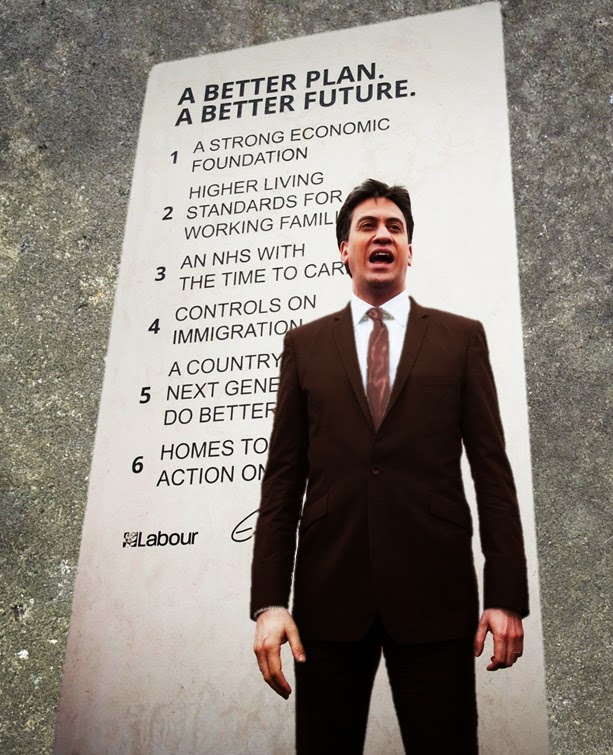
And since we don't believe these silly statements, however solemnly intoned they are, we then get the absurd spectacle of Cameron pledging to enshrine in law a promise not to increase income tax, VAT or national insurance. Followed by the even more absurd Miliband gimmick of having his vague, waffly pledges literally carved in stone.
I genuinely thought that this last one was a joke when I heard it. I still do.
But no matter how feverish the promises, how apocalyptic the denunciations of the other side(s), the electorate - as that Question Time audience illustrated - resolutely refuses to be convinced. We still think they're all lying. And they are.
Just to be clear: this was not always the case. There was a time when politicians told us grown-ups if things were going wrong. This is Edward Heath's message to the country in December 1973, telling us that we were in for the hardest Christmas since the war and that our standard of living was going to fall:
I'm not sure I can envisage Cameron or Miliband making that kind of broadcast.
Mind you, it didn't do Heath much good; two months later, he was thrown out of office. Maybe that's why telling the truth fell out of fashion. Or maybe it was John Smith as shadow chancellor in 1992, telling us that if we wanted better services - which we said we did - we would have to see tax rises, which we decided was beyond the pale. Or possibly it was Blair winning three consecutive elections by peddling his PFI fantasy of 'investment' on the never-never.
In any event, everyone now knows that there are serious problems coming, yet no politician is prepared to say so.
Despite all of which, I remain mostly optimistic about the future.
Primarily this is because I don't believe the current settlement can survive, since it is so clearly dysfunctional.
As many have pointed out, the principal justification for a first-past-the-post electoral system has always been that it provides strong, stable government. This no longer looks like a clinching argument.
The inherent distortions are about to be revealed in the starkest manner ever. It is almost certain that Ukip will win the third largest share of the vote, and yet could end up tenth in the share of seats (the position it was in at the dissolution of the last Parliament).
Similarly, Nicola Sturgeon has talked a great deal about 'shutting the Tories out of Downing Street' with an anti-Tory majority in the Commons. This may well be the result, but the majority of the popular vote is likely at the same time to be right-of-centre; the Conservatives, Ukip and the Liberal Democrats will probably get more than 50 per cent between them. (I'm assuming that the Lib Dems' more left-inclined supporters will have abandoned them.)
There is also the fact that we no longer have any national parties, just a fraying patchwork of regional and nationalist groups. Those that still pretend to be national are self-evidently not fit for purpose.
And then there's Scotland. Some commentators are berating the Conservatives for jeopardising the Union with their apparent encouragement of the Scottish National Party; others are berating the Labour Party for their complacency in letting the SNP outflank them on the left.
But it doesn't matter much who's to blame; the fact is that there aren't very many passionate Unionists left, on either side of the border. Those who do claim to believe in the Union seem incapable of making out a case for it that goes beyond sentiment and slogan.
Whatever happens tomorrow, large numbers of people are going to feel not merely unhappy - that's normal - but cheated.
Back in 2012, I wrote that 'things are about to change quite radically'. I think we're edging ever nearer a critical moment.
Thursday, 9 April 2015
Polly and the Non-Doms
I like Polly Toynbee. In my book A Classless Society, I celebrated her 1995 article in the aftermath of the fiftieth anniversary of VE Day, when she chided the British nation for being so obsessed with the past on 8 May that it forgot to make anything of Europe Day on 9 May. Leave aside that nonsense about defeating Nazism, she urged us, and get on with celebrating the EU. To be charitable, let's assume it was satire.
Her latest piece in the Guardian is a little less frivolous. She argues that the Labour Party's commitment to (sort of) abolishing the non-domiciled tax category may prove to be as 'totemic' as Margaret Thatcher's policy of selling council houses to their tenants. Whether the commitment (if enacted) would raise any revenue is irrelevant: 'The message, not the money, is what matters.'
I think she's right. This is a purely symbolic gesture. And I suspect it may play very well, possibly even among those Labour voters who are being tempted toward Ukip.
But what is the message that Ed Miliband is sending out with this announcement? According to Toynbee, it represents, along with the 'mansion' tax and the 50 per cent tax rate, a 'significant break with New Labour's contamination, infatuation and fear of the super-rich'.
And that seems to me to be a bit of a letdown. If even Labour's friends (and I believe that Toynbee is presently a friend of the Party) can only spin this as being an exorcism of New Labour ghosts, that doesn't really fit into the category of 'totemic policies that announce what a party stands for'. Rather, it's negative; it announces what Miliband is against, not what he's for. And what he's against, says Toynbee, is Tony Blair. Which is as a good way of uniting the nation as any, but is a slightly odd approach to take for the leader of the Labour Party.
A decent policy, but not one that feels like it's in the same class as council-house sales. More like Blair's own attack on Clause Four, though a bit later in the day.
Subscribe to:
Posts (Atom)