Showing posts with label Labour Party. Show all posts

Tuesday, 3 May 2016

some new writings

I'm still writing some stuff for the Lion & Unicorn website, including in recent times:

The odd story of thriller writer Hank Janson being prosecuted in 1955 for publishing obscene literature.

A consideration of whether Britain would be better off culturally outside the EU.

An unexplained disappearance from a Gloucestershire village in the 1660s.

A look at the continuing power of Ken Livingstone's London effect in Jeremy Corbyn's Labour Party.

Do have a read, if you wish.

Saturday, 26 September 2015

John McDonnell: a portrait

Following my profiles of Jeremy Corbyn and the other candidates in Labour's leadership and deputy leadership elections, I thought I should do the same for the new shadow chancellor, John McDonnell. It's now available on the Lion & Unicorn site. Do have a look.

Saturday, 12 September 2015

Wrong, wrong, wrong

What a buffoon I am! All these weeks and months I've been saying that Jeremy Corbyn wouldn't be elected leader of the Labour Party. And now he has been. I was wrong, completely and hopelessly wrong.

In my defence, I did from the outset say that Corbyn should be taken seriously, that he wasn't a joke candidate. But it was my conviction was that when it actually came to the crunch, the party would decide that the example of Iain Duncan Smith was not one that it wished to follow. And I was wrong. As I so often am.

But, despite my poor track record on predictions, I can at least confidently predict that it's going to be entertaining. God bless the party and all who sail in her.

Thursday, 10 September 2015

As voting closes...

Voting on the leadership and deputy-leadership of the Labour Party has just closed. And, as an interim guide to form, I've checked up on the traffic generated on this blog by the portraits I wrote of the various candidates. There are, it has to be said, no surprises.

The share of the total number of page views achieved by each candidate is as follows:

Leader:
Jeremy Corbyn    58%
Andy Burnham    15%
Yvette Cooper     14%
Liz Kendall           13%

Deputy leader:
Angela Eagle        28%
Stella Creasy        26%
Caroline Flint        18%
Tom Watson        16%
Ben Bradshaw     13%

The order in the leadership category reflects the result that pretty much everyone expects, though I want to put on record one last time my dissenting view: I still think Yvette Cooper is going to win. I'm not sure what conventional wisdom says about the deputy leadership, but I believe Tom Watson is still favourite.

If it goes to form, then, by this time on Saturday, the Labour Party will be led by Jeremy Corbyn and Tom Watson, two white men with an average age of 57, who both came into politics as unelected advisers to trade unions. Let no one say that the party hasn't embraced modern Britain in all its wondrous diversity.

Wednesday, 9 September 2015

Purged! part three

When I signed up as a registered supporter of the Labour Party, Iain McNicol, the party's general secretary, wrote to me, saying how 'thrilled' he was to have received my application and how 'delighted' the entire party were to have me aboard:


It was a little disconcerting to be addressed bluntly as 'Alwyn', rather than 'Dear Mr Turner'. But I assumed that he was a busy man and that he had a lot of these personal messages to send out. Also, he's younger than me - maybe he's more comfortable than I am in using first names with those who he's never met. In any event I forgave him, because I was, of course, equally thrilled and delighted 'to be part of this movement'.

Mr McNicol also thanked me for for my three quid 'administration fee' which, he assured me, 'means you'll be able to vote in our leadership elections'.

Sadly, all this camaraderie and bonhomie was not destined to last. When I came to cast the votes that I'd been promised, I discovered that, in the words of the late blues musician Roy Hawkins, 'The Thrill Is Gone'.


You'll note that Mr McNicol and I are no longer on first-name terms. Indeed we're not on any-name terms. I'm now 'Applicant' and he's 'The Labour Party'. A very definite frost has settled on our former friendship.

There are two grounds offered for this rejection. It may be, it is suggested, that I am 'a supporter of an organisation opposed to the Labour Party'.

Well, we can clear that up straight away. I'm not. I am not a member or supporter of any other political party. I've never tried to conceal, however, that I have voted for other parties at various points in the thirty-five years since I was first entered on the electoral register, sometimes for tactical reasons, sometimes because I preferred the alternative candidate.

In 1983, for example, I voted for Anne Sofer of the SDP because I (wrongly) thought she had a better chance of dislodging the sitting Conservative MP in my constituency. And in 2000 I voted for Ken Livingstone to become mayor of London, because I thought he'd be better at it than the Labour candidate, Frank Dobson. But voting is not the same as supporting.

So if that's not the reason for my exclusion, it must be the other argument: that I 'do not support the aims and values of the Labour Party'. I'm not, it's worth stressing, required to be a supporter of the party itself, but merely to support its 'aims and values'.

And what are these 'aims and values'? Well happily they're spelt out in Clause IV of the party's constitution, which opens:
The Labour Party is a democratic socialist party. It believes that by the strength of our common endeavour we achieve more than we achieve alone, so as to create for each of us the means to realise our true potential and for all of us a community in which power, wealth and opportunity are in the hands of the many not the few, where the rights we enjoy reflect the duties we owe, and where we live together freely, in a spirit of solidarity, tolerance and respect.
So far, so good. The only bit of that that I might feel like questioning is the assertion that Labour is 'a democratic socialist party'. But I do support the idea that that's what it ought to be.

The clause goes on to specify four key ambitions: a dynamic economy, a just society, an open democracy, a healthy environment. Yep, that's all fine with me.

Then we get the commitment to working with international bodies 'to secure peace, freedom, democracy, economic security and environmental protection for all', and a commitment to working with British institutions as well. And it concludes: 'On the basis of these principles, Labour seeks the trust of the people to govern.'

I agree with all of that, as well. Even including the bit about needing 'the trust of the people to govern'. Indeed I made precisely that point in my piece about who I was intending to vote for.

The more I think about this, the more offended I am. Are the Labour Party seriously suggesting that I don't share their belief in 'peace, freedom, democracy, economic security and environmental protection'? If so, is this libellous? Because it feels very close to being defamation.

Maybe I should have a word with my local MP, Sir Keir Starmer. He's a lawyer, he'll know whether this is actionable or not.

Sunday, 6 September 2015

Purged! part two

When, in 2014, the Labour Party changed its rules to allow registered supporters, Andrew Rawnsley reported in The Observer: 'Mr Miliband has an ambition to get the number up to 100,000.' The idea of allowing people a vote in future leadership elections was to involve more people in the party, Rawnsley added:
What Mr Miliband is essentially proposing is what Americans call a "closed primary". You can't just walk in off the street to take part. You have to show some level of commitment to Labour. But you don't have to be a full-blown member to have a vote.
The proposal was passed by Labour's National Executive Committee in February last year by a vote of 28 votes to two. The dissenters were Dennis Skinner and Christine Shawcroft, probably the two most left-wing members of the NEC. Ed Miliband professed himself delighted with the result:
These changes will help bridge the gap between Westminster and the rest of Britain. They are about opening up the Labour Party so that more people from every walk of life can have more say on the issues which matter to them most.
At one point, in October, it seemed as though the price for being a registered supporter might be as high as £10, but that came in for a lot of criticism. Tessa Jowell - not then declared as a London mayoral candidate, but with that contest clearly in mind - said: '£10 sounds very high. In my view the charge should be set at the lowest level possible consistent with the proper administering of the primary.' So it came down to £3. And there it still is.

Which is why I signed up to it. I think a £10 charge would have deterred me, but I always liked the idea of primaries (of voting in anything, really) and I thought that seemed a reasonable level.

I also thought that I'm maybe sort of among the kind of people that they might want to participate: someone who's voted Labour in the past, but not consistently, i.e. a floating voter who could be won over, and therefore someone whose opinion on the leadership might be worth taking into consideration. And being a single, childless man with a natural inclination towards sloth, I thought I might offer a different perspective to all those hard-working families so beloved of politicians.

Evidently I was wrong, since I've been rejected. (No word yet, incidentally, on the return of my three quid.) Somewhere there is someone in the Holborn & St Pancras Labour Party who has checked up on me, taken against me, and put my name on a blacklist, so that as soon as I tried to cast a vote, I received a rejection email.

This doesn't leave me feeling bitter, in the way that some longstanding members and activists clearly - and justifiably - feel when they've been excluded. But it does tend to reinforce the impression that it's all a bit risible (hence the cheap sarcasm yesterday). And it does irritate me enough that I don't particularly wish the party well; surely it's a normal human reaction to respond, 'Well, if that's how you feel about it...'

Mostly, though, it leaves me genuinely baffled. If the 'opening up' of Labour doesn't include me, who does it include? Perhaps I misunderstood from the outset, and the intention was to attract solid Labour voters who'd never joined the party. In which case, Miliband was even more useless than I thought: they're not the ones you need to win over.

But maybe in writing that last sentence, I've answered my own question. I have been writing on this blog for several years that Miliband was useless and would never win a general election. I've also been very critical of Labour's policy and direction. That doesn't mean I don't support the 'aims and values' of the party - which is all I signed up to - but maybe they're feeling a bit sensitive right now.

I do like the bit in the rejection email that says I can appeal but only if I apply 'to join Labour as a full member'. Which obviously costs a lot more money. You'd have to be very cynical, however, to conclude that this was all a fund-raising exercise. I'm not sure the party's capable of thinking that far ahead.

Saturday, 5 September 2015

Purged!

This is, as Rupert Murdoch would say, the humblest day of my life. I just voted in the Labour leadership, deputy leadership and mayoral candidate elections. And by return of email, I got the following message, telling me that I simply wasn't wanted:


Woe! Woe is me. Woe, woe and thrice again woe. I've been debarred, expelled, banished, excluded. My voice has been silenced and I've been denied my democratic rights.

Maybe it was because I said that I didn't consider myself a Labour supporter. Maybe someone noted my claim that I voted for the Monster Raving Loony Party in the general election. Whatever the cause, the result is unequivocal and admits of no appeal: I've ended up on a blacklist. I am beyond the pale, an outcast from Eden. And now I truly know the meaning of shame. I have done those things I ought not to have done, and I have left undone those things that I ought to have done, and there is no health in me.

Obviously I've written back to ask how I go about reclaiming the thirty pieces of silver (well, the three quid) that I gave them when I registered. But that'll be scant compensation for the feeling of rejection I'm experiencing.

Just for the record my votes (spurned, spurned, all spurned) went to:

Leader: (1) Liz Kendall, (2) Yvette Cooper, (3) Jeremy Corbyn, (4) Andy Burnham

Deputy: (1) Stella Creasy, (2) Angela Eagle, (3) Ben Bradshaw, (4) Caroline Flint, (5) Tom Watson

Mayoralty: (1) Christian Wolmar, (2) Gareth Thomas, (3) David Lammy, (4) Tessa Jowell, (5) Diane Abbott, (6) Sadiq Khan

I do like that 'Kind Regards' sign-off, though. That's a nice touch, don't you think? Even if they are purging me.

Thursday, 27 August 2015

There'll Always Be an England

As a contribution to the growing fascination with early-eighties leftist politics and culture, I thought I'd post here my review of David Pinner's 1984 novel There'll Always Be an England. I wrote this some fifteen years ago for a site called Trash Fiction, which is now preserved under some dust-sheets in the attic:

David Pinner was originally an actor (he starred in The Mousetrap) before becoming a writer, principally of stage-plays such as Lenin In Love and Potsdam Quartet. He also, however, wrote the novel Ritual, which became the legendary film The Wicker Man in 1973 with a script by Anthony Shaffer. And he wrote this curio from the 1980s. I don't know anything about his politics but I suspect he's a traditionalist Labour man, since the temporary (as they turned out) successes of the left in the Labour Party of the early-1980s clearly scared the Bejesus out of him.

The whole of the novel is a diatribe against Trotskyist infiltration into the Labour Party and the inability or unwillingness of mainstream Labour to defend itself. The protagonists - old-school MP Roy Hampton, and Militantesque Terry McMasters - exist as mouthpieces for political positions rather than as characters, and the same is true of just about everyone else in the book. This, for example, is Hampton's ex-girlfriend engaging in dinner conversation with a clergyman who makes the mistake of saying that Marxism and Christianity have a lot in common; she's explaining where he's gone wrong:
For instance, Marx wrote an article called On The Jewish Question, which reminds me of another 'great' German's credo. For in this particular article Marx affirmed: 'What is the secular basis of Judaism? Self-interest. What is the worldly religion of the Jew? Huckstering. What is his worldly God? Money. We recognise in Judaism, therefore, a general anti-social element of the present time.' And the Great Man ended his particular tirade with a sentiment which would have done credit to Hitler and Stalin, who as you know, Vicar, were both dedicated anti-Semites. For Marx proclaimed: 'Once society has succeeded in abolishing the empirical essence of Judaism - huckstering and its preconditions - the Jew will have become impossible!'
I don't know people who talk like that over dinner. Considering that Pinner is primarily a dramatist, his dialogue is a little clunky. After a couple more drinks, the same character makes her - and the book's - position perfectly clear:
...although I would be the first to admit that Thatcher's authoritarian right-wing Toryism is potentially dangerous, it's the totalitarian left wing of the Labour Party which is the greater threat to the continuance of our democracy. If the hard left ever come to power in this country, which they may well do in the next ten years or so, they will be much harder to remove from office than Mrs Thatcher's present administration.
Of course, it turned out we didn't need to worry. The hard left was so damn unpopular that it couldn't even have got elected in 1997. But if you want to revisit the nightmares Tony Benn inspired in the 1980s - before he became the venerable old democrat that we pretend he is today - then this is just the book for you.

Friday, 21 August 2015

The Labour leadership

Should I have the right to vote in the Labour leadership election? I've never been a member of the party. I have voted for it on several occasions, but then on other occasions I've voted for around half-a-dozen other parties, plus a couple of independents. It's not just that I'm not tribal; it's that I wouldn't actually call myself a Labour supporter.

But that's what I am now. I paid my three quid and I'm officially a registered supporter of the Labour Party. I had to declare that I agreed with the aims and values of the party, of course, but that wasn't too hard, since the new Clause IV introduced by Blair was deliberately mushy and meaningless. Do I approve of a world 'where we live together, freely, in a spirit of solidarity, tolerance and respect'. Yes, that sounds quite agreeable. Who's going to argue? (Apart from the likes of Nick Griffin, Robert Mugabe and Donald Trump.)

So it turns out that I do have the right to vote. Morally and politically, Labour may have been daft to sell me that right, but I've got it now. And I'm doing my best to use it dutifully, because - as Clause IV says - 'the rights we enjoy reflect the duties we owe'. And I've promised Labour that I'm in agreement with that.

I'm taking this vote seriously. Over the last fortnight I've written around fifteen thousand words as I've worked my way through newspaper archives, trying to get a clearer picture first of each of the candidates for deputy leader, and now those contesting the leadership: Liz Kendall, Yvette Cooper, Andy Burnham and Jeremy Corbyn.


My aim has been to identify the candidates who I think are best for the Labour Party. Not, you'll notice, for the country. And certainly not for me.

Because I'm shallow and easily bored. I like to see Westminster as a soap opera and I like big storylines.

In an ideal world, my preference is for all four of the major national parties to break up and to regroup in a different arrangement. The current set-up isn't working. Better than that, I'd like to see proportional representation so that we could have more parties, For a start, in my new improved system, there'd be four Labour parties, one each for Scotland, Wales, England and London.

But that's not on offer. And anyway I think it would be dishonest and dishonourable of me to abuse my place as a guest of the party by trying to trash the place. So I shall be respectful, and be guided by the consideration of who will stand the best chance of helping Labour rebuild and go on to contest a general election.

Not that I think any of them are in with much of a shout of winning in 2020, so steep are the odds against the party. But denying the Tories a majority is well within Labour's grasp, and even a minority government is a reasonable aspiration.

In that process, I don't believe that policy is particularly important. Broad direction and philosophy count, but detailed policies don't.

And, one final consideration, I know that it's not a very inspiring slate of candidates. As I've said before, it's probably the worst in my lifetime - worse even than in 2007, when there was only one name on the ballot paper and that belonged to Gordon Brown.

But still, despite all the limitations, despite everything, a choice has to be made.

And my decision is that I shall cast my vote for Liz Kendall.

Which has come as a surprise to me. She was probably in third place in my mind when the deadline for nominations arrived. But the more I think about the state of the party, the more I think that she's the only one who might stand a chance of winning the seats that Labour needs to win.

She's ludicrously inexperienced and has yet to display the kind of leadership that she would need, but I think she has the potential to do so. Certainly she seems to be the only one capable of thinking new thoughts and arguing for a new position. Neither Burnham nor Cooper have distinguished themselves in this campaign.

The only other serious candidate is, bizarrely, Jeremy Corbyn. Not for anything he's done, more for the campaign that has grown up around him. There is an argument to be made that he stands far and away the best chance of bringing back some nationalist voters - those who opted for UKIP or the SNP in the general election - and might get a few Greens on board. There might also be a rise in turnout in safe Labour seats. Those new recruits, however, would, I'm convinced, be massively outweighed by a voting collapse in the South and the Midlands, precisely the areas where Kendall would be strong.

I don't believe that the surge in membership is stable or sustainable, and I suspect most of the new recruits will melt away regardless of the outcome of this election. Nor have I seen any evidence that Corbyn's supporters have the ability, or even inclination, to persuade doubters. There is also the impression of disunity that would be given by Corbyn's parliamentary colleagues. This may not be the direct consequence of Corbyn's actions, but it is the political reality. And I cannot see how he could command support in the country if he couldn't get it in the Commons.

And talking of reality: I recognise that Kendall isn't going to win. I understand you can get odds of 100-1 against her doing so, which in a four-horse race isn't too impressive. Which means that, as things currently stand, I think the Tories will win the next general election.

Thursday, 20 August 2015

Fuck the rich: a portrait of Jeremy Corbyn

'We have to address the problems of society by redistributing wealth,' explained Jeremy Corbyn at a 1997 rally, before getting down to the real nitty gritty of his message: 'Fuck the rich.'*

I quote from that speech, because it's both characteristic and unusual. Unusual because it's rare to hear him indulge in coarse language in public; but characteristic because he never was much of a phrase-maker. 'Fuck the rich' is as pithy as he's ever got, and it's not a startlingly original phrase.

Jeremy Corbyn differs a little from the previous eight candidates who I've written about over the last fortnight - though not entirely, since he's similarly done nothing but politics from an early age. He is, however, considerably older (born in 1949) and he doesn't have a degree: he went to the North London Polytechnic to do trade union studies, but left before completing the course. Instead he did a couple of years voluntary work in Jamaica and returned to become an official with the National Union of Tailors and Garment Makers (quite a big union at its peak, but long since merged into the GMB).

There was some surprise, incidentally, when Corbyn revealed at a hustings last month that he'd never smoked cannabis. But it was typical of the left of his generation: there was an austerity that verged on the puritanical. He may have been at a poly in the 1960s, but that didn't mean he was to be confused with a load of bourgeois hippies.

He was elected to Haringey council in North London in 1974 and stayed there till he entered Parliament in 1983 as the MP for Islington North. In that election, he beat not only the Tory and SDP candidates, but also the former Labour MP, Michael O'Halloran, standing as Independent Labour.

Even before he arrived in Westminster, Corbyn was well known in Labour politics, described in The Times as 'the veteran left-wing campaigner for squatters' rights'. The paper further pointed out that he'd be difficult to expel from the party: 'Mr Corbyn, like Mr Livingstone, is no "entryist". He has been a Labour Party member since his youth.'

The early 1980s were exciting times for the left in London, for while the party was floundering nationally, it was making substantial headway in the capital. And Corbyn was a key part of that. He was never the front man, but he was the kind of figure that anyone who encountered the left at the time would recognise: the man who worked indefatigably in the back office, emerging only to sit through interminable meetings, the one whose corduroy trousers bore telltale signs of Gestetner ink from hours of duplicating newsletters.

His greatest contribution to the cause was running London Labour Briefing, the journal that effectively coordinated the left's capture of the capital in the 1980s. Unusually for a socialist publication of the era, Briefing concerned itself with tactics not ideology, and concentrated on local government, where the resistance to Margaret Thatcher's government was at its most effective. It was a clearinghouse for information, not a theoretical journal. Ken Livingstone's coup against Andrew McIntosh to take control of the GLC in 1981 was plotted in the pages of Briefing.

The same year the journal published an article by Peter Tatchell, arguing: 'We must look to new, more militant forms of extra-parliamentary opposition which involve mass popular participation and challenge the government's right to rule.' And it was Michael Foot's hysterical response to that article that turned Tatchell briefly into the tabloids' favourite leftie villain.

The Tatchell episode ended in farce and failure, but mostly Briefing was an impressively successful enterprise. The politics of diversity that it championed were denounced at the time as loony left, but they seeped into alternative culture and have since taken over the mainstream.

Corbyn went on every demonstration, and he normally spoke, but he was no orator like Tony Benn. He supported every strike, but he was no firebrand like Arthur Scargill. He attended every meeting, but he was no thinker or innovator like Ken Livingstone. In short, he was one of nature's corporals. And he was very good at it. The fact that he currently has the best organised campaign of any of the leadership candidates should come as no surprise at all: it's what he does - those rallies don't organise themselves, you know.

In Parliament, he was a keen defender of the Bennite principles enshrined in the 1983 manifesto, but it was immediately obvious that the party, under the leadership of Neil Kinnock, was moving in another direction, particularly after the defeat of the miners' strike and Kinnock's conference speech denouncing Militant.

'What is clear,' observed Corbyn in 1988, 'is that the Labour Party decided a long time ago, in 1985, that the official party policy was a vote-loser and that something had to be done about it.'
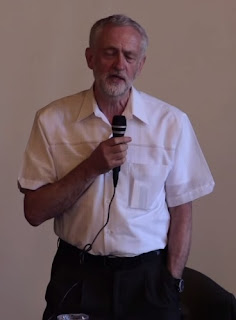
He and the rest of the left were increasingly isolated under Kinnock, then under John Smith and most notably under Tony Blair. Throughout, Corbyn could be found voting according to his conscience rather than following the whip.

When he got reported - which was seldom, for the media found nothing of interest in him - he tended to be speaking against party policy. 'Most people are not opposed to raising the top level of tax,' he said just before the 1997 election, even as Gordon Brown promised no income tax rises. 'And those who made lots of money under Thatcher should pay more.'

He was also attracted, and lent his weight, to any cause that seemed to be opposed to the British, American or Israeli states. This led him, and much of the left, into some very dubious company.

It also allowed some notable omissions. There's a revealing entry in one of Tony Benn's diaries in 1989 when he goes on a protest against the massacre of students in Tiananmen Square, and notes: 'It was the first time I had ever spoken in public against a communist government.' You have to say that he left it a bit late; this was only five months before the German people began to dismantle the Berlin Wall.

Corbyn's associations with groups like Sinn Fein/IRA and Hamas will undoubtedly come back to haunt him, should he be elected leader. And I don't think there's any mileage in the leftist argument that it's all about trying to find peaceful ways forward, because it's not true: the motivation was and is political, not humanitarian.

In the run-up to the 1992 election, Conservative Central Office commissioned an analysis of Labour MPs and their expressed support for 'extremist views'. It concluded that in joint first place were Bill Michie and Bob Parry, but Corbyn came in an honourable third place, level pegging with Harry Cohen and Dennis Skinner, and just ahead of Tony Banks, Eddie Loyden and Max Madden, followed by a further group of Harry Barnes, Tony Benn and Alice Mahon. (Congratulations, by the way, if you recognise all those names - you'll do well if they ever introduce a politics spin-off from Pointless.)

None of this has done Corbyn any harm in Islington North, where he is reckoned to be a good constituency MP. During his thirty-two years there, the constituency has changed completely, gentrified beyond recognition, but it's turned out that the newly arrived affluent liberals rather like him; he's become as much part of the Emirates era as he had once been of the Highbury years. The majority of 5,600 that he inherited had risen to over 21,000 by the election this May.

As the reforms of the Kinnock years became embedded, he warned that the abandonment of ideology was damaging Labour's membership. This is him in 1990:
People are not coming into the party, fewer people are coming to meetings, and there is a very low level of public activity in general. The party has not got a healthy base. It is all very shallow. We do our opinion polls, find out what people want and say, 'Okay, you can have it,' without asking what kind of society we have now, and what kind of society we want to replace it.
Just to make the point again that Corbyn was no inspiration as a wordsmith, compare this with Austin Mitchell's rather more striking formulation the previous year, saying that Labour had become: 'a mass party without members, an ideological crusade without an agreed ideology, a people's party cut off from the people.'

But Corbyn worked hard. And that work is reflected in his current standing. A lot of people have a great deal of respect for him, in trade unions and campaigning groups around the country, and particularly in London. There are also tens of thousands who marched with him on demonstrations over the years but who didn't stay the pace, and gave up on political activism, burnt out and disillusioned; many of these have returned to Labour in the last few weeks.

He is not the leader that anyone would have chosen. But, as I've discussed here before, he was the last man standing when the left decided it should try to field a candidate in the contest, in the seemingly absurd hope of having a say on the future direction of the party. And once he got up and running, it turned out that he had more support than anyone had imagined.

His effect on the campaign has been transformative, changing entirely the terms of the debate. And it has been for the better. This discussion - essentially over the legacy of New Labour - needed to be had, however painful and disagreeable it is. When he was leader, Ed Miliband was praised for keeping the party together, but it seems that he just delayed things for five years.

Corbyn himself has improved over these weeks. He's still no great speaker, but he looks like he's relaxing a little and consequently communicating better. He's developing some ability at handling the media that has never been apparent before. (Perhaps he's been getting tips off Ken Livingstone or Diane Abbott.)

Most importantly, he's found a winning formula, offering socialist authenticity as the man who never compromised his beliefs, but also indulging in terminology so vague that it might be mistaken for the theme song to Neighbours. Socialism, he says, is simple: 'You care for each other, you care for everybody, and everybody cares for everybody else. It's obvious, isn't it?'

Obvious perhaps, but still it's quite a long way from 'Fuck the rich'. Maybe the man's mellowing with age.

At the time of writing, Jeremy Corbyn is the clear favourite to be elected leader of the Labour Party next month. And that sentence represents, I think, the single most extraordinary political fact that I have ever recorded.


And that concludes my round-up of the four candidates for the Labour Party leadership, drawn - as ever - from newspaper reports. Tomorrow I shall stop procrastinating and decide who I should vote for.

* Additional note: After the 'fuck the rich' speech was repeated in Newsweek, following this post, a message was tweeted by the TimesArchive Twitter account:

Wednesday, 19 August 2015

Human till she talks: a portrait of Yvette Cooper

One of the standard jokes at the start of the current Labour leadership election was that Yvette Cooper's judgement has to be suspect: after all, she did marry Ed Balls. Not very funny, I know, and also deeply unfair, because on the plus side they chose Eastbourne for their wedding, she wore Vivienne Westwood for the ceremony, and they went to Euro-Disney for their honeymoon. Which deals with the lack of judgement charge.

In general, of course, it's unfair to reflect on a politician's partner, but in the case of the first husband and wife team to serve in a British cabinet, it's kind of inevitable. For nearly two decades, they've been seen as a single force. As a magazine pointed out in 1998, Cooper and Balls were 'New Labour's It Couple, the zenith of everything it stands for.' A Daily Telegraph profile of the pair the same year was headlined: 'Will this couple make it to Number 10?' Or, as the Guardian put it, they were 'the Posh and Becks of the Labour Party'.

Born in 1969, Yvette Cooper studied PPE at Oxford and went on to become an adviser to John Smith and to Harriet Harman. (My apologies for the repetitions in this series of portraits, but there really is a shocking lack of variation in the backgrounds of the candidates.)

She also worked for a while in journalism, as a leader writer and as the economics correspondent for the Independent. She was perfectly okay, and occasionally wandered out of her field. This is her on the supposed crisis in masculinity that was such a big media deal in the 1990s:
The only thing these men really have to adjust to is change itself. No, they can't have a job for life anymore. But so what? Few women ever had one. And no, they can't invest their entire identity in the firm they work for: the company might not be there in two years. And if they are too frit to visit their GPs they had better reconcile themselves to early avoidable death.
No tolerance for the nanny state here, then; you sink or swim according to your own efforts.

Her articles tended to be broadly supportive of the Labour Party in opposition, but even she struggled to put a positive gloss on Tony Blair at times, and had to concede that his borrowing of Will Hutton's 'stakeholding' concept was little more than, in her word, 'waffly'.

Her ambitions, however, lay in Parliament not Fleet Street. Under the patronage of Gordon Brown, she attempted to become the candidate for the safe seat of Don Valley, where she lost out to Caroline Flint, before securing the nomination for the even safer Pontefract & Castleford, where she beat both Hilary Benn and Derek Scott (Tony Blair's economic adviser, who later wrote Off Whitehall).

She was one of ten Labour MPs elected in the 1997 landslide who were still in their twenties, and was clearly marked out for early advancement.

When Brown announced that he was handing over control of interest rates to the Bank of England, it was Cooper - just four days into her parliamentary career - who was sent onto Newsnight to defend the move to Jeremy Paxman. 'With that one step,' she wrote, 'the government has done more to achieve economic stability than anything any British government has done for years.' She brushed aside suggestions that the move was an affront to democracy: in characteristic New Labour style, managerialism was more important than politics.

Shortly after the election, Cooper and Balls - the archetypal North London couple - moved from Hackney to the New Labour heartland of Islington, though they later moved again, this time to upwardly mobile Stoke Newington. For expenses purposes, this was, of course, their second home, entitling them to a subsidised mortgage. When such things began to provoke outrage, it was reported that between them they had 'racked up more than £300,000 in expenses' in 2006-07, considerably above the national average for MPs.

From a whip's perspective, her behaviour in Parliament was exemplary, largely - one suspects - because she was a genuine believer in the Blair-Brown 'project'. The Demon Ears column in the Observer concluded that she 'isn't that bad for a New Labour MP, even though she does dream on message'.

By October 1998 she was being offered a minor government post, though she turned it down in favour of remaining a member of the intelligence and security committee. It proved to be only a short delay: the following year she took on the public health portfolio, becoming the youngest minister in Blair's administration. She then went on to become the first minister to say she'd once smoked pot and, admirably, didn't claim not to have liked it: 'I did try cannabis while at university, like a lot of students at that time, and it is something that I have left behind.'

In her new role she was partly responsible for the cross-departmental project Sure Start, widely seen as one of the better initiatives of New Labour. Its fanbase was wide enough to include, slightly oddly, a children's TV favourite: 'Peppa Pig is a well-known fan of Sure Start children's centres,' it was revealed in 2010.

Less successful was the idea of a crusade against teenage pregnancies under the slogan 'It's OK to be a virgin'. Cooper had sufficient political nous to reject that in favour of 'a straightforward campaign which gives teenagers the facts and is aimed as much at boys as at girls'.

She moved to the Lord Chancellor's department in 2002, then to environment, transport and the regions, where she became minister of state for housing and planning.

The latter portfolio did not count among New Labour's great achievements: during Blair and Brown's period in office, an average of 562 council homes were built each year, compared to the annual average of 41,343 during Margaret Thatcher's premiership.

Cooper did little to improve this woeful record, but she did do some things. She relaxed the regulations on householders installing small windmills and solar panels, and she piloted the chaotic introduction of Home Information Packs. She also faced criticism for allowing more house-building on flood plains. And she suggested that middle-aged couples in social housing should be encouraged to move out of cities when their children left home, to free up housing stock. Her concern here was over 'underoccupied' social housing, an issue later addressed - in somewhat more heavy-handed manner - by the Coalition government's bedroom tax.

When Gordon Brown became prime minister, she remained as housing minister but was given a new right to attend cabinet meetings, and then, in 2008, she made the cabinet proper as chief secretary to the Treasury. Just in time for the credit crunch, though happily she didn't stay very long. As Brown's government descended into a farce of resignations, her loyalty was rewarded with a further promotion, and she served out the rest of the New Labour years as work and pensions secretary, inheriting the agenda set by her predecessor James Purnell.

She spent most of the Ed Miliband era as shadow home secretary, one of the easiest jobs in politics, since there's always something going wrong in the Home Office to provide you with ammunition. This was, famously, where Tony Blair had made his name in 1992-94 in his 'tough on crime' days. But Cooper failed completely to make the same kind of impact and was largely invisible. 'Home secretary Theresa May was fighting for her political life last night as she was engulfed by the border checks scandal,' read the papers in 2011, but Cooper failed to exploit the situation, and of the two you'd probably bet on May being the one to make it to prime minister.

Perhaps, though, that job was a waste of her talent, which is much more obviously focussed on the economy. As shadow chancellor, she would have made a trickier opponent for George Osborne than did her husband.

Beyond economic matters, there has been much talk of women's issues, though sometimes this has been seen as being somewhat narrow in scope. Arguing, for example, in support of cuts to single-parent benefits in 1997, she displayed little interest in those who wished to concentrate on parenthood: 'It's a question of priorities. If we put resources into childcare and helping people back to work, we will raise the standard of living for the poorest.'

Similarly, she has repeatedly claimed over the last few years that 'David Cameron has a real problem with women'. This is an over-simplification, seeming to imply that women can be seen as a homogenous, metropolitan, professional block, somewhat in the image of Cooper herself.

The reality is that age is as big a factor as gender. At the election this year, according to Ipsos-Mori, Labour had a 20-percentage-point lead over the Conservatives among women aged 18-24, but trailed by 18 points among women over the age of 55. Unfortunately for Labour, which clearly has a real problem with older women, there are considerably more of them, and they're more likely to vote.

Cooper considered standing for the leadership in 2010, and Balls said that if she did so, he wouldn't stand himself. She decided against it, however, because she wanted to spend more time with her children. Five years on, and it was inevitable that she would be a candidate. By any normal standards, she really ought to be the front-runner, the one that the others have to beat. But that's not how it's worked out.

In 1997 she condemned - with complete justification - the Conservatives for their remoteness: 'They took politics far away from normal people's lives.' She points, with some justification, to Sure Start as her contribution to changing that, but as a politician, she herself doesn't seem to connect. There's something that isn't quite right. Perhaps Simon Hattenstone put his finger on it in the Guardian in 2010. 'It's funny that Cooper seems so human till she starts to talk,' he wrote, 'while Balls seems so monstrous till he starts.'


This is the third in a series of profiles of the four candidates in the Labour Party leadership election. Yesterday: Liz Kendall. Tomorrow: Jeremy Corbyn.

Tuesday, 18 August 2015

Her Majesty's Loyal Opposition

The word that keeps coming up in the profiles I'm writing of the Labour candidates is 'loyal'. Of the nine candidates for the leadership and deputy leadership, eight have repeatedly been described as loyal. And in this context, loyalty means voting as the whips tell you. By contrast, the ninth candidate is Jeremy Corbyn, best known for ignoring the party whip on hundreds of occasions, and therefore being disloyal.

But this is a very limited version of loyalty. Traditionally, it was loyalty to the party that was cherished, rather than simply walking into the right lobby at Westminster. And, traditionally, it's been the political right that has been far less loyal than has the left or the trade unions.

The clearest example was the creation of the SDP in 1981, led by Roy Jenkins (who'd previously led the great parliamentary rebellion to ensure British entry into the European Community). When the right had control of the party, the left went along with it, even if they did grumble and moan. As soon as the left seemed to be in the ascendancy, the intellectual right split from Labour altogether.

The arrival of the New Labour right added a new dimension. Tony Blair, Gordon Brown and Peter Mandelson simply plotted endlessly. Blair tried to get John Smith to stage a leadership coup against Neil Kinnock. Then, when Smith did become leader, Blair and Mandelson schemed against him as well. And eventually, they all descended into plotting against each other. Despite the supposed iron discipline of New Labour, there was no loyalty at all to individuals, leaders or the party.

Jeremy Corbyn, on the other hand, has been an MP for thirty-two years, for perhaps thirty of which he has been in a beleaguered minority. He may not have always done what he was told, but he never threatened to leave if he didn't get his own way, and he has never (as far as I'm aware) plotted to stage a coup against the leadership.

This is relevant, of course, in terms of the current leadership election. Should anyone but Corbyn win, there will be demands for unity, discipline and loyalty. Should Corbyn win, don't expect the right to display any loyalty whatsoever.

You don't give up: a portrait of Liz Kendall

When Liz Kendall was asked recently if she would step down from the Labour leadership election in an attempt to unify the anti-Jeremy Corbyn forces, she bristled at the very suggestion. 'You don't give up fighting for what you believe in,' she insisted. 'I love the party too much to see us lose again.' The echoes of Hugh Gaitskell's 'Fight, fight and fight again' were presumably not unconscious.

Born in 1971, Liz Kendall (not to be confused with the similarly named girlfriend of American serial killer Ted Bundy) studied history at Cambridge. She then followed the conventional path and - like David Miliband and James Purnell - went to work for the Institute for Public Policy Research, one of the many left-wing think tanks of the time that between them produced more ministers manqué than government initiatives.

While there, she co-wrote a 1994 pamphlet on the virtue of citizens' juries, a kind of state-approved focus group that would 'bring the voice and experience of ordinary citizens into the political process'. It was a neat idea for expanding democracy, borrowed from Germany, but of course it never materialised, and I can't find a reference to it in the last twenty years.

As soon as Labour was elected in 1997, she was recruited to become a special adviser (alongside John McTernan) to Harriet Harman at the department of social security, where she concentrated 'on women's issues especially lone mothers'. Unfortunately, it was a cut to single parent benefits, ordered by Downing Street, that precipitated the first great rebellion of the Tony Blair government, and cost Harman her job. Kendall left Whitehall at the same time and went back to the IPPR and to work in the charity sector.

She was put on the national list of candidates, but failed to secure the nomination to succeed Tony Benn in Chesterfield, where the Labour candidate was, said the Guardian, 'virtually guaranteed a seat in Parliament' in the 2001 election. (Actually it fell to the Liberal Democrats.)

She moved on to the charity Maternity Alliance and became in due course a special adviser to the health secretary, Patricia Hewitt, perhaps the only politician to be name-checked in a David Bowie song (in 'The Gospel According to Tony Day', the 1967 B-side to 'The Laughing Gnome').

In 2010 she was finally elected to the House of Commons, taking over Hewitt's old seat in Leicester West. She was thirty-eight, which by New Labour standards was getting on a bit, but she was singled out by John Curtice in the Sunday Telegraph as one of the party's rising stars of the new Parliament, along with Tristram Hunt, Rachel Reeves, Chuka Umuna and Gloria De Piero.

She did have a position under Ed Miliband, as shadow spokesperson for care and older people, but you'd be hard pushed to notice her make any public impact. Nonetheless, when Miliband resigned following his election disaster in May, she was the first to declare her candidacy, the speed of her decision seeming to wrongfoot others who might be considered to be on the Blairite wing of the party.

She herself, for obvious reasons, tends to disown the Blairite tag, but there is something in it. As Blair himself admitted, he never came close to completing his public sector reforms, to achieving a reorientation towards users; Kendall talks a strong case on the subject. She's also spoken of the need to meet the Nato target of 2 per cent of GDP to be allocated to defence. And she's almost as harsh on Jeremy Corbyn as Blair himself, suggesting that, even if he were to win the leadership, she wouldn't want to see him as prime minister.

The implication of that, of course, is that she would rather see a Conservative government than a Corbynite Labour one. And that has attracted a great deal of abuse from the left. It is, though, a legitimate argument for any but the most tribal. If you believe that it is essential to have a strong economy in order to provide public services, and if you believe that Corbyn would severely damage the nation's economy, then it is logical to conclude that you'd rather wait your turn, in the expectation that there would still be something worth taking over in five years time.

If that seems silly, then it's indicative of the foolishness of the current party alignment. Somewhere, in a parallel universe, the Tories lost the general election badly and Bill Cash is currently the front-runner to become Conservative leader. He's a man of principle, not afraid to speak his mind, offers hope for the future, at least you know what he believes in etc etc. And Ken Clarke and Michael Heseltine are issuing statements that he'd rather see a pro-EU Labour government than for their own party to win under Cash.

Since her abrupt arrival on centre stage, Kendall has been profiled often enough in the papers for us to learn that she went to school with Geri Halliwell, that she's a fan of Public Enemy, Dr Dre and Eminem, that's she's a keen runner, and that she had a lengthy relationship with the comedian Greg Davies. None of which has done a single thing to project a personality, or to change the public perception of her as something of an enigma: someone who clearly wishes to be the leader, but exhibits no obvious sign of leadership.

In person, it's acknowledged, she is warm and charismatic. (Mind you, that's what they always said about Ed Miliband, as well.) She is also reckoned to be extremely determined, steely and committed, though this hasn't come across at all in the hustings thus far. Presumably, however, it explains why she considered it appropriate to stand for the leadership at all, with only five years in Parliament behind her and no time in government.

In that lack of experience, as in much else, she resembles nothing so much as a Labour version of David Cameron. Both have the same desire to accept aspects of the modern world that don't sit easily with traditionalists in their parties, in her case in relation to the public sector and social security. And perhaps if Kendall were in the same position as Cameron in 2005 - if her party were coming off the back of three election defeats, rather than just the two - she might have been better heard and made more impact.

But that's not where Labour is right now and, though she may well be back, it wouldn't be surprising if she left Parliament altogether. She could probably have far more impact campaigning outside than she would in a shadow cabinet led by Yvette Cooper, and certainly more than she would grimacing on the backbenches behind Jeremy Corbyn.

In 1974 Margaret Stewart wrote a fine book titled Protest or Power? A Study of the Labour Party. In that divide, there is little doubt about which side Kendall stands on.


This is the second in a series of profiles of the four candidates in the Labour Party leadership election. Yesterday: Andy Burnham. Tomorrow: Yvette Cooper.

Sunday, 16 August 2015

A throw of the dice

Throughout this Labour leadership contest, I've been predicting a victory for Yvette Cooper. Indeed I was predicting it in April before the general election. I don't like to change my predictions, so I won't. Despite everything, Yvette Cooper will become the leader of the Labour Party.

I am aware, however, that this is - to put it mildly - a minority position. And that I have no evidence for it whatsoever.

In fact, if I'd been paying attention to myself, I would have concluded that Jeremy Corbyn, currently the red-hot favourite, was the likely winner. 'New political forces will emerge, whether within the existing parties or outside of them,' I wrote in 2012; 'things are about to change quite radically.' I added last year that UKIP weren't that change. But maybe Corbyn is the catalyst for this change.

So let's assume that that I'm as wrong now as I was when I placed money on Peter Hain succeeding Tony Blair, the issue is whether Corbyn will be any good as leader.

There are three basic tasks for the opposition. First, that they oppose government policies by producing alternatives. Second, that those alternatives change the terms of the debate. Third, that by changing the debate, there comes at least a reasonable chance of winning the next election.

The first is where things have really gone wrong for the Labour establishment. Losing the election was disastrous, but Harriet Harman's call for MPs to abstain on welfare reform added insult to injury. It smacked of democratic centralism, implying that since the Tories had won the election, then their policies had to be accepted. The decision to abstain made no difference whatsoever to the outcome of the vote, but Harman has been around long enough that she should have got the grasp of symbolic gestures by now. And yet she blew it, and no other single event has done as much to strengthen Corbyn's cause.

Frankly, Corbyn couldn't make a worse fist of opposition than Harman already has.

His MPs, however, could make it much, much worse. If a significant number of them effectively refuse to accept the party's vote, then he will fail from the outset. And they may well do so. They could quote Tony Benn at a meeting of the shadow cabinet in 1970: 'When the boat is sunk, you can't exactly rock it.'

Assuming, though, that he could assert his authority of the parliamentary party, could Corbyn re-frame the national debate? Yes. Is it likely? No. He would have the entire media against him; not just the usual suspects, but the whole of what some like to call the legacy media.

And maybe in there is the hope: that social media and the revival of public meetings can bypass the newspapers and the broadcasters. Maybe Facebook and The Trews will eclipse the Daily Mail and the Ten O'Clock News as the source of political information. I'm not convinced. Not in the short-term. So it would require an active mass membership - in real life, not on the internet - to counteract media hostility. Again I'm not convinced. Nor do I see any sign of Corbyn supporters seeking to persuade, rather than to assert.

Could he offer the possibility of an election win? Well, very probably not. But honestly, you never really know. Labour winning in 2020 is such an uphill task anyway. Someone on Twitter (I apologise for forgetting who - let me know it was you) suggested that, if this were a dice game, Labour needed to throw a six to win, and that Andy Burnham, Yvette Cooper and Liz Kendall could only manage threes and fours. Corbyn, on the other hand, offered the chance of either a one or a six.

Maybe. It is possible that Corbyn (Corbyn, of all people!) could build a People's Army that would massively outnumber Nigel Farage's following, a crusade that stretches far beyond Parliament. How this works within the existing Labour Party structure, however, I have no idea.

I have a fear that a Corbyn-led Labour might echo the miners' strike of 1984-85. There sprang up then a national network of support groups that was really quite extraordinary. It was, said the Financial Times, 'the biggest and most continuous civilian mobilisation since the Second World War'.

If you were involved, even in a peripheral way, with this movement, it was almost impossible to credit the opinion polls which showed the majority of the public firmly on the side of the government and against the NUM. But that was the reality. Most people didn't support the miners, and the result was one of the left's most celebrated of heroic defeats.


Back before Corbyn declared himself a candidate, I wrote: 'The task of choosing a new leader is to find someone who can articulate a sense of hope for the future, to persuade somewhere around a quarter of the electorate that he or she can help us build a better society.'

At the moment, there's only one candidate who's being seen in those terms. But I suspect there's only one six on his die (if that) and that the other faces are all ones. And I fear that Labour might actually need a double-six anyway.

I have yet to decide who to vote for. Over the course of the next week, I shall look back over the careers of the four candidates as a way of clarifying that question for myself. And I shall start tomorrow with Andy Burnham.

Saturday, 15 August 2015

The Labour deputy leadership

Where do we stand in the Labour Party deputy leadership election? Having spent some time wandering through the newspapers and around the internet, looking at the careers of the candidates, I now have to decide who to vote for.

These are the runners, pictured from left to right: Caroline Flint (age 53), Angela Eagle (54), Ben Bradshaw (54), Tom Watson (48) and Stella Creasy (38).


So what can we say about these five? Well, first, that they don't actually make for a bad field, and second, that they do have a great deal in common.

In particular, they're all unashamedly professional politicians, with only Bradshaw's previous incarnation as a radio reporter departing from the normal career path. (And that wasn't straying too far: the separation between media and politics was barely discernible in the 1990s.) Their time in Parliament has mostly been characterised by loyalty, though Watson and Flint did separately resign from government, seemingly in would-be coups aimed against, respectively, Tony Blair and Gordon Brown. And all are, insofar as such distinctions mean anything any more, on what would have been see as the right of the party in the 1980s. At least, though, they were all educated at different universities.

Given that the deputy leadership position is not of the greatest significance - Denis Healey once said it was worth only 'a pitcherful of warm spit' - perhaps one shouldn't spend too long deliberating. Apart from anything else, it's hard to see the final choice really attracting much attention, given the Jeremy Corbyn story that'll be breaking one way or another at the same time.

But still, it does matter. At the very least, it 'sends a signal', as politicians like to say. And in the context of the Corbyn story, the signal might actually mean a little more than usual this time.

A victory for Bradshaw or Flint would indicate that the smooth operators are still with us. And I don't think that's where the Labour Party should be heading. They're the kind of politicians who remind me of a great line in one of Hugh Trevor-Roper's letters: 'In general, actors have no minds, only memories and poses.'

Elsewhere, I struggle to see Watson as anything other than a burly bruiser with authoritarian tendencies. Again, he seems to me to represent a politics that Labour should be leaving behind.

But both Eagle and Creasy are good, strong candidates. Electing either one would send a strong signal that Labour is a serious, radical party.

Judging entirely by media coverage (which is all I have), I'm impressed by Eagle's consistency, commitment and decency. I know she studied PPE at Oxford, and Lord knows we've had more than enough of them in recent times, but sometimes we have to overlook youthful mistakes. More importantly, she's retained an unusual degree of individuality for someone who navigated the New Labour years more or less successfully. Maybe it's the early role models standing her in good stead; when asked her favourite book, she rather splendidly nominated Mae West's autobiography Goodness Had Nothing to Do With It.

It's hard to resist that, and I hope Eagle gets a very senior position in the new shadow cabinet. But as my first choice for deputy leader, I think I've concluded that Stella Creasy is the better option, for the following reason.

One of the great myths peddled by Blair was that the Labour Party could achieve nothing unless it were in government. He was wrong. And since the Labour Party has spent most of its existence in opposition, and there's a good chance that the next decade will add to that record, it's important to recognise that he was wrong.

At its best, the Labour Party has been able to transform people's lives at the grassroots, even when it hasn't occupied Downing Street. It was built on a sense of mutuality and community self-help, the sense that, in Harold Wilson's words: 'The Labour Party is a moral crusade or it is nothing.' Many of the old traditions have died, of course, victims of affluence and neglect. But if the party is to have any hope of rebuilding, it needs to do so from the ground up, rediscovering the fact that power is not the preserve of Westminster.

Creasy seems to me to be the one who sees that most clearly, and has thought most carefully about the future. And, talking of signals, I like the fact that she is one of only twenty-four Labour and Co-operative MPs, having been endorsed by both parties.

She is, of course, absurdly young, and has little experience of life or parliament and none whatsoever of government. But she does at least look as though she's ready for the long haul, and will still be there on the other side.


This concludes my look at the deputy leadership candidates. Next week I shall go through the leadership hopefuls to try to work out who to vote for in that election.

Friday, 14 August 2015

An indie kid: a portrait of Stella Creasy

'She's incredibly impressive,' according to one anonymous Labour MP. 'The problem is that she lets everyone know that she thinks she's incredibly impressive.'

Born in 1977, the child of a head teacher and an opera singer, Stella Creasy later attributed her youthful interest in politics to the family's move to Colchester when she was fourteen years old. 'It was a big shock for me to move from Manchester, which was very nice, liberal and middle class, to small-town Essex and have people who suddenly didn't agree that we needed to do more to help people and that poverty was a bad thing.'

Thus began her unlikely crusade to convert the Thatcherite working class of the South to the community spirit of the Northern middle class. She joined the Labour Party and while still at Cambridge University (where she studied social and political sciences) stood for election to Colchester council. She failed that time, but went on to be elected as the youngest councillor in Walham Forest. By the age of twenty-five she was deputy mayor of the borough.

She insisted that she was fully committed to fighting for her beliefs in local government: 'If I'm going to make a difference,' she said, 'it will be at the town hall.' But she kept her networking options open, just in case, by working as an adviser in Westminster for Douglas Alexander and Charles Clarke. And in 2009, now with a doctorate in psychology from the London School of Economics, she was selected to inherit the safe parliamentary seat of Walthamstow. She was already being referred to in the press as 'a career politician'.

Duly elected in 2010, she was swiftly identified as being 'tribal, loyal and dogged' and having 'the ambition and the hidden wiring to go far'. Certainly she demonstrated an impressive ability to generate media coverage, helped by her own extensive use of Twitter.

Indeed it was Twitter that brought her to many people's attention. In 2013 she called for the website to take firmer action when users were abused, particularly when women were threatened with sexual violence. This was in response to a sustained assault on a female journalist, but Creasy's intervention ensured that she too was soon receiving tweets threatening her with rape and death.

She was seen early on by journalists and broadcasters as a Labour equivalent of Louise Mensch: young, media-friendly and articulate, particularly good when you needed a comment on issues relating to women in public life.

So when David Cameron appropriated the language of a television commercial and told Angela Eagle to 'calm down, dear' in the Commons, Creasy was quick out of the blocks. 'His saying "calm down, dear" is symptomatic of a culture in which the contribution of women isn't valued but dismissed. We'll all be better for it when women don't "calm down" but get stuck in to helping change the world.'

The rent-a-quote image was unfortunate, because Creasy is much better than might be suggested by hackneyed platitudes fed to a grateful media. She's a serious politician, whose thinking and values evoke an old version of Labour - the version that emphasised voluntary societies, cooperatives and workers' education groups, the one that celebrated collective endeavour and mutual help.

Her most impressive contribution as a newly elected MP, for example, was taking an early lead in the campaign to regulate payday loans companies - but she did so by trumpeting the virtues of credit unions as an alternative. She argues more persuasively than most about the need for a democracy of participation.

In what may be the least likely political comparison you'll read this month, she reminds me a little of Frank Field, though obviously without the awkward, austere nature that has made him such a difficult figure. But there is something there of the willingness to find new solutions and of the restless campaigning spirit. 'I absolutely want to change the world,' she said. 'That's why I do politics, that's why I got involved.'

Elsewhere, the newspaper profiles told us, she supports Manchester United, thinks Fifty Shades of Grey was 'boring and repetitive', and has an absurdly exaggerated estimation of the music of the Wedding Present. 'I'm a bit of an indie kid,' she says: 'I get right down in the mosh pit when I go to gigs.'

With only five years in Parliament, and at the age of just thirty-eight, she has far less experience than her rivals for the deputy leadership. Even so, no one was much surprised when she put herself forward as a candidate. It seemed such a natural career move for a politician who The Times described as coming 'from Labour central casting'.


This is the last in a series of posts looking at each of the candidates in the current elections for deputy leader of the Labour Party , with portraits drawn entirely from their media coverage. Tomorrow I shall decide who to vote for.

Thursday, 13 August 2015

Little Goody Two-Shoes: a portrait of Ben Bradshaw

Denis Healey once said of David Owen: 'The good fairies gave the young doctor almost everything: thick dark locks, matinee idol features, a lightning intelligence. Unfortunately the bad fairy also made him a shit.' Much the same could be said of Ben Bradshaw, except for the doctor bit. And, of course, the bit about him being a shit.

Bradshaw was born in London in 1960 and studied German at Sussex University. Following a brief time in print media, he moved into radio broadcasting, where he became the BBC correspondent in Berlin at the end of the 1980s, just as the Wall came tumbling down. He was very good and he was clearly seen as a rising star of Radio 4; by the mid-1990s he had started to get slots as the stand-in presenter on shows like PM and Weekend World.

Seeking a constituency for the forthcoming election, he was adopted by the Exeter Labour Party, despite telling the selection committee that he was gay. This was at a time when attitudes were noticeably changing, but culturally there was still a long way to go before homosexuality was widely accepted. Legally, the situation was worse: civil partnerships, let alone same-sex marriages, were a pipe-dream, and the age of consent for male homosexuals was eighteen.

And politically it was all very risky - both for Bradshaw to tell the local party and for them to choose him anyway. No candidate who had previously declared their homosexuality had ever been elected to Parliament. 'It is not something I am going to make an issue of,' Bradshaw told the press, 'but I am not so naive that I do not think others may do so.'

He was right. The local Conservative Party chairman greeted his selection with a sorrowful shake of the head: 'It would be a sad day for Exeter if it ever elected an active homosexual as its MP.' The Tory candidate, Dr Adrian Rogers, was a Christian GP who had already made his position clear, denouncing homosexuality as 'a sterile, disease-ridden and God-forsaken occupation'.

Bradshaw's sexuality was therefore a big local issue as the election approached. So too was the fact that the BBC gave him five months paid leave from his job on The World at One to campaign, though the criticism this attracted was somewhat derailed by Rogers's comments on the corporation: 'there are far too many homosexuals in the BBC'.

The slightly unpleasant tenor of the campaign meant there was considerable rejoicing when, in the great Labour victory of 1997, Bradshaw recorded a 12.5 per cent swing to take Exeter from the Tories with a substantial 11,000 majority. That margin has since fallen a little, but the city remains a safe Labour seat in a part of the country where the party is not naturally strong.

Bradshaw demonstrated a commitment to gay rights that ran ahead of the party leadership, so that in 2000 - when it seemed as though the government was backing out of its commitment to repeal Section 28 - he spoke out, saying 'that he had never seen so much anger in the Parliamentary Labour Party'. He might even have been ahead of the curve in other areas as well: 'Cyclists have a right to be pious,' he declared, somewhat piously. 'They cut congestion, cut pollution and cut costs to the NHS by staying fit.'

There were also less obvious positions, such as the issue of repatriation of art treasures. When Labour MP Bernie Grant asked Exeter's museum to return objects that came originally from the African kingdom of Benin (now in Nigeria), Bradshaw was forthright in his response: 'We are not going to send these treasures back - particularly not to a country governed by such an odious dictatorship as Nigeria. Their human rights record is appalling.'

Mostly, though, he became known in Parliament for not rocking the boat. He was allegedly referred to by Alastair Campbell as 'Little Goody Two-Shoes', while the Guardian called him a 'Hugh Grant lookalike turned ultra-loyal Blairite'. He had, wrote Edward Pearce in the Express, 'the distinct look of a teenage seraph on the make'.


In July 2001, following Tony Blair's second victory, Bradshaw was given a ministerial job in the Foreign Office, again raising some eyebrows, since he would be dealing with the Middle East, not a region noted for its enthusiastic embrace of homosexuality. In fact, though, the most contentious issue turned out to be his robust defence in 2002 of the Guantanamo Bay detention camp, insisting that conditions there were perfectly humane, and saying of the suspects who were being detained without trial: 'we are talking about some of the most dangerous men in the world'.

He was similarly bullish the following year when he joined the government's assault on his old employers at BBC Radio 4. The station had covered Dr David Kelly's revelations about the abuse of intelligence reports in the run-up to the invasion of Iraq, and had brought the wrath of the government down upon its head. Bradshaw was a minor, though notable, player in the campaign to re-position the story, making it about insignificant detail rather than the broad picture.

He went on to become deputy leader of the House of Commons, and then minister for, successively, the environment, the South-West and health, before ending up as secretary of state for culture, media and sport for the final year of Gordon Brown's premiership.

On taking up the latter position, he was asked to list his favourite cultural works. He selected Casablanca (for some reason it's the most cliched film choice for a politician), Bob Marley's Kaya (that's the non-political one), Michelangelo's David and Thomas Hardy's Tess of the d'Urbevilles (well, it was the Western Morning News who were asking).

During his time in government, there were some difficult issues to be faced: Britain's involvement in the arms trade, the badger cull, bird flu, the BBC licence fee, the fact that Jeremy Hunt, as the Tory shadow culture spokesperson, got a better press than he did. There were also some odd moments of his own making, such as the time when, during a shortage of NHS dentists, he suggested going to see your GP about your teeth instead.

But none of this seemed to cause him any great harm or even discomfort. Indeed, nothing ever seems to do so.

His public persona is one of apparently relentless good humour and absurd optimism, a determination to accentuate the positive that sometimes veers towards Pollyanna-ism. He even found a silver lining to the credit crunch; he wasn't arguing, he said, 'that a recession is good for people's health, but on issues like mental health, more men go and see their GPs if they are unemployed'.

Similarly, when Labour lost the safe of Norwich North in a 2009 by-election on a 16.5 per cent swing to the Tories, Bradshaw admitted that it was 'disappointing', but also 'said that the result did not appear to be as disastrous as Labour's loss of Crewe & Nantwich to the Tories and Glasgow East to the SNP last year'. (Just for the record: Labour did manage to regain Glasgow East in 2010, but has since lost it again, while the others have remained Tory through two subsequent elections.)

It's hard sometimes to identify quite what it is that Bradshaw stands for or what he has done, and equally hard to see that his career has been better spent in Parliament than it would have been on Radio 4. But he always seems very personable and, in some undefined way, quite important.

In 2000 the Independent on Sunday launched its Pink List, listing alphabetically the fifty most influential gay and lesbian people in Britain, and Bradshaw was included (as was his deputy leadership rival Angela Eagle). In later years, the names were ranked in order of significance, so that we could track his rising significance: in 2005 he stood at #69, moving up every year till he hit the top ten in 2009, the same year he was named Stonewall Politician of the Year. But political fortunes are never secure, and after Labour lost power he found himself plunging down to a lowly #82 in 2011.

Perhaps the highest accolade of his career thus far, however, came earlier this year, when this blog suggested he should go for the leadership of the Labour Party. The reasoning was simple: 'he's by far the best dressed MP of any party.'


This is the fourth of a series of posts in which - unless I fall by the wayside - I shall be looking at each of the candidates in the current Labour Party elections for leader and deputy leader, with portraits drawn entirely from their media coverage. Tomorrow: Stella Creasy.