Voting on the leadership and deputy-leadership of the Labour Party has just closed. And, as an interim guide to form, I've checked up on the traffic generated on this blog by the portraits I wrote of the various candidates. There are, it has to be said, no surprises.
The share of the total number of page views achieved by each candidate is as follows:
Leader:
Jeremy Corbyn 58%
Andy Burnham 15%
Yvette Cooper 14%
Liz Kendall 13%
Deputy leader:
Angela Eagle 28%
Stella Creasy 26%
Caroline Flint 18%
Tom Watson 16%
Ben Bradshaw 13%
The order in the leadership category reflects the result that pretty much everyone expects, though I want to put on record one last time my dissenting view: I still think Yvette Cooper is going to win. I'm not sure what conventional wisdom says about the deputy leadership, but I believe Tom Watson is still favourite.
If it goes to form, then, by this time on Saturday, the Labour Party will be led by Jeremy Corbyn and Tom Watson, two white men with an average age of 57, who both came into politics as unelected advisers to trade unions. Let no one say that the party hasn't embraced modern Britain in all its wondrous diversity.
Showing posts with label Andy Burnham. Show all posts
Showing posts with label Andy Burnham. Show all posts
Thursday, 10 September 2015

Friday, 21 August 2015
The Labour leadership
Should I have the right to vote in the Labour leadership election? I've never been a member of the party. I have voted for it on several occasions, but then on other occasions I've voted for around half-a-dozen other parties, plus a couple of independents. It's not just that I'm not tribal; it's that I wouldn't actually call myself a Labour supporter.
But that's what I am now. I paid my three quid and I'm officially a registered supporter of the Labour Party. I had to declare that I agreed with the aims and values of the party, of course, but that wasn't too hard, since the new Clause IV introduced by Blair was deliberately mushy and meaningless. Do I approve of a world 'where we live together, freely, in a spirit of solidarity, tolerance and respect'. Yes, that sounds quite agreeable. Who's going to argue? (Apart from the likes of Nick Griffin, Robert Mugabe and Donald Trump.)
So it turns out that I do have the right to vote. Morally and politically, Labour may have been daft to sell me that right, but I've got it now. And I'm doing my best to use it dutifully, because - as Clause IV says - 'the rights we enjoy reflect the duties we owe'. And I've promised Labour that I'm in agreement with that.
I'm taking this vote seriously. Over the last fortnight I've written around fifteen thousand words as I've worked my way through newspaper archives, trying to get a clearer picture first of each of the candidates for deputy leader, and now those contesting the leadership: Liz Kendall, Yvette Cooper, Andy Burnham and Jeremy Corbyn.

My aim has been to identify the candidates who I think are best for the Labour Party. Not, you'll notice, for the country. And certainly not for me.
Because I'm shallow and easily bored. I like to see Westminster as a soap opera and I like big storylines.
In an ideal world, my preference is for all four of the major national parties to break up and to regroup in a different arrangement. The current set-up isn't working. Better than that, I'd like to see proportional representation so that we could have more parties, For a start, in my new improved system, there'd be four Labour parties, one each for Scotland, Wales, England and London.
But that's not on offer. And anyway I think it would be dishonest and dishonourable of me to abuse my place as a guest of the party by trying to trash the place. So I shall be respectful, and be guided by the consideration of who will stand the best chance of helping Labour rebuild and go on to contest a general election.
Not that I think any of them are in with much of a shout of winning in 2020, so steep are the odds against the party. But denying the Tories a majority is well within Labour's grasp, and even a minority government is a reasonable aspiration.
In that process, I don't believe that policy is particularly important. Broad direction and philosophy count, but detailed policies don't.
And, one final consideration, I know that it's not a very inspiring slate of candidates. As I've said before, it's probably the worst in my lifetime - worse even than in 2007, when there was only one name on the ballot paper and that belonged to Gordon Brown.
But still, despite all the limitations, despite everything, a choice has to be made.
And my decision is that I shall cast my vote for Liz Kendall.
Which has come as a surprise to me. She was probably in third place in my mind when the deadline for nominations arrived. But the more I think about the state of the party, the more I think that she's the only one who might stand a chance of winning the seats that Labour needs to win.
She's ludicrously inexperienced and has yet to display the kind of leadership that she would need, but I think she has the potential to do so. Certainly she seems to be the only one capable of thinking new thoughts and arguing for a new position. Neither Burnham nor Cooper have distinguished themselves in this campaign.
The only other serious candidate is, bizarrely, Jeremy Corbyn. Not for anything he's done, more for the campaign that has grown up around him. There is an argument to be made that he stands far and away the best chance of bringing back some nationalist voters - those who opted for UKIP or the SNP in the general election - and might get a few Greens on board. There might also be a rise in turnout in safe Labour seats. Those new recruits, however, would, I'm convinced, be massively outweighed by a voting collapse in the South and the Midlands, precisely the areas where Kendall would be strong.
I don't believe that the surge in membership is stable or sustainable, and I suspect most of the new recruits will melt away regardless of the outcome of this election. Nor have I seen any evidence that Corbyn's supporters have the ability, or even inclination, to persuade doubters. There is also the impression of disunity that would be given by Corbyn's parliamentary colleagues. This may not be the direct consequence of Corbyn's actions, but it is the political reality. And I cannot see how he could command support in the country if he couldn't get it in the Commons.
And talking of reality: I recognise that Kendall isn't going to win. I understand you can get odds of 100-1 against her doing so, which in a four-horse race isn't too impressive. Which means that, as things currently stand, I think the Tories will win the next general election.

Monday, 17 August 2015
A football man: a portrait of Andy Burnham
'Have you never felt the lure of sex, drugs and rock 'n' roll?' Mary Whitehouse was asked. To which she replied: 'It depends on what you mean by sex; otherwise not.'
Back in 1993-94 the Observer used to run a feature called Any Questions, in which they told us who their interviewee would be next week and invited readers to send in their queries. And, as far as I can tell, this represented Andy Burnham's first appearances in the national press, with questions to Ian Botham, Graham Gooch and indeed to the ever fascinating Mary Whitehouse.
Sadly the names weren't attached to specific queries, so we'll never know whether Burnham was the one who asked Whitehouse about sex and drugs and rock 'n' roll. Probably not. Given his love of sport, he's more likely to have been the one who asked her: 'Do you regret not having had a professional tennis career?'
Born in 1970, Andy Burnham studied English at Cambridge University and followed what was rapidly becoming the conventional path into Labour Party politics: he worked as a researcher for Tessa Jowell and as parliamentary officer for the NHS confederation, before getting a nice job administering the Football Task Force that had been set up by Tony Banks, minister of sport in Tony Blair's first government.
 The aims of the Task Force were to combat racism in football, to encourage disabled access, to help 'players to act as role models in terms of behaviour and sportsmanship', and to give fans a voice, particularly in terms of 'ticketing and pricing policies that reflect the need of all on an equitable basis'. As the new Premier League season gets into its stride, you can judge their successes for yourself.
From there, it was but a short step to becoming a political adviser to Chris Smith, the culture secretary, and thence a safe seat in Leigh, though his parachuted arrival was not to the taste of everyone in the local party. 'This is jobs for the boys,' one member complained. 'It stinks to high heaven.'
Duly elected in 2001, he became known as one of the most loyal of new Labour MPs and was swiftly rewarded with promotion into the lower tiers of government. Not that he agreed with the leadership on everything, of course; it's just that he didn't like to advertise the fact. 'I'm not someone who has aired my differences with the party in public,' he says. 'I'm a football man. I do that in the changing room. On the pitch I tend to play the team game.'
In 2006, as Blair began the process of winding up his leadership of the party, Burnham's was one of the names he cited as the future of Labour, alongside those of Douglas Alexander, Ed Balls, David Miliband, Ed Miliband, James Purnell and Pat McFadden. Of those seven, four have now departed from the House of Commons, while another has already had his chance at leadership and blown it: the future isn't working out as planned.
By that stage, Burnham was making his way through the ranks, spending a while as a health minister, where he described his first week as one of mixed blessings: 'It's probably my worst nightmare to find out that my first parliamentary appearance would be winding up on a debate on deficits in the NHS,' he observed, though on a positive note: 'my week had begun on a high with Everton winning.' (He's rather partial to football, in case it had escaped anyone's attention.)
Following time spent in other jobs - Europe minister, chief secretary to the Treasury and culture secretary - he returned to the health department as secretary of state in 2009, and subsequently made the portfolio his own, serving as shadow health spokesperson during Ed Miliband's leadership.
In 2007 he called for the launch of an NHS constitution to spell out the institution's core values and 'to settle a new consensus around the NHS as the right model for Britain's healthcare needs for at least the medium term, if not for the longer term'.
He has also been campaigning for many years for the integration of health and care provision, proposing the creation of a National Health and Care Service. For a politician who claims to like 'doing things that are bold, important, setting a big agenda,' this has been his big idea. It hasn't, though, really sparked into life, and no one discusses its implications: what it means, how it would work. It's quite possibly a very policy indeed, but it sounds dull the way he tells it, and it hasn't caught the public imagination.
His bland, if not blind, loyalty in government led him into some more controversial areas. He was a keen advocate for the issuing of compulsory identity cards, he defended the PFI schemes for the building of new hospitals, and he suggested that the government might need to act to prevent alcohol being sold too cheaply. He was also called upon to implement the decision to scrap the plans for a so-called super-casino in Manchester, Gordon Brown's one distinctive repudiation of the Blair years.
And then there was the Stafford Hospital scandal. He set up the official enquiry into problems at Stafford immediately he became health secretary, but some still felt that there were outstanding questions, and that, in the words of The Spectator, 'he'll never be able to win a Labour leadership contest until he has a proper answer to those questions'.
Elsewhere, he has been dismissive of 'the educated, articulate, letter-writing people' who 'have no idea of what it is like to bring up a kid on a very low income and the pressure that creates and the difficulties that occur'. And he has been keen to stress the value of competitive sport: 'Competitiveness teaches good life values, winning and losing and taking in your stride, teamwork, discipline and a sense of obligation.'
In his time as secretary of state for culture, media and sport, he trumpeted his love of The Royle Family, professed himself - like Stella Creasy - to be a fan of the Wedding Present (particularly, and predictably, their 1987 album George Best), and claimed that 'Jeff Stelling epitomises standards in broadcasting'. He also mounted a robust defence of printed newspapers, arguing that that their 'heritage means something and can help people navigate a world where there is an ocean of shite on the internet'.
The great mystery about Burnham is why he's been talked up for so long and promoted so young. He gives the impression of being competent and personable, but largely uninspiring; an able lieutenant, perhaps, but no commander. He is the only leadership candidate this time who also went for the job in 2010. On that occasion, he finished fourth in a field of five, which was a little unkind - he was probably the third best option.
Above all, though, as he never ceases to remind us, he's a football fan. 'The Burnham family are a close-knit mob and there are three organisations that matter to us,' he once remarked: 'Everton Football Club, the Labour Party and the Catholic church - in that order.'
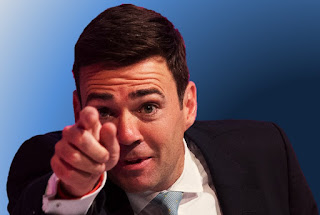
This is the first in a series of profiles of the four candidates in the Labour Party leadership election. Like the pieces I posted about the candidates for deputy leader, these are drawn entirely from the media, so they could be riddled with errors. Tomorrow: Liz Kendall
Back in 1993-94 the Observer used to run a feature called Any Questions, in which they told us who their interviewee would be next week and invited readers to send in their queries. And, as far as I can tell, this represented Andy Burnham's first appearances in the national press, with questions to Ian Botham, Graham Gooch and indeed to the ever fascinating Mary Whitehouse.
Sadly the names weren't attached to specific queries, so we'll never know whether Burnham was the one who asked Whitehouse about sex and drugs and rock 'n' roll. Probably not. Given his love of sport, he's more likely to have been the one who asked her: 'Do you regret not having had a professional tennis career?'
Born in 1970, Andy Burnham studied English at Cambridge University and followed what was rapidly becoming the conventional path into Labour Party politics: he worked as a researcher for Tessa Jowell and as parliamentary officer for the NHS confederation, before getting a nice job administering the Football Task Force that had been set up by Tony Banks, minister of sport in Tony Blair's first government.
 The aims of the Task Force were to combat racism in football, to encourage disabled access, to help 'players to act as role models in terms of behaviour and sportsmanship', and to give fans a voice, particularly in terms of 'ticketing and pricing policies that reflect the need of all on an equitable basis'. As the new Premier League season gets into its stride, you can judge their successes for yourself.
From there, it was but a short step to becoming a political adviser to Chris Smith, the culture secretary, and thence a safe seat in Leigh, though his parachuted arrival was not to the taste of everyone in the local party. 'This is jobs for the boys,' one member complained. 'It stinks to high heaven.'
Duly elected in 2001, he became known as one of the most loyal of new Labour MPs and was swiftly rewarded with promotion into the lower tiers of government. Not that he agreed with the leadership on everything, of course; it's just that he didn't like to advertise the fact. 'I'm not someone who has aired my differences with the party in public,' he says. 'I'm a football man. I do that in the changing room. On the pitch I tend to play the team game.'
In 2006, as Blair began the process of winding up his leadership of the party, Burnham's was one of the names he cited as the future of Labour, alongside those of Douglas Alexander, Ed Balls, David Miliband, Ed Miliband, James Purnell and Pat McFadden. Of those seven, four have now departed from the House of Commons, while another has already had his chance at leadership and blown it: the future isn't working out as planned.
By that stage, Burnham was making his way through the ranks, spending a while as a health minister, where he described his first week as one of mixed blessings: 'It's probably my worst nightmare to find out that my first parliamentary appearance would be winding up on a debate on deficits in the NHS,' he observed, though on a positive note: 'my week had begun on a high with Everton winning.' (He's rather partial to football, in case it had escaped anyone's attention.)
Following time spent in other jobs - Europe minister, chief secretary to the Treasury and culture secretary - he returned to the health department as secretary of state in 2009, and subsequently made the portfolio his own, serving as shadow health spokesperson during Ed Miliband's leadership.
In 2007 he called for the launch of an NHS constitution to spell out the institution's core values and 'to settle a new consensus around the NHS as the right model for Britain's healthcare needs for at least the medium term, if not for the longer term'.
He has also been campaigning for many years for the integration of health and care provision, proposing the creation of a National Health and Care Service. For a politician who claims to like 'doing things that are bold, important, setting a big agenda,' this has been his big idea. It hasn't, though, really sparked into life, and no one discusses its implications: what it means, how it would work. It's quite possibly a very policy indeed, but it sounds dull the way he tells it, and it hasn't caught the public imagination.
His bland, if not blind, loyalty in government led him into some more controversial areas. He was a keen advocate for the issuing of compulsory identity cards, he defended the PFI schemes for the building of new hospitals, and he suggested that the government might need to act to prevent alcohol being sold too cheaply. He was also called upon to implement the decision to scrap the plans for a so-called super-casino in Manchester, Gordon Brown's one distinctive repudiation of the Blair years.
And then there was the Stafford Hospital scandal. He set up the official enquiry into problems at Stafford immediately he became health secretary, but some still felt that there were outstanding questions, and that, in the words of The Spectator, 'he'll never be able to win a Labour leadership contest until he has a proper answer to those questions'.
Elsewhere, he has been dismissive of 'the educated, articulate, letter-writing people' who 'have no idea of what it is like to bring up a kid on a very low income and the pressure that creates and the difficulties that occur'. And he has been keen to stress the value of competitive sport: 'Competitiveness teaches good life values, winning and losing and taking in your stride, teamwork, discipline and a sense of obligation.'
In his time as secretary of state for culture, media and sport, he trumpeted his love of The Royle Family, professed himself - like Stella Creasy - to be a fan of the Wedding Present (particularly, and predictably, their 1987 album George Best), and claimed that 'Jeff Stelling epitomises standards in broadcasting'. He also mounted a robust defence of printed newspapers, arguing that that their 'heritage means something and can help people navigate a world where there is an ocean of shite on the internet'.
The great mystery about Burnham is why he's been talked up for so long and promoted so young. He gives the impression of being competent and personable, but largely uninspiring; an able lieutenant, perhaps, but no commander. He is the only leadership candidate this time who also went for the job in 2010. On that occasion, he finished fourth in a field of five, which was a little unkind - he was probably the third best option.
Above all, though, as he never ceases to remind us, he's a football fan. 'The Burnham family are a close-knit mob and there are three organisations that matter to us,' he once remarked: 'Everton Football Club, the Labour Party and the Catholic church - in that order.'

This is the first in a series of profiles of the four candidates in the Labour Party leadership election. Like the pieces I posted about the candidates for deputy leader, these are drawn entirely from the media, so they could be riddled with errors. Tomorrow: Liz Kendall
Sunday, 16 August 2015
A throw of the dice

I am aware, however, that this is - to put it mildly - a minority position. And that I have no evidence for it whatsoever.
In fact, if I'd been paying attention to myself, I would have concluded that Jeremy Corbyn, currently the red-hot favourite, was the likely winner. 'New political forces will emerge, whether within the existing parties or outside of them,' I wrote in 2012; 'things are about to change quite radically.' I added last year that UKIP weren't that change. But maybe Corbyn is the catalyst for this change.
So let's assume that that I'm as wrong now as I was when I placed money on Peter Hain succeeding Tony Blair, the issue is whether Corbyn will be any good as leader.
There are three basic tasks for the opposition. First, that they oppose government policies by producing alternatives. Second, that those alternatives change the terms of the debate. Third, that by changing the debate, there comes at least a reasonable chance of winning the next election.
The first is where things have really gone wrong for the Labour establishment. Losing the election was disastrous, but Harriet Harman's call for MPs to abstain on welfare reform added insult to injury. It smacked of democratic centralism, implying that since the Tories had won the election, then their policies had to be accepted. The decision to abstain made no difference whatsoever to the outcome of the vote, but Harman has been around long enough that she should have got the grasp of symbolic gestures by now. And yet she blew it, and no other single event has done as much to strengthen Corbyn's cause.
Frankly, Corbyn couldn't make a worse fist of opposition than Harman already has.
His MPs, however, could make it much, much worse. If a significant number of them effectively refuse to accept the party's vote, then he will fail from the outset. And they may well do so. They could quote Tony Benn at a meeting of the shadow cabinet in 1970: 'When the boat is sunk, you can't exactly rock it.'
Assuming, though, that he could assert his authority of the parliamentary party, could Corbyn re-frame the national debate? Yes. Is it likely? No. He would have the entire media against him; not just the usual suspects, but the whole of what some like to call the legacy media.
And maybe in there is the hope: that social media and the revival of public meetings can bypass the newspapers and the broadcasters. Maybe Facebook and The Trews will eclipse the Daily Mail and the Ten O'Clock News as the source of political information. I'm not convinced. Not in the short-term. So it would require an active mass membership - in real life, not on the internet - to counteract media hostility. Again I'm not convinced. Nor do I see any sign of Corbyn supporters seeking to persuade, rather than to assert.
Could he offer the possibility of an election win? Well, very probably not. But honestly, you never really know. Labour winning in 2020 is such an uphill task anyway. Someone on Twitter (I apologise for forgetting who - let me know it was you) suggested that, if this were a dice game, Labour needed to throw a six to win, and that Andy Burnham, Yvette Cooper and Liz Kendall could only manage threes and fours. Corbyn, on the other hand, offered the chance of either a one or a six.
Maybe. It is possible that Corbyn (Corbyn, of all people!) could build a People's Army that would massively outnumber Nigel Farage's following, a crusade that stretches far beyond Parliament. How this works within the existing Labour Party structure, however, I have no idea.
I have a fear that a Corbyn-led Labour might echo the miners' strike of 1984-85. There sprang up then a national network of support groups that was really quite extraordinary. It was, said the Financial Times, 'the biggest and most continuous civilian mobilisation since the Second World War'.
If you were involved, even in a peripheral way, with this movement, it was almost impossible to credit the opinion polls which showed the majority of the public firmly on the side of the government and against the NUM. But that was the reality. Most people didn't support the miners, and the result was one of the left's most celebrated of heroic defeats.

Back before Corbyn declared himself a candidate, I wrote: 'The task of choosing a new leader is to find someone who can articulate a sense of hope for the future, to persuade somewhere around a quarter of the electorate that he or she can help us build a better society.'
At the moment, there's only one candidate who's being seen in those terms. But I suspect there's only one six on his die (if that) and that the other faces are all ones. And I fear that Labour might actually need a double-six anyway.
I have yet to decide who to vote for. Over the course of the next week, I shall look back over the careers of the four candidates as a way of clarifying that question for myself. And I shall start tomorrow with Andy Burnham.
Wednesday, 5 August 2015
We won't be the young ones very long
In June 2003 The Times reported that Tony Blair was planning a government reshuffle, but was struggling to find MPs to bring in, because so many had 'blotted their copybooks by rebelling over Iraq and foundation hospitals'. This ruled out a number who had previously served in a junior capacity and might otherwise to be expected to make a return:
In the event, Blair rather botched the reshuffle, and none of the 2001 intake were brought into government, but happily it was only a hiccup: the good boys were duly promoted a few months later.
Two of those government appointees, Burnham and Watson, are currently back in the news, the bookies' favourites to inherit the party as leader and deputy leader. So they've done well for themselves.
 A bit too well, really. In a solid, competent, unexceptional government they'd be ministers of state. Not actually in the cabinet, but relatively serious figures. Nowhere near the leadership, of course. Yet there they are. Having been promoted too early, they're now in with a good chance of being over-promoted. And maybe those two things are related.
The rapid advance of a young generation of political advisers and officials into Parliament during the New Labour era was followed by an equally rapid clamber into government. Despite the vast size of the parliamentary party, there simply wasn't enough competition for places. Which is why the current slate of candidates is so poor.
Still, I've got to vote for someone, so in future posts I shall start going through the candidates to see if anyone can surprise and inspire me.
The shortage of comeback candidates leaves the field virtually clear for the 2001 intake of MPs. James Purnell, Mr Blair's media adviser in the first term, is already being addressed as 'minister' by backbench colleagues. Andy Burnham, a former special adviser to Chris Smith, is also expected to get the call-up. Tom Watson, a union official before he came to Parliament, and Chris Bryant, the indefatigable euro campaigner, are tipped for government.Meanwhile Andy McSmith was writing in the Independent on Sunday that the problem with the 2001 intake was that more than half had 'defied the whips on important issues', while others had 'committed the lesser offence of going against the prime minister's wishes'. Only five of the forty new MPs had 'what the whips would regard as clean voting records'. The five he identified were David Cairns, Tony Cunningham, James Purnell, Sion Simon and Tom Watson.
In the event, Blair rather botched the reshuffle, and none of the 2001 intake were brought into government, but happily it was only a hiccup: the good boys were duly promoted a few months later.
Two of those government appointees, Burnham and Watson, are currently back in the news, the bookies' favourites to inherit the party as leader and deputy leader. So they've done well for themselves.

The rapid advance of a young generation of political advisers and officials into Parliament during the New Labour era was followed by an equally rapid clamber into government. Despite the vast size of the parliamentary party, there simply wasn't enough competition for places. Which is why the current slate of candidates is so poor.
Still, I've got to vote for someone, so in future posts I shall start going through the candidates to see if anyone can surprise and inspire me.
Thursday, 16 July 2015
Leader of the gang
There's been a lot of very excited comment in the last day or so about how Jeremy Corbyn is on course to win in the Labour Party's leadership election. Round these parts, however, we try not to get over-excited. As The Hitchhiker's Guide to the Galaxy used to advise: Don't panic. Corbyn will not be the next leader. So who will?
Back in early April, I predicted that - following its inevitable defeat in the coming election - the party would opt for a female leader and choose either Yvette Cooper or Rachel Reeves. Since Reeves isn't standing, I'm going to have to stick with my other suggestion and predict a Cooper victory in September. She won't lead on first-preference votes, but I expect her to come through the middle and win in the third round.
She is not, in my opinion, the best choice that the Labour Party could make. But none of the three outsiders I nominated - Gloria de Piero, John Mann, Ben Bradshaw - took up the challenge, and we have instead the current dull slate of candidates. Of whom Cooper is probably the least poor.
Andy Burnham is the boring and unexceptional option, Jeremy Corbyn is the fascinating and catastrophic choice, and Liz Kendall - well, I don't know. I just don't get Kendall. In print, her arguments have some validity, but her delivery is as about as convincing as a student teacher. I simply can't picture her as a party leader, let alone prime minister. And I can at least see Cooper as a leader.
 But Labour should have learnt at least one lesson from the last five miserable years. When the electorate tell you that your leader has a problem with credibility and image, then you should listen to them. Every single poll showed that Ed Miliband's popularity trailed that of his party. And Labour's response was to give us more Miliband, as though it were our fault: we simply hadn't understood how wonderful he was.
He wasn't. He was dreadful. And since his colleagues couldn't summon up the courage to remove him, they should have insisted on the next best strategy: don't focus exclusively on the leader.
The party would be wise to do so this time. Cooper is not a great candidate, by any means (though she's a huge improvement on Miliband), and she's not surrounded by the best generation of politicians in Labour's history. But then, the government - with a couple of exceptions - ain't much cop either. Collectively, Labour don't look any more incompetent than the Tories.
Here's a potential shadow cabinet line-up, with their counterparts in the real cabinet shown in brackets:
A couple of other things left over from Ed Miliband's doomed leadership.
The change in the rules for the election of the leader was a mistake. The idea of one-member one-vote was fine, but there should be some way of whittling down the cast-list before it goes to the vote. Much the same as the Tories do, where the MPs choose two candidates who are then put to the party membership. The point is that a leader spends most of their time working with parliamentary colleagues; if they can't command support there, then they stand no chance, regardless of what the party in the country thinks.
I know this doesn't always work smoothly in the Conservative Party. There have been two leadership elections since William Hague introduced the system, and one of them resulted in the absurd elevation of Iain Duncan Smith. I also know that Labour has a rule that a candidate needs the nominations of 20 per cent of MPs - but in the cases of Diane Abbott and Jeremy Corbyn, we have seen how flawed this would-be filtering mechanism is.
And finally, the one thing that Miliband did get right was his promotion of new talent. In 2011 I noted the appearance on consecutive days on Question Time and Any Questions of Gloria de Piero and Rachel Reeves, both of whom had only been elected the previous year and both of whom were already in the shadow cabinet.
'These are the potential stars of the next parliament being given a chance to get a bit of exposure and experience,' I wrote. I added: 'The unmistakable impression, however, is that Labour's given up on the idea of opposition for the immediate future and is building for the world after the next election.'
That world's now arrived, and Miliband's investment in apprentice politicians may now pay off.

Back in early April, I predicted that - following its inevitable defeat in the coming election - the party would opt for a female leader and choose either Yvette Cooper or Rachel Reeves. Since Reeves isn't standing, I'm going to have to stick with my other suggestion and predict a Cooper victory in September. She won't lead on first-preference votes, but I expect her to come through the middle and win in the third round.
She is not, in my opinion, the best choice that the Labour Party could make. But none of the three outsiders I nominated - Gloria de Piero, John Mann, Ben Bradshaw - took up the challenge, and we have instead the current dull slate of candidates. Of whom Cooper is probably the least poor.
Andy Burnham is the boring and unexceptional option, Jeremy Corbyn is the fascinating and catastrophic choice, and Liz Kendall - well, I don't know. I just don't get Kendall. In print, her arguments have some validity, but her delivery is as about as convincing as a student teacher. I simply can't picture her as a party leader, let alone prime minister. And I can at least see Cooper as a leader.

He wasn't. He was dreadful. And since his colleagues couldn't summon up the courage to remove him, they should have insisted on the next best strategy: don't focus exclusively on the leader.
The party would be wise to do so this time. Cooper is not a great candidate, by any means (though she's a huge improvement on Miliband), and she's not surrounded by the best generation of politicians in Labour's history. But then, the government - with a couple of exceptions - ain't much cop either. Collectively, Labour don't look any more incompetent than the Tories.
Here's a potential shadow cabinet line-up, with their counterparts in the real cabinet shown in brackets:
- Yvette Cooper - leader (David Cameron)
- Chuka Umunna - shadow chancellor (George Osborne)
- Alan Johnson - foreign affairs (Philip Hammond)
- Rachel Reeves - business (Sajid Javid)
- John Mann - home affairs (Theresa May)
- Keir Starmer - justice (Michael Gove)
- Hilary Benn - health (Jeremy Hunt)
- Caroline Flint - education (Nicky Morgan)
- Andy Burnham - work and pensions (Iain Duncan Smith)
- Gloria de Piero - energy and climate change (Amber Rudd)
- Liz Kendall - transport (Patrick McLoughlin)
- Dan Jarvis - defence (Michael Fallon)
- Michael Meacher - environment and food (Liz Truss)
- Stella Creasey - communities and local government (Greg Clark)
- Chris Bryant - culture, media and sport (John Whittingdale)
- Emma Reynolds - women and equalities (Nicky Morgan, again)
- Chris Leslie - shadow first secretary (Greg Hands)
- Jeremy Corbyn - international development (Justine Greening)
- Rosie Winterton - chief whip (Mark Harper)
- Ben Bradshaw - leader of the house (Chris Grayling)
A couple of other things left over from Ed Miliband's doomed leadership.
The change in the rules for the election of the leader was a mistake. The idea of one-member one-vote was fine, but there should be some way of whittling down the cast-list before it goes to the vote. Much the same as the Tories do, where the MPs choose two candidates who are then put to the party membership. The point is that a leader spends most of their time working with parliamentary colleagues; if they can't command support there, then they stand no chance, regardless of what the party in the country thinks.
I know this doesn't always work smoothly in the Conservative Party. There have been two leadership elections since William Hague introduced the system, and one of them resulted in the absurd elevation of Iain Duncan Smith. I also know that Labour has a rule that a candidate needs the nominations of 20 per cent of MPs - but in the cases of Diane Abbott and Jeremy Corbyn, we have seen how flawed this would-be filtering mechanism is.
And finally, the one thing that Miliband did get right was his promotion of new talent. In 2011 I noted the appearance on consecutive days on Question Time and Any Questions of Gloria de Piero and Rachel Reeves, both of whom had only been elected the previous year and both of whom were already in the shadow cabinet.
'These are the potential stars of the next parliament being given a chance to get a bit of exposure and experience,' I wrote. I added: 'The unmistakable impression, however, is that Labour's given up on the idea of opposition for the immediate future and is building for the world after the next election.'
That world's now arrived, and Miliband's investment in apprentice politicians may now pay off.

Thursday, 18 June 2015
The Sign of Four
Some first impressions from last night's Labour leadership debate...
There are some Conservative MPs, supporters and commentators who have found the candidature of Jeremy Corbyn to be really too terribly amusing. They would be wise to stop their chortling. First because it comes over as smart young people bullying an old man, which is the kind of impression Tories shouldn't be giving. And secondly because Corbyn speaks for Britain much more convincingly than they do.
Just to be clear. Obviously I don't think Corbyn is going to win the leadership. Nor do I think he should - he'd be a disaster beyond the nightmares of Iain Duncan Smith. The electorate wouldn't accept him for a moment and Labour would be destroyed.
Forget policies, however, and the values he espouses are not too far removed from the image the British have of ourselves as a nation. When he talks of principles of fairness and equality, of community and public services, he resonates in a way that Ed Miliband never achieved.
To take a more obvious example: Tony Benn was adopted as the nation's sweetheart when it became clear that his politics were never going to be implemented, so we could simply bask in the warm glow of his values. Corbyn is no Benn - he lacks the charisma and the easy humour - but he's as close as we've got, and his status will be raised by this campaign.
He knows he's not going to win the poll, but there's another process going on at the moment, a quest for the soul of the party, and he's making his contribution to that. He may at least change the rhetoric, which would be a start.
Of the others, Andy Burnham still comes across as a lightweight, as does Liz Kendall - though presumably there's some grit there, given her determination to be a candidate when she has so little to suggest she's a leader. And the most convincing of the four was Yvette Cooper.
I commented on Twitter earlier this week that none of the four candidates would have made it into one of Harold Wilson's cabinets, and that none would become prime minister. I should like to amend that a little. Cooper would have done well in Wilson's time. At her age she'd only be a minister of state right now, but a cabinet seat would be confidently predicted for her in a few years' time.
On the other hand, I still can't see her - or any of the others - as prime minister.
But these are early days. The only thing we know about the 2020 election is that the Tories won't be led by David Cameron. Like most people, I think George Osborne will be prime minister and that he'll win the next general election. But all sorts of things can go wrong. What if the Tories are stupid enough to choose Boris Johnson as their leader? Cooper could beat him.
One other thing: I'm glad that Labour is finally getting round to thinking about the idea that sometimes leaders have to be removed. The Conservatives are wonderful at this - they even got rid of Margaret Thatcher when they realised she'd become a liability (which she had). At various times there was plotting in Labour ranks against Harold Wilson, Michael Foot, Neil Kinnock, Gordon Brown and Ed Miliband - and not one person was ever prepared to stand against any of them. It can't go on.
Oh, and one other, other thing: I am aware of the many criticisms of Jeremy Corbyn - and the Left more widely - about how his hatred of Israel has led him into bed with some deeply unpleasant political figures and groups. Those criticisms are entirely justified. But I don't think that, for the public, this will damage the impression of a decent, principled man. (Unless he actually began to look like a serious candidate, of course...)
And, because I like him, I would like to note in his defence that he was one of the few MPs who still came to the non-stop picket of the South African embassy back in the 1980s, even though the group who organised that demonstration had been expelled from the mainstream Anti-Apartheid Movement. I spent quite a lot of time on those pavements and his support was a very good thing.

Monday, 15 June 2015
Labour leadership and the Magna Carta
The Labour government of Tony Blair and Gordon Brown was not noted for its liberal tendencies. During Blair's premiership, this was symbolised by the attempt in 2006 to allow the state to detain 'terror suspects' for up to ninety days without charge. Just like in apartheid South Africa.
That attempt failed, but two years later - with Brown now prime minister - a new Counter-Terrorism Act plucked another figure out of the air, and sought to increase the maximum period of detention without charge from twenty-eight to forty-two days.
Thirty-six Labour MPs rebelled against this in a Commons vote, but it sneaked through when the Democratic Unionist Party ('the political wing of the 17th century, according to Owen Jones) was bribed by the Labour government to support the measure. It was not until the House of Lords voted against that the government dropped the proposal.
This occurs to me today for two reasons. One is that it's the 800th anniversary of the signing of the Magna Carta, which brings to mind Tony Benn's response to that Commons vote: 'I never thought I would be in the House of Commons on the day the Magna Carta was repealed.'
And the other reason is that today is the day that nominations close for the leadership of the Labour Party. Andy Burnham, Yvette Cooper and Liz Kendall already have enough to ensure that their names go on the ballot paper; at the time of writing, the support for Jeremy Corbyn's campaign is unsure.
Kendall was not a member of parliament in 2008, so didn't have a chance to express her opinion, but no one will be surprised that Burnham and Cooper happily trotted through the lobbies to support the forty-two days rule - this simply wasn't something worth risking their political careers on. Corbyn, equally unsurprising, was one of the rebels.
That attempt failed, but two years later - with Brown now prime minister - a new Counter-Terrorism Act plucked another figure out of the air, and sought to increase the maximum period of detention without charge from twenty-eight to forty-two days.
Thirty-six Labour MPs rebelled against this in a Commons vote, but it sneaked through when the Democratic Unionist Party ('the political wing of the 17th century, according to Owen Jones) was bribed by the Labour government to support the measure. It was not until the House of Lords voted against that the government dropped the proposal.
This occurs to me today for two reasons. One is that it's the 800th anniversary of the signing of the Magna Carta, which brings to mind Tony Benn's response to that Commons vote: 'I never thought I would be in the House of Commons on the day the Magna Carta was repealed.'
And the other reason is that today is the day that nominations close for the leadership of the Labour Party. Andy Burnham, Yvette Cooper and Liz Kendall already have enough to ensure that their names go on the ballot paper; at the time of writing, the support for Jeremy Corbyn's campaign is unsure.
Kendall was not a member of parliament in 2008, so didn't have a chance to express her opinion, but no one will be surprised that Burnham and Cooper happily trotted through the lobbies to support the forty-two days rule - this simply wasn't something worth risking their political careers on. Corbyn, equally unsurprising, was one of the rebels.

Saturday, 13 June 2015
Making your way in the world today...
Some extracts from an article written by Paul Waugh and published in the Independent on 17 February 2001:
'Tony Blair faced more accusations of "control freakery" last night when activists claimed that Labour was preparing to parachute a cabinet aide into one of the party's safest seats at the election.
'The constituency of Leigh in Lancashire had its selection process suspended this week when it looked as though the local party would exclude Andy Burnham, a special adviser to Chris Smith, the Secretary of State for Culture, Media and Sport…
'Officials from the Labour North West regional party intervened when Leigh Constituency Labour Party's executive committee voted on Tuesday for a shortlist of just four candidates...
'However, Kevin Lees, a regional official, warned the constituency party that unless it backed a larger shortlist of six or eight, he would suspend the selection process.
'When the local members ignored his advice, Mr Lees formally suspended proceedings and ordered that the party's ruling National Executive Committee should draw up the shortlist instead.
'The sanction of imposing a shortlist is a tough measure, normally used when there are allegations of infighting or militancy in a local party.
'Local members are convinced that the reason Millbank wants a larger shortlist is to include Mr Burnham and Jenny Smith, a former aide to Bill Morris, the general secretary of the T&G union…
'An angry party member told the Independent: "This is jobs for the boys, and it's making a mockery of democracy. We've had our mines closed and the area desperately needs regeneration, and we need a local person to represent local people. The views of the local constituency are being overruled by a regional body about their choice of future Labour candidate. It stinks to high heaven."'

Subscribe to:
Posts (Atom)