One of the things I write is a game called Who's in the Bag?, which is a simple - but effective - little thing. There's a bag full of cards, on each of which there are three names and, without actually speaking the names themselves, you have to get your team-mates to guess who they are. There's a timer as well. It sells well and has done for a couple of decades now.
Every few years, though, it has to be updated to allow for changing tastes and fashions. Some people - say, Winston Churchill, Jane Austen, Stevie Wonder - are likely to stay in every edition. But others pass their sell-by date and have to be dropped. Robert Kilroy-Silk, for instance: he was thrown out of the Bag some time ago. Liam Gallagher more recently. For other reasons, Max Clifford and Rolf Harris won't be in the Bag this time. And meanwhile some new people will have emerged since the last version, who need to be added.
I'm now working on a new edition of both the main game and the add-on pack of cards. Which means I have to come up with over 1,200 names that I can reasonably expect to be recognised, or that are possible to guess even if they're not recognisable. Donald Trump, for example, is an easy name to convey, even if you've never heard of him. (Lucky you.) Similarly, Mary Beard, Nicola Sturgeon and Paddy Power.
The other factor is that this will probably still be in print in 2020. So there's an element of prediction here. Will Ed Sheeran still be a thing in five years time, or will he have faded in the same way as - oh, I don't know - Jake Bugg seems to have done? What about Harry Kane? Jennifer Lawrence? Will Katie Hopkins become big enough to warrant being put in the Bag?
It's a bit like a low-budget version of Madame Tussaud's selection process. I mentioned in my book A Classless Society that we knew Iain Duncan Smith was doomed as Tory leader when Tussaud's said he wouldn't get an effigy. 'He is not in the papers very much and you never hear his name,' said a spokesperson. 'We are not sure if our visitors will recognise him.' It was a damning verdict.
And the question that's currently troubling me is the parallel case of the Labour leadership. Whoever wins gets put in the Bag, of course. But the losers? If Andy Burnham doesn't get to be leader, is he going to become a household name? How about Jeremy Corbyn? Flavour of the month now, but if he fails to win this election, how big will his public profile be in a couple of years? Politicians generally aren't instantly familiar, as Pointless discovered a couple of years ago.
Much safer is the process of discarding people. Amongst those who I've thrown out of the Bag this time are Ed Balls, Boutros Boutros-Ghali, Rebekah Brooks, Nick Clegg, Abu Hamza, Harriet Harman, Martin McGuinness, Peter Mandelson and Ian Paisley. These are, in my estimation, yesterday's men and women. There's a dangerous sense of power that comes with writing this game...
Any suggestions for people who have become famous in the last three years would be most appreciated.
Showing posts with label Nick Clegg. Show all posts
Monday, 31 August 2015
Sunday, 10 May 2015
A tale of some minor parties
A week or so back, I predicted that one consequence of the election would be the resignations of Nigel Farage and Nick Clegg as the leaders of, respectively, Ukip and the Liberal Democrats. I also predicted that Natalie Bennett would not resign as leader of the Green Party of England and Wales.
These things having now come to pass, it's time to evaluate them.
Starting with the last first, Bennett should have the decency to go immediately. She has proved herself to be completely useless as a leader. The Greens had a dreadful election, and much of the blame for that rests with her.
The party achieved less than 4 per cent of the vote. Under most sensible forms of proportional representation, the bar for securing seats is set at 5 per cent. Frankly they're fortunate that first-past-the-post came to their rescue and gave them an MP.
Yet the opportunity was unquestionably there for the Greens: lots of airtime and visibility, a weak Labour leadership, a widespread dissatisfaction with mainstream politics. A breakthrough of sorts was possible. Obviously not in terms of winning large numbers of seats, but even without representation, a minor party can still have an influence, can help to shape the political agenda.
You only need look to Ukip. At a time when they had no MPs at all, they were still capable of scaring the British prime minister into promising a referendum when he didn't want one, and panicking the Labour Party into saying they'd 'get tough' on immigration, when we knew they wouldn't.
So what did Bennett do? She joined in the chorus of 'the Tories are mean and nasty'. Well, if you believed that, then you should have done the sensible thing and voted for a party capable of removing the Conservatives from office. Which is, indeed, what the vast majority of those opposed to the Tories actually did.
At a constituency level, things may have been different, but on the national stage Bennett offered nothing at all that was distinctive. One brief mention in a leaders' debate of climate change and vanishing species, and that was it. At a time when fracking offers a perfect way of linking the local with the global, there was only silence.
It is, of course, more difficult to get attention for environmental issues at a time of economic hardship, but this is far from a new problem. I wrote about it in Crisis? What Crisis?, my book on the 1970s. There's been plenty of time to work out a strategy for such a situation.
The Greens are one of the few parties who actually have a USP. Yet they didn't exploit it. Instead there was a manifesto and a platform full of policies on an absurd range of issues that were entirely irrelevant, including the stupidity over copyright, to which I drew attention a while back. (And which subsequently annoyed the hell out of a lot of creative people who were sympathetic to the party.)
Why? Where's the benefit in burying your brand? Why allow your core message to be lost amidst a welter of questions about a tax policy you will never have a chance to implement?
One other point, which most people are (quite rightly) too polite and decent to say out loud: the voice was wrong. The British public didn't warm to being waffled at in an Australian accent. Obviously it shouldn't matter, but it does.
In short, Bennett should go.
So too should Farage. He's left open the possibility of coming back from his holidays and standing again for the Ukip leadership, but he should resist the temptation. The party is better off without him now.
He has been an extraordinary figure who has over-achieved on a spectacular scale. In many ways, he was the story of the Coalition years, conducting a brilliant guerrilla campaign against Westminster. (Do I need to point out that I'm talking about technique not policies? I do hope not.) I went to one of his EU debates with Nick Clegg and he was a superb performer - committed Europhiles were coming out of the hall saying how good he was.
But he still has to go.
When Ukip won the elections for the European Parliament a year ago, I wrote that they'd reached their high-water mark. If they were ever to go any further, I suggested, they needed to thank Farage for all his work and ask him to step down. He'd taken them as far as he possibly could. My comparison was with Ian Holloway, a colourful, charming and competent manager who got Blackpool Football Club to the Premier League, but couldn't keep them there.
My argument was that if Ukip wanted to secure - let alone go beyond - the 4.4 million votes they achieved last year, they had to make serious inroads into Labour heartlands, and Farage was probably not the man for that. He did pretty well this week, but the party fell to 3.9 million votes on a far higher turnout. It could have been better if he'd gone last year. Now it's probably too late, and decline is (I think) inevitable.
Ukip are, as normal with third parties, an odd coalition of the disgruntled and the idealistic from all points of the political compass.
There are two broad bases of support: the Eurosceptic deserters from the Conservative Party and the disillusioned white working-class who feel abandoned by Labour. These are represented by Douglas Carswell and Paul Nuttall respectively, and I assume that they will be the two candidates in a leadership election. I also assume that Carswell will win, to the detriment of the party's electoral interests.
The alternative is Suzanne Evans, currently the acting leader, who would be their best choice of all. And since I think that, I don't expect her to get the job on a permanent basis.
Their moment has passed, but they leave behind an example of how to make a difference. Why is there no Left party that can do this?
And so, finally, to Nick Clegg.
What can one say? Well, firstly, that he made exactly the right decision in 2010. The Lib Dems, and before them the Liberals, had always banged on about coalition government being a good thing. They were offered it, and they accepted. To do otherwise would have been foolish.
Some people complained that Clegg would have sold his own mother to get power, but that judgement seemed a little harsh. After all, he did join the Lib Dems, which isn't traditionally the way to achieve high office. Given the state of modern politics, he could have fitted perfectly comfortably into the modern Conservative or Labour Parties, but he chose the road less travelled.
As the junior partner in the Coalition, the Lib Dems proved surprisingly effective at government. They got through key policies like the pupil premium and raising the threshold for income tax; even the tuition fees increase - damaging though it was - had a logic, if they'd only had the sense to call it a time-limited graduate tax.
Most of their members and (probably) their supporters would have preferred a coalition with Labour, but that wasn't available in 2010. In the circumstances, I thought they played a difficult hand rather well and could justifiably be proud of their record.
But over recent months, and particularly during the campaign itself, they decided to distance themselves from their Coalition partners and, in so doing, they thoroughly ruined the good story they had to tell.
The final straw came when Danny Alexander decided to reveal the contents of private government papers in an attack on the Tories. The effect was to make the party look incompetent and untrustworthy. Who would want to work with people who go telling tales out of school? The first rule of Coalition Club is you don't talk about what goes on behind the scenes at Coalition Club.
Before the election, it was widely assumed that Tim Farron would become the next leader. Now that looks like such a nailed-on certainty that the party's going to have to twist someone's arm to stand against him, so that it least has the formal structure of a contest. Norman Lamb, possibly; or that bloke up in Scotland, whose constituency is so remote that not even SNP canvassers could find it.
Farron is the obvious and correct choice. He's as close as they've got to an old-fashioned Liberal, and since the parliamentary party is down to the numbers last seen under Jeremy Thorpe, they might as well adopt an old-fashioned approach.
But it's an absurdly uphill struggle now. The thing is this: if the Lib Dems didn't exist, who would bother to invent them?
These things having now come to pass, it's time to evaluate them.
Starting with the last first, Bennett should have the decency to go immediately. She has proved herself to be completely useless as a leader. The Greens had a dreadful election, and much of the blame for that rests with her.
The party achieved less than 4 per cent of the vote. Under most sensible forms of proportional representation, the bar for securing seats is set at 5 per cent. Frankly they're fortunate that first-past-the-post came to their rescue and gave them an MP.
Yet the opportunity was unquestionably there for the Greens: lots of airtime and visibility, a weak Labour leadership, a widespread dissatisfaction with mainstream politics. A breakthrough of sorts was possible. Obviously not in terms of winning large numbers of seats, but even without representation, a minor party can still have an influence, can help to shape the political agenda.
You only need look to Ukip. At a time when they had no MPs at all, they were still capable of scaring the British prime minister into promising a referendum when he didn't want one, and panicking the Labour Party into saying they'd 'get tough' on immigration, when we knew they wouldn't.
At a constituency level, things may have been different, but on the national stage Bennett offered nothing at all that was distinctive. One brief mention in a leaders' debate of climate change and vanishing species, and that was it. At a time when fracking offers a perfect way of linking the local with the global, there was only silence.
It is, of course, more difficult to get attention for environmental issues at a time of economic hardship, but this is far from a new problem. I wrote about it in Crisis? What Crisis?, my book on the 1970s. There's been plenty of time to work out a strategy for such a situation.
The Greens are one of the few parties who actually have a USP. Yet they didn't exploit it. Instead there was a manifesto and a platform full of policies on an absurd range of issues that were entirely irrelevant, including the stupidity over copyright, to which I drew attention a while back. (And which subsequently annoyed the hell out of a lot of creative people who were sympathetic to the party.)
Why? Where's the benefit in burying your brand? Why allow your core message to be lost amidst a welter of questions about a tax policy you will never have a chance to implement?
One other point, which most people are (quite rightly) too polite and decent to say out loud: the voice was wrong. The British public didn't warm to being waffled at in an Australian accent. Obviously it shouldn't matter, but it does.
In short, Bennett should go.
So too should Farage. He's left open the possibility of coming back from his holidays and standing again for the Ukip leadership, but he should resist the temptation. The party is better off without him now.
He has been an extraordinary figure who has over-achieved on a spectacular scale. In many ways, he was the story of the Coalition years, conducting a brilliant guerrilla campaign against Westminster. (Do I need to point out that I'm talking about technique not policies? I do hope not.) I went to one of his EU debates with Nick Clegg and he was a superb performer - committed Europhiles were coming out of the hall saying how good he was.
But he still has to go.
When Ukip won the elections for the European Parliament a year ago, I wrote that they'd reached their high-water mark. If they were ever to go any further, I suggested, they needed to thank Farage for all his work and ask him to step down. He'd taken them as far as he possibly could. My comparison was with Ian Holloway, a colourful, charming and competent manager who got Blackpool Football Club to the Premier League, but couldn't keep them there.
My argument was that if Ukip wanted to secure - let alone go beyond - the 4.4 million votes they achieved last year, they had to make serious inroads into Labour heartlands, and Farage was probably not the man for that. He did pretty well this week, but the party fell to 3.9 million votes on a far higher turnout. It could have been better if he'd gone last year. Now it's probably too late, and decline is (I think) inevitable.
Ukip are, as normal with third parties, an odd coalition of the disgruntled and the idealistic from all points of the political compass.
There are two broad bases of support: the Eurosceptic deserters from the Conservative Party and the disillusioned white working-class who feel abandoned by Labour. These are represented by Douglas Carswell and Paul Nuttall respectively, and I assume that they will be the two candidates in a leadership election. I also assume that Carswell will win, to the detriment of the party's electoral interests.
The alternative is Suzanne Evans, currently the acting leader, who would be their best choice of all. And since I think that, I don't expect her to get the job on a permanent basis.
Their moment has passed, but they leave behind an example of how to make a difference. Why is there no Left party that can do this?
And so, finally, to Nick Clegg.
What can one say? Well, firstly, that he made exactly the right decision in 2010. The Lib Dems, and before them the Liberals, had always banged on about coalition government being a good thing. They were offered it, and they accepted. To do otherwise would have been foolish.
Some people complained that Clegg would have sold his own mother to get power, but that judgement seemed a little harsh. After all, he did join the Lib Dems, which isn't traditionally the way to achieve high office. Given the state of modern politics, he could have fitted perfectly comfortably into the modern Conservative or Labour Parties, but he chose the road less travelled.
As the junior partner in the Coalition, the Lib Dems proved surprisingly effective at government. They got through key policies like the pupil premium and raising the threshold for income tax; even the tuition fees increase - damaging though it was - had a logic, if they'd only had the sense to call it a time-limited graduate tax.
Most of their members and (probably) their supporters would have preferred a coalition with Labour, but that wasn't available in 2010. In the circumstances, I thought they played a difficult hand rather well and could justifiably be proud of their record.
But over recent months, and particularly during the campaign itself, they decided to distance themselves from their Coalition partners and, in so doing, they thoroughly ruined the good story they had to tell.
The final straw came when Danny Alexander decided to reveal the contents of private government papers in an attack on the Tories. The effect was to make the party look incompetent and untrustworthy. Who would want to work with people who go telling tales out of school? The first rule of Coalition Club is you don't talk about what goes on behind the scenes at Coalition Club.
Before the election, it was widely assumed that Tim Farron would become the next leader. Now that looks like such a nailed-on certainty that the party's going to have to twist someone's arm to stand against him, so that it least has the formal structure of a contest. Norman Lamb, possibly; or that bloke up in Scotland, whose constituency is so remote that not even SNP canvassers could find it.
Farron is the obvious and correct choice. He's as close as they've got to an old-fashioned Liberal, and since the parliamentary party is down to the numbers last seen under Jeremy Thorpe, they might as well adopt an old-fashioned approach.
But it's an absurdly uphill struggle now. The thing is this: if the Lib Dems didn't exist, who would bother to invent them?
Wednesday, 6 May 2015
The general election campaign, 2015
Possibly the sheer resilience of Nick Clegg, the thickest-skinned politician ever. Probably Natalie Bennett, with her brain-fades and advocacy of polyamorous marriages. Definitely Grant Shapps in all his gormless glory.
What else? Russell Brand would be in there. Maybe Ed Miliband and the hen party? Maybe David Cameron forgetting which football club he's supposed to support? That's the kind of thing I normally record.
The one event that would certainly be included - even though it'll fade from the collective memory - would be the BBC Question Time last week, in which the audience accused successively Miliband, Cameron and Clegg of being liars. More than anything else, that seemed to nail this campaign and the state of modern politics.
Before, during and after the manifesto launches, we've had - from all parties - a relentless series of what columnists nowadays like to call 'offers', but which we used to call policies. Or bribes, to be more precise. Each day there's been a new proposal to reduce tax or to increase spending or, more frequently, to tell other people what things they should be doing differently.
Employers, housing associations, landlords, fuel companies, rail operators, bankers, tobacco firms: all of them, ministers manqué claim, could be regulated more stringently or made to reduce their profitability. This is all perfectly fine and legitimate - only the libertarian fringes object on principle to all intervention in 'the market' - but it's hard not to see it as being an alternative to government action.
One party suggests they'll build x number of houses, and another chips in with x x 2 (or x x 3, if x x 2 has already been taken). None of the contenders actually intend to build any houses themselves, of course: these are just figures plucked out of thin air and magically transformed into targets.
Because we are still, sadly, in a political world of targets. Lord know it's not as bad as during the first government of Tony Blair when, as I wrote in my book A Classless Society:
There were targets for the quantity of cars, cycles and pedestrians on the road, as well as for traffic casualties and dog mess; for the numbers of smokers, heroin addicts and pregnant teenagers; for the incidence of robberies and building-fires; for how many children visited museums and galleries, and for the proportion of school-leavers going on to higher education. There was even a target for the number of otters to be found in the wild...But even without this excess of zeal, the thinking behind the target culture still dominates political thinking; the stated intention to do something is believed to be just as good - and certainly much easier - than actually doing it. As Blair himself once put it: 'It's the signals that matter, not the policy.'
This time the signals extend to cover the behaviour of foreigners.
The Tory manifesto promises to deliver '100,000 more UK companies exporting in 2020 than in 2010' with a 'target of £1 trillion in exports' - presumably whether or not people want to buy our stuff.
It also says: 'We will set challenging targets for Visit Britain and Visit England to ensure more visitors travel outside the capital' - whether or not that was in the holiday plans made by those tourists.
Meanwhile, the Labour manifesto promises to 'push for global targets to tackle inequality and promote human rights' - whether or not... well, you get the idea on that one.
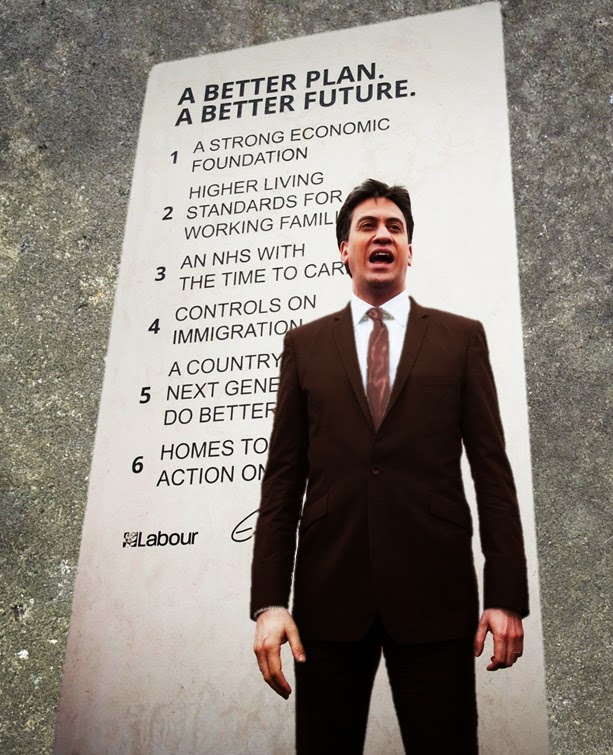
And since we don't believe these silly statements, however solemnly intoned they are, we then get the absurd spectacle of Cameron pledging to enshrine in law a promise not to increase income tax, VAT or national insurance. Followed by the even more absurd Miliband gimmick of having his vague, waffly pledges literally carved in stone.
I genuinely thought that this last one was a joke when I heard it. I still do.
But no matter how feverish the promises, how apocalyptic the denunciations of the other side(s), the electorate - as that Question Time audience illustrated - resolutely refuses to be convinced. We still think they're all lying. And they are.
Just to be clear: this was not always the case. There was a time when politicians told us grown-ups if things were going wrong. This is Edward Heath's message to the country in December 1973, telling us that we were in for the hardest Christmas since the war and that our standard of living was going to fall:
I'm not sure I can envisage Cameron or Miliband making that kind of broadcast.
Mind you, it didn't do Heath much good; two months later, he was thrown out of office. Maybe that's why telling the truth fell out of fashion. Or maybe it was John Smith as shadow chancellor in 1992, telling us that if we wanted better services - which we said we did - we would have to see tax rises, which we decided was beyond the pale. Or possibly it was Blair winning three consecutive elections by peddling his PFI fantasy of 'investment' on the never-never.
In any event, everyone now knows that there are serious problems coming, yet no politician is prepared to say so.
Despite all of which, I remain mostly optimistic about the future.
Primarily this is because I don't believe the current settlement can survive, since it is so clearly dysfunctional.
As many have pointed out, the principal justification for a first-past-the-post electoral system has always been that it provides strong, stable government. This no longer looks like a clinching argument.
The inherent distortions are about to be revealed in the starkest manner ever. It is almost certain that Ukip will win the third largest share of the vote, and yet could end up tenth in the share of seats (the position it was in at the dissolution of the last Parliament).
Similarly, Nicola Sturgeon has talked a great deal about 'shutting the Tories out of Downing Street' with an anti-Tory majority in the Commons. This may well be the result, but the majority of the popular vote is likely at the same time to be right-of-centre; the Conservatives, Ukip and the Liberal Democrats will probably get more than 50 per cent between them. (I'm assuming that the Lib Dems' more left-inclined supporters will have abandoned them.)
There is also the fact that we no longer have any national parties, just a fraying patchwork of regional and nationalist groups. Those that still pretend to be national are self-evidently not fit for purpose.
And then there's Scotland. Some commentators are berating the Conservatives for jeopardising the Union with their apparent encouragement of the Scottish National Party; others are berating the Labour Party for their complacency in letting the SNP outflank them on the left.
But it doesn't matter much who's to blame; the fact is that there aren't very many passionate Unionists left, on either side of the border. Those who do claim to believe in the Union seem incapable of making out a case for it that goes beyond sentiment and slogan.
Whatever happens tomorrow, large numbers of people are going to feel not merely unhappy - that's normal - but cheated.
Back in 2012, I wrote that 'things are about to change quite radically'. I think we're edging ever nearer a critical moment.
Friday, 1 May 2015
...like the leaving of it
Seven days from now, we may well be getting the first resignation of a party leader. Presumably the Scottish National Party, Plaid Cymru and the Green Party of England and Wales will stick with their incumbent leaders, but for the others, nothing is certain. Quite possibly Nigel Farage and/or Nick Clegg will fail to be elected in the first place, while either David Cameron or Ed Miliband - whichever doesn't get to be prime minister - won't be long for the leadership.
As an object lesson in how not to leave the job of party leader, you'd have to go a long way to beat Gordon Brown.
Following the indecisive result of the general election in 2010, he hung around in Downing Street for a few days - as he was constitutionally bound to do, since he was still prime minister - but then abruptly walked out, a few hours before the deal between Cameron and Clegg was concluded: and on that he was constitutionally wrong.
The real problem, though, was what followed. Brown resigned the Labour leadership and sulked off to Scotland, leaving Harriet Harman to mind the shop for the next few months while the long process of choosing a new leader played itself out. It was during that period that the narrative of the financial crash and crisis was firmly fixed in the public consciousness by the coalition government.
Brown was badly damaged by then, but he should still have been capable of articulating an alternative view, of defending the economic growth figures bequeathed to the new government. He didn't do so. And the legacy of Brown's self-indulgence could be seen on Question Time last night, as Ed Miliband squirmed in the face of questions on Labour's economic record. The ground lost in 2010 has never been recovered.
Compare and contrast Michael Howard departure from the Conservative Party leadership in 2005. He announced immediately after losing the election that he would be standing down, but not for another six months, not till a new leader had been chosen. He then reshuffled his front-bench team and promoted George Osborne to shadow chancellor and David Cameron to shadow education secretary, thereby setting up the new generation to inherit the leadership. It worked perfectly (though Howard would probably have preferred Osborne).
It is possible in retrospect to conclude that Howard didn't ultimately do his party any favours in the short term, that David Davis would have been a sounder choice in 2005 and might well have won a majority in 2010. But even if one accepted this, Howard was at least doing what he genuinely believed was in his party's interests. Unlike Brown, who simply abandoned his party.
Friday, 24 April 2015
Who gets my vote: part 2
Continuing my ruminations about who to vote for in the coming election, the Liberal Democrats in my constituency of Holborn & St Pancras are fielding Jill Fraser.
This is a good choice - Fraser (she's the one in the middle) is a popular figure. In 2003 she won a shock by-election to be elected to Camden Council (this was against the backdrop of the invasion of Iraq), and went on to become mayor of the borough in 2006. She stood for parliament in the Holborn & St Pancras constituency in 2005, achieving an 11 per cent swing from Labour to Lib Dem, and she's very active and visible in local campaigning.
Her son is a university lecturer (which is surely a good thing), but most famously she works in a local chip-shop and has done for over two decades. This is not necessarily the image conjured up by the words 'North London Liberal'.
She didn't stand in 2010, but the Lib Dem candidate came in second again, for the third election running. The candidate then, Jo Shaw, got a shade under 28 per cent of the vote. Even with the personal standing of Fraser, it's unlikely to get much better this time. Last year the Lib Dems were all but wiped out in the local elections, and Fraser lost her council seat (as did all but one of their candidates).
The reality, of course, is that it doesn't really matter who the candidate is. This is nobody's idea of a target seat (even assuming that the Lib Dems enjoyed the luxury of having target seats) and the party isn't exactly pouring resources into the constituency campaign. Fraser could promise free chips to every voter without it making any real difference.
I've long thought that the Lib Dems would do better in this election than was being predicted. And my reasoning was that they had quite a decent story to tell. Nick Clegg made the right decision in 2010 to enter a coalition government. Coalitions are what the party had been talking about for my entire adult life, and it would have been absurd to turn down the opportunity when it arose. Further, I have no doubt that the presence of the Lib Dems made the government a better one than it would have been had the Tories governed alone. Those were the two options that existed after the nation had voted, and we got the better of the two.
Now, though, I'm not so sure about the Lib Dem prospects. I think that as the choice between David Cameron and Ed Miliband becomes starker, there is a very real possibility that the Lib Dems will get squeezed. Clegg seems to me to be playing a limited hand pretty well, but for most of this campaign it's been as though the party hardly exists. No one appears to care in the slightest what they have to say.
And that's a bit of a shame, because I think the country benefits from having a moderately strong Lib Dem presence. It provides an alternative where none would otherwise exist, and it can sometimes spring a surprise. Eastbourne, for example, where the Labour Party stands no chance, was Tory for eighty years solid until the IRA murdered Ian Gow in 1990; now it's a Lib Dem constituency and likely to remain so.
I mean, obviously we have no idea what they stand for or what they believe. Lord knows they haven't actually been liberal for a long time, save for the occasional outbreak of concern over civil liberties. But believing in stuff isn't really their thing. Their job is to represent the don't knows. Which isn't intended as a criticism: there are an awful lot of don't knows, and they're entitled to have their uncertain voice heard, just as much as those who think they know everything.
And maybe I'm wrong about them being squeezed. Their best post-war performance came in 1983, in their incarnation as the SDP-Liberal Alliance. The country was then offered the choice of Margaret Thatcher or Michael Foot, and a very large number of people decided that they're rather have neither. The same could hold true for the party this time. Except that I don't think it will.
More than the state of the party at a national level, however, the problem for Jill Fraser is that she's rather wasted on Holborn & St Pancras. She'd make someone a good MP. But not us.
Subscribe to:
Posts (Atom)