Showing posts with label Ed Miliband. Show all posts

Sunday, 6 September 2015

Purged! part two

When, in 2014, the Labour Party changed its rules to allow registered supporters, Andrew Rawnsley reported in The Observer: 'Mr Miliband has an ambition to get the number up to 100,000.' The idea of allowing people a vote in future leadership elections was to involve more people in the party, Rawnsley added:
What Mr Miliband is essentially proposing is what Americans call a "closed primary". You can't just walk in off the street to take part. You have to show some level of commitment to Labour. But you don't have to be a full-blown member to have a vote.
The proposal was passed by Labour's National Executive Committee in February last year by a vote of 28 votes to two. The dissenters were Dennis Skinner and Christine Shawcroft, probably the two most left-wing members of the NEC. Ed Miliband professed himself delighted with the result:
These changes will help bridge the gap between Westminster and the rest of Britain. They are about opening up the Labour Party so that more people from every walk of life can have more say on the issues which matter to them most.
At one point, in October, it seemed as though the price for being a registered supporter might be as high as £10, but that came in for a lot of criticism. Tessa Jowell - not then declared as a London mayoral candidate, but with that contest clearly in mind - said: '£10 sounds very high. In my view the charge should be set at the lowest level possible consistent with the proper administering of the primary.' So it came down to £3. And there it still is.

Which is why I signed up to it. I think a £10 charge would have deterred me, but I always liked the idea of primaries (of voting in anything, really) and I thought that seemed a reasonable level.

I also thought that I'm maybe sort of among the kind of people that they might want to participate: someone who's voted Labour in the past, but not consistently, i.e. a floating voter who could be won over, and therefore someone whose opinion on the leadership might be worth taking into consideration. And being a single, childless man with a natural inclination towards sloth, I thought I might offer a different perspective to all those hard-working families so beloved of politicians.

Evidently I was wrong, since I've been rejected. (No word yet, incidentally, on the return of my three quid.) Somewhere there is someone in the Holborn & St Pancras Labour Party who has checked up on me, taken against me, and put my name on a blacklist, so that as soon as I tried to cast a vote, I received a rejection email.

This doesn't leave me feeling bitter, in the way that some longstanding members and activists clearly - and justifiably - feel when they've been excluded. But it does tend to reinforce the impression that it's all a bit risible (hence the cheap sarcasm yesterday). And it does irritate me enough that I don't particularly wish the party well; surely it's a normal human reaction to respond, 'Well, if that's how you feel about it...'

Mostly, though, it leaves me genuinely baffled. If the 'opening up' of Labour doesn't include me, who does it include? Perhaps I misunderstood from the outset, and the intention was to attract solid Labour voters who'd never joined the party. In which case, Miliband was even more useless than I thought: they're not the ones you need to win over.

But maybe in writing that last sentence, I've answered my own question. I have been writing on this blog for several years that Miliband was useless and would never win a general election. I've also been very critical of Labour's policy and direction. That doesn't mean I don't support the 'aims and values' of the party - which is all I signed up to - but maybe they're feeling a bit sensitive right now.

I do like the bit in the rejection email that says I can appeal but only if I apply 'to join Labour as a full member'. Which obviously costs a lot more money. You'd have to be very cynical, however, to conclude that this was all a fund-raising exercise. I'm not sure the party's capable of thinking that far ahead.

Tuesday, 18 August 2015

You don't give up: a portrait of Liz Kendall

When Liz Kendall was asked recently if she would step down from the Labour leadership election in an attempt to unify the anti-Jeremy Corbyn forces, she bristled at the very suggestion. 'You don't give up fighting for what you believe in,' she insisted. 'I love the party too much to see us lose again.' The echoes of Hugh Gaitskell's 'Fight, fight and fight again' were presumably not unconscious.

Born in 1971, Liz Kendall (not to be confused with the similarly named girlfriend of American serial killer Ted Bundy) studied history at Cambridge. She then followed the conventional path and - like David Miliband and James Purnell - went to work for the Institute for Public Policy Research, one of the many left-wing think tanks of the time that between them produced more ministers manqué than government initiatives.

While there, she co-wrote a 1994 pamphlet on the virtue of citizens' juries, a kind of state-approved focus group that would 'bring the voice and experience of ordinary citizens into the political process'. It was a neat idea for expanding democracy, borrowed from Germany, but of course it never materialised, and I can't find a reference to it in the last twenty years.

As soon as Labour was elected in 1997, she was recruited to become a special adviser (alongside John McTernan) to Harriet Harman at the department of social security, where she concentrated 'on women's issues especially lone mothers'. Unfortunately, it was a cut to single parent benefits, ordered by Downing Street, that precipitated the first great rebellion of the Tony Blair government, and cost Harman her job. Kendall left Whitehall at the same time and went back to the IPPR and to work in the charity sector.

She was put on the national list of candidates, but failed to secure the nomination to succeed Tony Benn in Chesterfield, where the Labour candidate was, said the Guardian, 'virtually guaranteed a seat in Parliament' in the 2001 election. (Actually it fell to the Liberal Democrats.)

She moved on to the charity Maternity Alliance and became in due course a special adviser to the health secretary, Patricia Hewitt, perhaps the only politician to be name-checked in a David Bowie song (in 'The Gospel According to Tony Day', the 1967 B-side to 'The Laughing Gnome').

In 2010 she was finally elected to the House of Commons, taking over Hewitt's old seat in Leicester West. She was thirty-eight, which by New Labour standards was getting on a bit, but she was singled out by John Curtice in the Sunday Telegraph as one of the party's rising stars of the new Parliament, along with Tristram Hunt, Rachel Reeves, Chuka Umuna and Gloria De Piero.

She did have a position under Ed Miliband, as shadow spokesperson for care and older people, but you'd be hard pushed to notice her make any public impact. Nonetheless, when Miliband resigned following his election disaster in May, she was the first to declare her candidacy, the speed of her decision seeming to wrongfoot others who might be considered to be on the Blairite wing of the party.

She herself, for obvious reasons, tends to disown the Blairite tag, but there is something in it. As Blair himself admitted, he never came close to completing his public sector reforms, to achieving a reorientation towards users; Kendall talks a strong case on the subject. She's also spoken of the need to meet the Nato target of 2 per cent of GDP to be allocated to defence. And she's almost as harsh on Jeremy Corbyn as Blair himself, suggesting that, even if he were to win the leadership, she wouldn't want to see him as prime minister.

The implication of that, of course, is that she would rather see a Conservative government than a Corbynite Labour one. And that has attracted a great deal of abuse from the left. It is, though, a legitimate argument for any but the most tribal. If you believe that it is essential to have a strong economy in order to provide public services, and if you believe that Corbyn would severely damage the nation's economy, then it is logical to conclude that you'd rather wait your turn, in the expectation that there would still be something worth taking over in five years time.

If that seems silly, then it's indicative of the foolishness of the current party alignment. Somewhere, in a parallel universe, the Tories lost the general election badly and Bill Cash is currently the front-runner to become Conservative leader. He's a man of principle, not afraid to speak his mind, offers hope for the future, at least you know what he believes in etc etc. And Ken Clarke and Michael Heseltine are issuing statements that he'd rather see a pro-EU Labour government than for their own party to win under Cash.

Since her abrupt arrival on centre stage, Kendall has been profiled often enough in the papers for us to learn that she went to school with Geri Halliwell, that she's a fan of Public Enemy, Dr Dre and Eminem, that's she's a keen runner, and that she had a lengthy relationship with the comedian Greg Davies. None of which has done a single thing to project a personality, or to change the public perception of her as something of an enigma: someone who clearly wishes to be the leader, but exhibits no obvious sign of leadership.

In person, it's acknowledged, she is warm and charismatic. (Mind you, that's what they always said about Ed Miliband, as well.) She is also reckoned to be extremely determined, steely and committed, though this hasn't come across at all in the hustings thus far. Presumably, however, it explains why she considered it appropriate to stand for the leadership at all, with only five years in Parliament behind her and no time in government.

In that lack of experience, as in much else, she resembles nothing so much as a Labour version of David Cameron. Both have the same desire to accept aspects of the modern world that don't sit easily with traditionalists in their parties, in her case in relation to the public sector and social security. And perhaps if Kendall were in the same position as Cameron in 2005 - if her party were coming off the back of three election defeats, rather than just the two - she might have been better heard and made more impact.

But that's not where Labour is right now and, though she may well be back, it wouldn't be surprising if she left Parliament altogether. She could probably have far more impact campaigning outside than she would in a shadow cabinet led by Yvette Cooper, and certainly more than she would grimacing on the backbenches behind Jeremy Corbyn.

In 1974 Margaret Stewart wrote a fine book titled Protest or Power? A Study of the Labour Party. In that divide, there is little doubt about which side Kendall stands on.


This is the second in a series of profiles of the four candidates in the Labour Party leadership election. Yesterday: Andy Burnham. Tomorrow: Yvette Cooper.

Monday, 17 August 2015

A football man: a portrait of Andy Burnham

'Have you never felt the lure of sex, drugs and rock 'n' roll?' Mary Whitehouse was asked. To which she replied: 'It depends on what you mean by sex; otherwise not.'

Back in 1993-94 the Observer used to run a feature called Any Questions, in which they told us who their interviewee would be next week and invited readers to send in their queries. And, as far as I can tell, this represented Andy Burnham's first appearances in the national press, with questions to Ian Botham, Graham Gooch and indeed to the ever fascinating Mary Whitehouse.

Sadly the names weren't attached to specific queries, so we'll never know whether Burnham was the one who asked Whitehouse about sex and drugs and rock 'n' roll. Probably not. Given his love of sport, he's more likely to have been the one who asked her: 'Do you regret not having had a professional tennis career?'

Born in 1970, Andy Burnham studied English at Cambridge University and followed what was rapidly becoming the conventional path into Labour Party politics: he worked as a researcher for Tessa Jowell and as parliamentary officer for the NHS confederation, before getting a nice job administering the Football Task Force that had been set up by Tony Banks, minister of sport in Tony Blair's first government.

The aims of the Task Force were to combat racism in football, to encourage disabled access, to help 'players to act as role models in terms of behaviour and sportsmanship', and to give fans a voice, particularly in terms of 'ticketing and pricing policies that reflect the need of all on an equitable basis'. As the new Premier League season gets into its stride, you can judge their successes for yourself.

From there, it was but a short step to becoming a political adviser to Chris Smith, the culture secretary, and thence a safe seat in Leigh, though his parachuted arrival was not to the taste of everyone in the local party. 'This is jobs for the boys,' one member complained. 'It stinks to high heaven.'

Duly elected in 2001, he became known as one of the most loyal of new Labour MPs and was swiftly rewarded with promotion into the lower tiers of government. Not that he agreed with the leadership on everything, of course; it's just that he didn't like to advertise the fact. 'I'm not someone who has aired my differences with the party in public,' he says. 'I'm a football man. I do that in the changing room. On the pitch I tend to play the team game.'

In 2006, as Blair began the process of winding up his leadership of the party, Burnham's was one of the names he cited as the future of Labour, alongside those of Douglas Alexander, Ed Balls, David Miliband, Ed Miliband, James Purnell and Pat McFadden. Of those seven, four have now departed from the House of Commons, while another has already had his chance at leadership and blown it: the future isn't working out as planned.

By that stage, Burnham was making his way through the ranks, spending a while as a health minister, where he described his first week as one of mixed blessings: 'It's probably my worst nightmare to find out that my first parliamentary appearance would be winding up on a debate on deficits in the NHS,' he observed, though on a positive note: 'my week had begun on a high with Everton winning.' (He's rather partial to football, in case it had escaped anyone's attention.)

Following time spent in other jobs - Europe minister, chief secretary to the Treasury and culture secretary - he returned to the health department as secretary of state in 2009, and subsequently made the portfolio his own, serving as shadow health spokesperson during Ed Miliband's leadership.

In 2007 he called for the launch of an NHS constitution to spell out the institution's core values and 'to settle a new consensus around the NHS as the right model for Britain's healthcare needs for at least the medium term, if not for the longer term'.

He has also been campaigning for many years for the integration of health and care provision, proposing the creation of a National Health and Care Service. For a politician who claims to like 'doing things that are bold, important, setting a big agenda,' this has been his big idea. It hasn't, though, really sparked into life, and no one discusses its implications: what it means, how it would work. It's quite possibly a very policy indeed, but it sounds dull the way he tells it, and it hasn't caught the public imagination.

His bland, if not blind, loyalty in government led him into some more controversial areas. He was a keen advocate for the issuing of compulsory identity cards, he defended the PFI schemes for the building of new hospitals, and he suggested that the government might need to act to prevent alcohol being sold too cheaply. He was also called upon to implement the decision to scrap the plans for a so-called super-casino in Manchester, Gordon Brown's one distinctive repudiation of the Blair years.

And then there was the Stafford Hospital scandal. He set up the official enquiry into problems at Stafford immediately he became health secretary, but some still felt that there were outstanding questions, and that, in the words of The Spectator, 'he'll never be able to win a Labour leadership contest until he has a proper answer to those questions'.

Elsewhere, he has been dismissive of 'the educated, articulate, letter-writing people' who 'have no idea of what it is like to bring up a kid on a very low income and the pressure that creates and the difficulties that occur'. And he has been keen to stress the value of competitive sport: 'Competitiveness teaches good life values, winning and losing and taking in your stride, teamwork, discipline and a sense of obligation.'

In his time as secretary of state for culture, media and sport, he trumpeted his love of The Royle Family, professed himself - like Stella Creasy - to be a fan of the Wedding Present (particularly, and predictably, their 1987 album George Best), and claimed that 'Jeff Stelling epitomises standards in broadcasting'. He also mounted a robust defence of printed newspapers, arguing that that their 'heritage means something and can help people navigate a world where there is an ocean of shite on the internet'.

The great mystery about Burnham is why he's been talked up for so long and promoted so young. He gives the impression of being competent and personable, but largely uninspiring; an able lieutenant, perhaps, but no commander. He is the only leadership candidate this time who also went for the job in 2010. On that occasion, he finished fourth in a field of five, which was a little unkind - he was probably the third best option.

Above all, though, as he never ceases to remind us, he's a football fan. 'The Burnham family are a close-knit mob and there are three organisations that matter to us,' he once remarked: 'Everton Football Club, the Labour Party and the Catholic church - in that order.'


This is the first in a series of profiles of the four candidates in the Labour Party leadership election. Like the pieces I posted about the candidates for deputy leader, these are drawn entirely from the media, so they could be riddled with errors. Tomorrow: Liz Kendall

Tuesday, 11 August 2015

Window dressing: a portrait of Caroline Flint

One of Caroline Flint's earliest appearances in the national press came in a piece by Peter Tory of the Daily Express. Writing about the 1990 Labour Party conference, he cited her as an example of there being 'so little wit in today's politics'.

Twenty-five years on, she is now a candidate for the deputy leadership of the party, but in all that time there has been little to dispel that initial impression.

Born in 1961, Caroline Flint studied American Literature and History at the University of East Anglia. While there, she later revealed, she smoked a cannabis joint, but, as the papers reported: 'she didn't like the taste and the fact that it was illegal acted "as a brake", she told journalists over drinks at the Home Office.' (This, it appears, is the one infallible sign of a politician of the future: they're the students who only tried cannabis once and found that it brought them no pleasure.)

Her early jobs included stints as head of the women's unit of the National Union of Students, as an equal opportunities officer with Lambeth council, and as a senior researcher for the GMB union, before being elected to Parliament to represent the ultra-safe Labour seat of Don Valley in 1997.

This was the era, of course, of 'Blair's Babes': the disparaging term used to refer to the 101 women who became Labour MPs in the landslide victory. Of the new members in this company, Flint was soon talked of as one of the future high-fliers, along with Yvette Cooper, Charlotte Atkins, Valerie Davey, Judy Mallaber and Candy Atherton.

Perhaps a clue to the conduct of her career could be found when she was asked, along with the other women MPs, to contribute some inspiring lines for a book that was to raise money for a breast cancer charity. Flint chose lyrics from the Bruce Springsteen song 'The Ghost of Tom Joad':
Wherever there's somebody fightin' for a place to stand
or decent job or helpin' hand,
wherever somebody's strugglin' to be free,
look in their eyes Mom, you'll see me.
(One of her current rivals for the deputy leadership, Angela Eagle, incidentally, went with a Barbara Castle quote: 'In politics, guts is everything.')

Or perhaps a clue could be found in the photo-shoot she did for Elle magazine, declaring that it was 'time to get some glamour into politics'.

Inside Parliament she became known for her almost obsequious loyalty to the leadership. The ghost of Tom Joad might not have been impressed, for example, to see her dutifully lined up to support the cuts in benefits to single parents in December 1997, the first great controversy of Tony Blair's government. She was, wrote Nick Cohen, 'a thoroughly New Labour MP', while Simon Hoggart thought she was 'the most egregiously greasy Labour backbencher'.

By the end of 1998 she was to be heard proudly proclaiming: 'Of course New Labour's radical. Tony Blair is the first Labour prime minister to declare war!'

Re-elected in 2001, she remained loyal, while also displaying the most progressive of attitudes, coming together with David Miliband, Jim Murphy and other Labour MPs to form a group campaigning for Britain to adopt the euro.

In 2003 she did finally vote against Tony Blair's expressed wishes, but it was only on the subject of fox-hunting. She was one of more than three hundred Labour MPs who voted for a complete ban on the sport, and since seven members of the cabinet were in that number, it was perhaps not as great a risk as it might have been.

Promoted into government, she was the home office minister responsible for drugs policy when cannabis was downgraded from class B to class C in 2004, and steered through Parliament the Drugs Bill that made magic mushrooms illegal. Both those were controversial moves, though controversial in different quarters.

Primarily associated with the Blairite camp in the petty wars of New Labour, she was nonetheless promoted by Gordon Brown when he became prime minister.

As housing minister in 2008, she attracted enormous criticism with a suggestion that unemployed people should have to sign 'commitment contracts', whereby they promised to seek work before they could become social housing tenants. 'The link between social housing and worklessness is stark,' she said, and she was prepared to break it.

Her proposals were promptly attacked by charities such as Crisis, the National Housing Association and Shelter. 'The government wants to return Britain's unemployed to the workhouse by throwing them onto the streets,' commented the chief executive of the latter, perhaps a little histrionically, while Labour MP Austin Mitchell remarked: 'She must have flipped.' In fact, everyone attacked the plans, said the Morning Star, 'even the Tory Party, whose housing spokesman Grant Shapps showed a better understanding of councils' legal obligations to the homeless than Flint did.'

Clearly disturbed by the hostile response, Gordon Brown refused to come out in public to support the idea. His spokesperson said only that the prime minister thought 'in principle it's a good idea to be debated'.

The incident didn't impede her career, however, and her enthusiasm for the European Union saw her promoted to minister for Europe in October 2008. She was not quite in the cabinet, yet somehow not quite outside it either, since she was allowed to attend some meetings.

Hew new role came at a time when the whispering campaign against Brown was growing in volume, and Flint - as a Blairite - was assumed to be part of the conspiracy to force him out of office. The crunch moment came in June 2009 when James Purnell became the third cabinet minister in a week to resign, following Hazel Blears and Jacqui Smith. His resignation statement said in public what everyone already knew: that the party stood no chance of being re-elected while Brown remained leader.

(This, it will be remembered, was the occasion when David Miliband was expected to lead a coup, but proved not to have the bottle for the job.)

Flint responded immediately to Purnell's resignation, issuing an unequivocal statement to say that she would not be following her colleague's lead. 'I am very proud to be a member of Gordon Brown's government,' she insisted.

This display of loyalty came as a surprise to some, including perhaps to her. For within twenty-four hours, she had handed in her own resignation letter to Brown, denouncing his 'two-tier government', and adding: 'several of the women attending cabinet - myself included - have been treated by you as little more than female window dressing. I am not willing to attend cabinet in a peripheral capacity any longer.'

That phrase - 'female window dressing' - became her best known utterance, though another line was perhaps more accurate: 'I am a natural party loyalist.'

In 2010 there was some half-hearted speculation in the press that she might herself run for the leadership, but she chose not to do so. Instead she followed her Blairite instincts and voted for David Miliband. Even so, she was given a senior job in Ed Miliband's shadow cabinet. 'Ed,' she declared, 'will have my full backing.'
This is the second in a series of posts in which - unless I fall by the wayside - I shall be looking at each of the candidates in the current Labour Party elections for leader and deputy leader, with portraits drawn entirely from their media coverage.

Tuesday, 28 July 2015

Chummy

One day someone should get Pete Frame to do a family tree of the New Labour spadocracy. This is an early attempt to make sense of the connections by the excellent Dan Atkinson, writing in the Guardian on 6 April 1995, long before they all became household names:
We know communitarianism is the vogue, but the Blair and Brown bunnies may be taking things too far. Ed Balls, he of endogenous growth and adviser to Mr Brown, is seeing Yvette Cooper, who has worked for Harriet Harman and is now on Gordon's payroll, too. Yvette is chummy with the fragrant Liz Lloyd, a researcher in Tony Blair's office. Liz's main squeeze is another Ed - the younger Miliband. He has also just started working for Gordon (if you want to rile the office, just ring and ask for 'Ed'). and his brother, David Miliband, is Liz's boss. The office politics must be worse than the real sort.

Monday, 27 July 2015

Naive, well meaning and behind the times

Ed Miliband's victory in the Labour Party leadership election of 2010 seems a long time ago now. (In fact, Ed Miliband seems a long time ago.) And the defeat of David Miliband in that contest seems to belong to a different world entirely.

On re-reading the newspapers of the time, however, I find that it's not that different at all - indeed much of it could come from today's news reports. Here are some quotes from David Miliband himself during the 2010 campaign:
Strong opposition, while necessary, is not sufficient. Simple opposition takes us back to our comfort zone as a party of protest, big in heart but essentially naive, well meaning but behind the times. This is the role our opponents want us to play.
I will tell you what the choice is very clearly. I am the person who can fire the imagination of the public as well as the party. I can unify the party. I'm the person who can lead us to beat the Tories in the battle of ideas. And I'm the person who is the most credible prime minister.
Unless we start wining back the Milton Keyneses, we'll never win power. We've got just ten seats out of 212 in the south, excluding London.
The tragedy of the 2010 election is that we ceded the mantle of progress and reform: the former on the issues of political change and inequality, the latter on public services and the economy. Despite huge achievements in government, we were trapped by Labour's demons of the 1980s when politics has moved on. 
Never again must Labour come to offer more and more but demand less and less. We must never again let the Conservatives claim the inheritance of the co-operative movement, mutual societies and the self-organised groups who built the Labour movement. we must be not just the defenders of the public sector, but its reformers.
That first quote, incidentally, about being naive, well meaning and behind the times was understood - correctly - by everyone as an attack on his brother, who was seen as a return to the good old principled days of Labour. Ed was the left insurgent back then. Didn't stop him from winning, of course. As I've said before, what a waste of five years that turned out to be.

And it's worth asking two questions: Would a Labour Party led by David Miliband have won the election this year? And would that have been a better option than a Conservative victory?
Just in passing: The 'comfort zone' line is being directed at Jeremy Corbyn right now, and I don't know that I care very much for the phrase. Particularly when it's coming from Tony Blair, whose life seems to me to be somewhat more comfortable than anything Corbyn will ever manage, even if he lives seven lifetimes. (Not that I'm saying he believes in reincarnation.)

Friday, 24 July 2015

Yesterday once more

There's a lot of talk about the 1980s, all of a sudden. Particularly about the 1983 general election, when Labour went down to a crushing defeat. And since it's been a long time since I put a graph on this blog, I thought I'd remedy that with a chart showing the opinion polls conducted by Gallup on a monthly basis right through the 1979-83 Parliament.


There are, as Sherlock would say, a couple of points of interest.

When James Callaghan relinquished the Labour leadership in November 1980, he left the party on a 47 per cent share of the vote, more than 10 points ahead of Margaret Thatcher's Conservatives. Michael Foot maintained that position for a few weeks, but then it all went catastrophically wrong.

In January 1981, Labour stood at 46.5 per cent. By December of that year, support had crashed to half that level, on 23.5 per cent. It still stands, I believe, as an all-time calendar-year record. And this was the year, of course, that Tony Benn challenged Denis Healey for the deputy leadership of the party, a particularly nasty and divisive contest.

So spectacular was Labour's decline that it tended to eclipse, then and afterwards, the appalling performance by the Conservatives in the same year of 1981. They started in January on 33 per cent, and ended in December on 23 per cent.

To present the figures like this, however, is not entirely honest. Because, as you can see on the graph, December 1981 was something of a rogue poll, showing a massive spike in support for the newly formed Liberal-SDP Alliance. The existence of a third force was the main cause of the decline in support for both major parties that year, but the Alliance was never to get anywhere near those dizzying heights again.

If we go to the poll published in April 1982 - the last one conducted before the Argentine invasion of the Falkland Islands - the figures stand at: Alliance 37 per cent, Conservatives 31.5 per cent, Labour 29 per cent. In other words, the Tories had remained fairly constant, and the Alliance had primarily taken its support from Labour.

Victory in the Falklands, combined with an economic recovery, saw the Tories end the Parliament back on track: they won 42.4 per cent of the vote in the 1983 general election, just 1.5 points down on the 1979 election. And behind them, virtually neck-and-neck, came Labour and the Alliance.

The standard explanation on the Left, obviously, was that the SDP had split the anti-Tory vote, gifting Thatcher a landslide that was simply not supported by her share of the vote. The bitterness - and lord, was there bitterness - was directed primarily at Roy Jenkins and David Owen for having led the breakaway from Labour.

My own interpretation is to lay the blame entirely at the feet of Labour MPs, who chose Michael Foot rather than Denis Healey as leader. With Healey as leader, life in the party would have been chaotic and vicious for a while (as it turned out to be anyway), but the SDP would not have come into being. At least not in that potent form, though Jenkins may have tried to start a new (unsuccessful) party. And Thatcher would probably not have won in 1983.

Because leadership is important. Tony Benn's constant refrain was that issues not personalities are what's important in politics. But he was wrong. People vote on personality, as we've just seen in this year's general election.

Labour lost because the electorate, having given Ed Miliband a cursory glance, didn't believe he was up to being prime minister. Just as, in 1981-83 the electorate didn't think that Foot was up to the job. It's not primarily about the policies, it's about character.

Thursday, 23 July 2015

Pass the parcel

Jeremy Corbyn's status as a grass-roots favourite in the Labour Party is a recent phenomenon. In 1992, following a shock defeat at the hands of the Tories, twenty-three people stood for election to the national executive committee in the constituency members' section. Only the top seven were voted onto the committee, and the results were:
  1. Neil Kinnock (533,000 votes)
  2. David Blunkett (531,000 votes)
  3. Gordon Brown (523,000 votes)
  4. John Prescott (446,000 votes)
  5. Robin Cook (426,000 votes)
  6. Tony Blair (387,000 votes)
  7. Tony Benn (354,000 votes)             
  8. Dennis Skinner (306,000 votes)
  9. Bryan Gould (179,000 votes)
  10. Ken Livingstone (145,000 votes)
  11. Alice Mahon (57,000 votes)
  12. Diane Abbott (49,000 votes)
  13. Dawn Primarolo (46,000 votes)
  14. Jeremy Corbyn (22,000 votes)
  15. Paul Boateng (18,000 votes)
  16. Michael Meacher (7,000 votes)
  17. John Spellar (5,000 votes)
  18. Clive Soley (4,000 votes)
  19. Eleanor Young (3,000 votes)
  20. Andrew Yunge Gordon (1,000 votes)
  21. Graham Metcalfe (1,000 votes)
  22. Mike Stokes (1,000 votes)
  23. Andy Whitfield (1,000 votes)
You can see which way the wind was blowing. In his heyday, Tony Benn - who'd been on the NEC since 1959 - used to come top of this annual poll; now he was barely hanging on to his seat. (And indeed the following year, he would lose it.) Meanwhile, Bryan Gould and Dennis Skinner were voted off in favour of two newcomers: Gordon Brown and Tony Blair.

In this context, it's perhaps not surprising that Corbyn didn't make the cut, but even so, it hardly suggests he was setting the membership alight at the time. Benn came in last of the winning group with 354,000 votes; Corbyn managed only 22,000. He was fourteenth overall, but more relevantly, of those considered at the time to be on the left of the party, he came eighth, behind not just Benn, Skinner and Gould, but also Ken Livingstone, Alice Mahon, Diane Abbott and Dawn Primarolo. Those last four, incidentally, all entered Parliament after him.

But that was then and this is now, so why am I bothering to drag this up?

Well, it's just to make again the point that Corbyn didn't enter the current leadership race with any intention - let alone hope - of winning. He knows he was never cut out for leader. So much so that he wasn't even a leader on the left. When Dawn Primarolo, of all people, gets twice as much support from party members, you can hardly take that as a vote of confidence in your ability to inspire the rank and file.

But, with the exception of Abbott (who had her go at the leadership last time), Corbyn's the last one available to stand. The rest are too old, too dead or no longer in Parliament. And so it fell to him. It's not that the Ugly Duckling turned into a swan, more a case of Pass the Parcel.
A month or so back, after the first television hustings, I suggested that Corbyn shouldn't be dismissed as lightly as he was being: 'When he talks of principles of fairness and equality, of community and public services, he resonates in a way that Ed Miliband never achieved.'

I think that's become very clear in recent weeks. But he's still not a leader.

When you think of the major left figures since the war - Nye Bevan, Tony Crosland, Michael Foot, Tony Benn, Ken Livingstone - some of them were great thinkers, some orators, some had presence. All were able to deploy humour, which goes a long way when trying to persuade the British voter of the virtues of left thinking. Corbyn lacks all of these gifts.

In the last election, Ed Miliband didn't lose because he was too left-wing. He lost because he was Ed Miliband. The same problem - mutatis mutandis - would be even more manifest with Jeremy Corbyn. Which is why he's not going to be elected leader.

Monday, 22 June 2015

'Satan's bearded folk singer' *

In the article published in the Sunday Times yesterday and signed by both George Osborne and Iain Duncan Smith, they begin by quoting David Blunkett's views on the benefits system: 'bonkers'.

I've always had a lot of time for Blunkett. I seldom agree with him, but he's generally worth listening to (except when he's claiming that Ed Miliband was the new Clement Attlee). His instincts are those of the old working class, which made him an unusual figure in the New Labour Party. He was clearly aware of that position, that he was out of step with the modern leadership, which is why - for all his reputation as a plain-speaker - he buttoned his lip on some subjects altogether: when, for example, was the last time you heard him mention homosexuality?

More broadly, however, he has consistently voiced perceptions that challenge any sense of left-wing complacency. And, as the excitement over the Labour leadership election mounts, I'm reminded of a line from 2000, published in his book The Blunkett Tapes:
'The liberal left believe that if they think hard enough that the world is with them, then somehow it is, whereas the very opposite is true. Britain is an innately conservative country and we need to win people over to progressive politics.'
* The 'Satan's bearded folk singer' quote comes, of course, from the late Linda Smith.

Thursday, 18 June 2015

The Sign of Four

Some first impressions from last night's Labour leadership debate...

There are some Conservative MPs, supporters and commentators who have found the candidature of Jeremy Corbyn to be really too terribly amusing. They would be wise to stop their chortling. First because it comes over as smart young people bullying an old man, which is the kind of impression Tories shouldn't be giving. And secondly because Corbyn speaks for Britain much more convincingly than they do.

Just to be clear. Obviously I don't think Corbyn is going to win the leadership. Nor do I think he should - he'd be a disaster beyond the nightmares of Iain Duncan Smith. The electorate wouldn't accept him for a moment and Labour would be destroyed.

Forget policies, however, and the values he espouses are not too far removed from the image the British have of ourselves as a nation. When he talks of principles of fairness and equality, of community and public services, he resonates in a way that Ed Miliband never achieved.

To take a more obvious example: Tony Benn was adopted as the nation's sweetheart when it became clear that his politics were never going to be implemented, so we could simply bask in the warm glow of his values. Corbyn is no Benn - he lacks the charisma and the easy humour - but he's as close as we've got, and his status will be raised by this campaign.

He knows he's not going to win the poll, but there's another process going on at the moment, a quest for the soul of the party, and he's making his contribution to that. He may at least change the rhetoric, which would be a start.

Of the others, Andy Burnham still comes across as a lightweight, as does Liz Kendall - though presumably there's some grit there, given her determination to be a candidate when she has so little to suggest she's a leader. And the most convincing of the four was Yvette Cooper.

I commented on Twitter earlier this week that none of the four candidates would have made it into one of Harold Wilson's cabinets, and that none would become prime minister. I should like to amend that a little. Cooper would have done well in Wilson's time. At her age she'd only be a minister of state right now, but a cabinet seat would be confidently predicted for her in a few years' time.

On the other hand, I still can't see her - or any of the others - as prime minister.

But these are early days. The only thing we know about the 2020 election is that the Tories won't be led by David Cameron. Like most people, I think George Osborne will be prime minister and that he'll win the next general election. But all sorts of things can go wrong. What if the Tories are stupid enough to choose Boris Johnson as their leader? Cooper could beat him.

One other thing: I'm glad that Labour is finally getting round to thinking about the idea that sometimes leaders have to be removed. The Conservatives are wonderful at this - they even got rid of Margaret Thatcher when they realised she'd become a liability (which she had). At various times there was plotting in Labour ranks against Harold Wilson, Michael Foot, Neil Kinnock, Gordon Brown and Ed Miliband - and not one person was ever prepared to stand against any of them. It can't go on.

Oh, and one other, other thing: I am aware of the many criticisms of Jeremy Corbyn - and the Left more widely - about how his hatred of Israel has led him into bed with some deeply unpleasant political figures and groups. Those criticisms are entirely justified. But I don't think that, for the public, this will damage the impression of a decent, principled man. (Unless he actually began to look like a serious candidate, of course...)

And, because I like him, I would like to note in his defence that he was one of the few MPs who still came to the non-stop picket of the South African embassy back in the 1980s, even though the group who organised that demonstration had been expelled from the mainstream Anti-Apartheid Movement. I spent quite a lot of time on those pavements and his support was a very good thing.

Wednesday, 13 May 2015

Yesterday's News Today: Ed Miliband in 2010

I was looking through some old newspapers yesterday, and stumbled across the Guardian's coverage of Ed Miliband's debut as Labour leader in 2010.

You'll remember that Miliband was elected at the start of the conference week that September, and that a couple of days later he made his first big speech in his new role. The paper invited various figures to comment on the speech:

Tony Benn: 'I supported him for leader, and he's justified my every hope.'

Roy Hattersley: 'Ed Miliband made the speech which, for years, I have wanted a Labour leader to make.'

Jenni Russell: 'The party has chosen the right man. David Miliband could not have spoken like this.'

Seumas Milne: 'This is a long way ahead of Brown, let alone Blair. It also reflects the mainstream centre of public opinion.'

Polly Toynbee: 'Here was a fresh tone of honesty and authenticity ... This was grownup politics.'

Derek Simpson: 'His clear support for the vital role of trade unions is welcome. It has been too long since we heard a Labour leader speak in those terms.'

Anne Perkins: 'warm words, priorities that any progressive would welcome, and no convincing narrative to show what he wanted to do with them.'

Norman Tebbit: 'He had been well rubbed down with snake oil.'

Martin Kettle: 'a political ecumenism which indicates that Miliband's Labour would be seriously open to a centre-left coalition if and when the chance comes.'
2010 conference speech
Elsewhere, the Independent ran a similar, though less impressive, feature, with comments from Jim Murphy: 'He ensured Labour would remain in the mainstream... He is a serious, deep politician.' And from Dave Prentis: 'These first steps towards refreshing the party are a giant leap towards reconnecting with voters.'

To add to the picture, here's Kevin Maguire in the Daily Mirror: 'His freshness allowed him to pose as the optimist without appearing to be silly.' While the Sun reported Ken Livingstone: 'It was excellent. The only leader's speech in thirty years when I've agreed with every word.'

And some other newspaper comment. The Daily Telegraph leader concluded: 'Labour may yet rue the day they picked the younger Miliband.'

Daniel Finkelstein wrote in The Times: 'The more this week that Mr Miliband has said that he gets it, the less I have believed that he does. The more he said he "understood" voter concerns (rather than shared them) the more I wondered whether he really does.'

Finally back to the Guardian, this is Deborah Orr, writing two days on: 'The first time I watched Ed Miliband's speech to the Labour conference on Tuesday I felt soothed, even grateful. I'd waited a long time to hear a Labour leader say such things after all. Then every time I saw a clip of the speech, that clip seemed slightly absurd... New Labour was a tragedy. New Generation Labour, I'm afraid, seems farcical to me already.'

Friday, 8 May 2015

Ed Miliband: an obituary

In early 2013 I was part of a panel event under the banner of Crunch the News, alongside the excellent New Statesman writer Helen Lewis and the equally excellent comedian Josie Long.

The country was then just about halfway through the Coalition parliament, but already it was evident that an initial burst of activism - centred on tuition fees and UK Uncut - was flagging a little. Indeed Long had written a piece on precisely this subject only a month or so earlier, talking about how 2012 has been 'tiring and saddening'.

I was there to plug Things Can Only Get Bitter, an e-book I'd written about the devastating impact of the 1992 general election, and my message that day was that the anti-Tory opposition needed to learn from the crushed hopes of my generation. It had to recognise that it was in for the long haul, because in 2015 the Conservative Party was going to win a majority in the election.

Despite my best intentions, I'm sure I came over as irritating, pompous and patronising. And none of that will have been ameliorated by the fact that I turned out to be right.

There were two main reasons why I was always convinced that the Conservatives would win: one of them was David Cameron, to whom I shall return in a future post, and the other was Ed Miliband.

In 2010 I went to the first hustings for the Labour leadership, having been invited by Sam Harrison (the best editor a boy could have). As we were coming out of the hall, I ended my assessment of the five candidates with the words: 'What's the point of Ed Miliband?' and Sam dug me in the ribs. A couple of paces in front of us was the man himself with a sidekick.

My immediate feeling was: 'Oh no, I hope I haven't upset him.' And my second feeling was: That's not the response one ought to have for a man who wants to be prime minister. Fear possibly, respect certainly, but not concern over hurting his feelings.

Nothing I saw subsequently convinced me that he was up to the job. In July 2011, I wrote: 'Ed Miliband was - to be generous - only the third best candidate in the leadership election last year, and he's been going downhill ever since he won.' Later that year, I pointed out that the Labour Party's poll ratings of 40 to 42 per cent were inadequate, that at a similar point in Margaret Thatcher's first term, Labour was touching 50 per cent.

In 2012 I wrote that Miliband 'still doesn't look like a serious candidate to be prime minister', and a year ago, I returned to the theme: 'I've never believed Ed Miliband was capable of winning the general election. I still don't believe he will.'

The key problem, I argued in August last year, was nothing to do with his image as being a nerdy policy wonk. Precisely the opposite, it was that his appeal was purely to the emotions. His line on the economy (all his early forecasts of mass unemployment having proved wrong) was simply that Cameron didn't 'get it' and wasn't listening to 'hard working families' and 'the most vulnerable in our society'. My point was: 'A potential prime minister should aspire to being more than a sympathetic ear in times of trouble.'

Policy did come eventually, but it was piecemeal, on a small scale, and it didn't hang together, except by that thread of 'the Tories are out of touch'. And that was pathetically inadequate, just like everything else about Miliband's ill-fated leadership.

And again I'm experiencing that same sensation from 2010. How can I be so mean to a nice young man like Ed Miliband? It feels almost as if I were bullying him, even though I so obviously don't have the power, status or ability so to do.

My criticism, however, is not really of him at all. I thought - like everyone else - that he fought quite a good election campaign, given that he's Ed Miliband. But he was trying to make bricks without straw. The real criticism is of a Labour Party that was stupid enough to elect him leader in the first place.

Beyond that, the sadness is that the vacuity of Miliband's leadership was perfectly in tune with Labour in recent times.

One of the great mistakes of the Left in the years since 1992 has been the belief that the Conservative brand was fatally and permanently toxic.

In some circles, of course, this is how it appears. In Scotland, for example, where Nicola Sturgeon's call to 'lock the Tories out of Downing Street' was so successful over the last month. More significantly, this is the perception in London, that multicultural, cosmopolitan city of the world that has so little to do with the rest of England, let alone the United Kingdom.

There was a certain irony that the day before Cameron's great triumph, the death was announced of the Hot Chocolate singer Errol Brown. Apart from anything else, Brown was famous for having sung John Lennon's 'Imagine' at a Tory rally during the 1987 election campaign. In my book Rejoice! Rejoice! I joked that this 'might well have been an act of subversive irony', but the truth is that Brown was perhaps the last credible celebrity honest enough to admit in public that his interests were best represented by the Conservatives.

Nowadays musicians and writers, actors and comedians, in fact almost everyone who wants to hang on to a showbiz career, is careful to let us know that their sympathies are with the Left. Since this doesn't match their material interests, one can only assume that there are an awful lot of 'shy Tories' in Luvvie Land.

But the anti-Tory attitude that is common currency in the cultural, broadcasting and new media circles of London is not universal. The fury that has been directed at newspapers like the Sun, the Mail and the Telegraph over the last week or so, as the election campaign got personal and unpleasant, never quite acknowledged just how successful these titles are.

Listen to phone-in programmes on the radio and a different picture emerges. One in which the Conservative Party can persuade two million more people to cast a vote than can the Labour Party. One in which Ukip can out-poll both the Liberal Democrats and the Scottish National Party put together, attracting more than three times the support of the Green Party.

In short, the United Kingdom is still a conservative-minded country.

If the Labour Party is to get over this setback in England and Wales, it needs to recognise this fact. Being against the evil Tories is simply not enough. Admittedly, that feeling sustained Tony Blair through three election victories (albeit with terribly diminishing returns), but that moment has passed, killed by Cameron.

The pre-Blair Labour Party was essentially built on power. It understood that there was a class war (even if the conduct of the conflict was often quite civilised) and it took its stand alongside the power of the organised working class. That tradition died in the miners' strike of 1984-85.

A new Left emerged at the same time, symbolised by the Greater London Council under Ken Livingstone: an inclusive rainbow coalition of interest groups and identity politics. Primarily this socially liberal tendency had its great successes in the cultural field, though Blair was more than happy to hitch a ride on the bandwagon. So too was Cameron.

With success came obsolescence. There are obviously battles still to be fought on the grounds of gender, disability, race and so on. But compared with the culture wars of thirty years ago, these feel more like mopping-up operations than a fight to the death.

So what remains for the Left? A residual rant against 'the hated Tories' does not constitute a philosophy. And nor, it is clear from yesterday, is it effective, Even against an Old Etonian prime minister with an agenda of cutting the welfare state, the charge of being out of touch, irrelevant in modern Britain, simply didn't work.

To put it another way, the old Clause IV of the Labour Party constitution - the one demanding 'the common ownership of the means of production, distribution and exchange' - was a call to arms.

The new version, introduced by Blair in 1995 is not. There's vague waffling about 'the strength of our common endeavour', there's talk of 'duties' as well as 'rights', there's an espousal of 'solidarity, tolerance and respect'. There is literally nothing here with which Cameron would disagree, save for the unsubstantiated claim that Labour is 'a democratic socialist party'.

As long ago as the 1950s, of course, people had stopped believing that the old Clause IV would ever be implemented by Labour. But it remained as a statement of ultimate faith. Its removal left a great gaping hole where once there had been the heart of the movement.

That absence is what the Labour Party has now to address. It's what Miliband failed so comprehensively to do. He did try from time to time, but it was unconvincing and half-hearted. At the 2012 conference, for example, he tried out the slogan 'One-Nation Socialism' (as used by John Prescott in 1995), but who remembers that now?

The consequence was Miliband took the party down to a humiliating defeat. It was a dreadful performance. Forget the parallels with 1992, Labour yesterday secured fewer votes and a smaller share of the vote than did Neil Kinnock when losing to Margaret Thatcher in 1987. That was when the SDP-Liberal Alliance was still a major force, splitting the Left. This time it was supposed to be the Right that was split.

The Miliband leadership has been a complete waste of five years, and still the question has yet to be answered: What is the Labour Party for?

Thursday, 7 May 2015

Who gets my vote: the final verdict

Having checked out the claims of the various candidates in my constituency - Labour, Tory, Lib Dem, Green and others - I find I still have to make a decision about who to vote for.

Ed Miliband tells me to put my family first when voting. Well, my parents are retired and have had a better deal on their pensions from the coalition than from the last Labour government. (You may remember Peter Mandelson saying there was 'no mileage' to be gained from chasing the pensioner vote.) And my brother will be hit by the mansion tax.

Personally, I won't be affected (now or ever) by a mansion tax. Nor will I be affected (now or ever) by an increase in the top rate of tax to 50 per cent. Or by a levy on bankers or tobacco companies.

On the other hand, Miliband adds that, as prime minister, he would 'put working families first'. So it doesn't sound as though there's much there for those of us who are childless.

And indeed I know perfectly well that my taxes will go up. But that's regardless of who gets in. Even before we get round to paying for those election bribes, current expenditure has to be funded and no one really believes that the shortfall is going to be made up by investment bankers and Starbucks.

I like the argument put forward by Russell Brand and, more coherently, by Owen Jones that: 'Campaigners can put pressure on the Labour leadership, and they can extract concessions that could transform lives'. But that does assume that campaigners are on the 'right' side. And photographs of a gender-segregated public meeting for the Labour Party (in Britain, in 2015) suggest that that's not necessarily to be taken for granted. Miliband's susceptibility to pressure may simply be weakness.

In any event, this position implies that 'this time' we must vote Labour in order to keep out the evil Tories.

I've heard this argument in every general election since I became entitled to vote. But this time it feels as though the two-party state is teetering on the brink of collapse, and I'm inclined to think that this is the key issue, since most of the parties as they currently stand are close to being meaningless.

The existence of the SNP and Plaid Cymru make sense; none of the others do. It's time to change the system of representative democracy, and to start again. Proportional representation would at least be a start.

Maybe this isn't an occasion for short-term calculation.

I should add that I'm not a card-carrying member of any political party (though back in the 1980s I did once stand in a council election for the Humanist Party), so I have no direct calls on my allegiance. As a pompous self-proclaimed historian, I think this is probably a good thing.

I do, however, have a loyalty, an interest that I ought to declare. I once wrote the election manifesto for one of the established parties. But not because I was a member - just because I was a jobbing writer.

So - full disclosure, as journalists like to say - back in 1996 I was asked to write As Sutch: The Political Manifesto of the Official Monster Raving Loony Party.
Much of this was based on Screaming Lord Sutch's previous press releases, and with the passage of time I've now lost track of which bits were mine and which were existing pledges. The Flying Squad being equipped with Space Hoppers - was that my idea? The introduction of selection and streaming to evening classes? The building of pram lanes?

I'm fairly sure that the abolition of Jeffrey Archer, Damien Hirst and Mystic Meg were my suggestions. And fixing the minimum wage and the state pension at 100 per cent of an MP's salary. And making it illegal for adverts to use the sound of doorbells and telephones ringing.

Certainly the running gag about Tony Blair going bald, the questioning of whether Vinnie Jones really was Welsh, and the jokes based on scurrilous (and untrue) rumours about Michael Portillo and Peter Lilley - I'll hold my hand up to those ones.

The idea of the publisher, McNaughty Books, was to exploit the coming general election campaign to get some sales on a joke gift-book. It didn't work. Lord Sutch's beloved mother fell and broke her hip in March 1997, and he withdrew from the election in order to nurse her. 'The is the first time I have missed a general election,' he said, 'but when you have family, they come first.'

He did contest two further by-elections later in 1997, taking his total number of candidacies to forty, but his heart wasn't really in it. His mother died the following year and, unable to cope with the ensuing depression, Sutch committed suicide in 1999.

The Official Monster Raving Loony Party survives, but it's not fielding any candidates in my constituency, so I can't vote for them. Unless I spoil my ballot paper by adding their name to it...

Wednesday, 6 May 2015

The general election campaign, 2015

Just in case my publishers are reading this (which they're not - they don't talk to me anymore), I should stress that I'm not intending to write a history of these times. But if I were, who and what would I take out of this election campaign as being worthy of note?

Possibly the sheer resilience of Nick Clegg, the thickest-skinned politician ever. Probably Natalie Bennett, with her brain-fades and advocacy of polyamorous marriages. Definitely Grant Shapps in all his gormless glory.
What else? Russell Brand would be in there. Maybe Ed Miliband and the hen party? Maybe David Cameron forgetting which football club he's supposed to support? That's the kind of thing I normally record.

The one event that would certainly be included - even though it'll fade from the collective memory - would be the BBC Question Time last week, in which the audience accused successively Miliband, Cameron and Clegg of being liars. More than anything else, that seemed to nail this campaign and the state of modern politics.

Before, during and after the manifesto launches, we've had - from all parties - a relentless series of what columnists nowadays like to call 'offers', but which we used to call policies. Or bribes, to be more precise. Each day there's been a new proposal to reduce tax or to increase spending or, more frequently, to tell other people what things they should be doing differently.

Employers, housing associations, landlords, fuel companies, rail operators, bankers, tobacco firms: all of them, ministers manqué claim, could be regulated more stringently or made to reduce their profitability. This is all perfectly fine and legitimate - only the libertarian fringes object on principle to all intervention in 'the market' - but it's hard not to see it as being an alternative to government action.

One party suggests they'll build x number of houses, and another chips in with x x 2 (or x x 3, if x x 2 has already been taken). None of the contenders actually intend to build any houses themselves, of course: these are just figures plucked out of thin air and magically transformed into targets.

Because we are still, sadly, in a political world of targets. Lord know it's not as bad as during the first government of Tony Blair when, as I wrote in my book A Classless Society:
There were targets for the quantity of cars, cycles and pedestrians on the road, as well as for traffic casualties and dog mess; for the numbers of smokers, heroin addicts and pregnant teenagers; for the incidence of robberies and building-fires; for how many children visited museums and galleries, and for the proportion of school-leavers going on to higher education. There was even a target for the number of otters to be found in the wild...
But even without this excess of zeal, the thinking behind the target culture still dominates political thinking; the stated intention to do something is believed to be just as good - and certainly much easier - than actually doing it. As Blair himself once put it: 'It's the signals that matter, not the policy.'

This time the signals extend to cover the behaviour of foreigners.

The Tory manifesto promises to deliver '100,000 more UK companies exporting in 2020 than in 2010' with a 'target of £1 trillion in exports' - presumably whether or not people want to buy our stuff.

It also says: 'We will set challenging targets for Visit Britain and Visit England to ensure more visitors travel outside the capital' - whether or not that was in the holiday plans made by those tourists.

Meanwhile, the Labour manifesto promises to 'push for global targets to tackle inequality and promote human rights' - whether or not... well, you get the idea on that one.

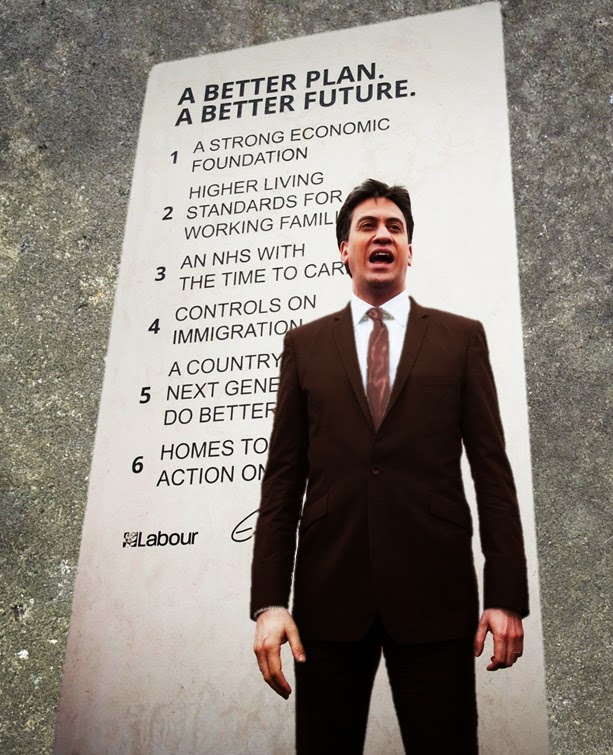
And since we don't believe these silly statements, however solemnly intoned they are, we then get the absurd spectacle of Cameron pledging to enshrine in law a promise not to increase income tax, VAT or national insurance. Followed by the even more absurd Miliband gimmick of having his vague, waffly pledges literally carved in stone.

I genuinely thought that this last one was a joke when I heard it. I still do.

But no matter how feverish the promises, how apocalyptic the denunciations of the other side(s), the electorate - as that Question Time audience illustrated - resolutely refuses to be convinced. We still think they're all lying. And they are.

Just to be clear: this was not always the case. There was a time when politicians told us grown-ups if things were going wrong. This is Edward Heath's message to the country in December 1973, telling us that we were in for the hardest Christmas since the war and that our standard of living was going to fall:


I'm not sure I can envisage Cameron or Miliband making that kind of broadcast. 

Mind you, it didn't do Heath much good; two months later, he was thrown out of office. Maybe that's why telling the truth fell out of fashion. Or maybe it was John Smith as shadow chancellor in 1992, telling us that if we wanted better services - which we said we did - we would have to see tax rises, which we decided was beyond the pale. Or possibly it was Blair winning three consecutive elections by peddling his PFI fantasy of 'investment' on the never-never. 

In any event, everyone now knows that there are serious problems coming, yet no politician is prepared to say so.

Despite all of which, I remain mostly optimistic about the future. 

Primarily this is because I don't believe the current settlement can survive, since it is so clearly dysfunctional. 

As many have pointed out, the principal justification for a first-past-the-post electoral system has always been that it provides strong, stable government. This no longer looks like a clinching argument. 

The inherent distortions are about to be revealed in the starkest manner ever. It is almost certain that Ukip will win the third largest share of the vote, and yet could end up tenth in the share of seats (the position it was in at the dissolution of the last Parliament).

Similarly, Nicola Sturgeon has talked a great deal about 'shutting the Tories out of Downing Street' with an anti-Tory majority in the Commons. This may well be the result, but the majority of the popular vote is likely at the same time to be right-of-centre; the Conservatives, Ukip and the Liberal Democrats will probably get more than 50 per cent between them. (I'm assuming that the Lib Dems' more left-inclined supporters will have abandoned them.)

There is also the fact that we no longer have any national parties, just a fraying patchwork of regional and nationalist groups. Those that still pretend to be national are self-evidently not fit for purpose.

And then there's Scotland. Some commentators are berating the Conservatives for jeopardising the Union with their apparent encouragement of the Scottish National Party; others are berating the Labour Party for their complacency in letting the SNP outflank them on the left.

But it doesn't matter much who's to blame; the fact is that there aren't very many passionate Unionists left, on either side of the border. Those who do claim to believe in the Union seem incapable of making out a case for it that goes beyond sentiment and slogan.

Whatever happens tomorrow, large numbers of people are going to feel not merely unhappy - that's normal - but cheated.

Back in 2012, I wrote that 'things are about to change quite radically'. I think we're edging ever nearer a critical moment.

Friday, 1 May 2015

...like the leaving of it

Seven days from now, we may well be getting the first resignation of a party leader. Presumably the Scottish National Party, Plaid Cymru and the Green Party of England and Wales will stick with their incumbent leaders, but for the others, nothing is certain. Quite possibly Nigel Farage and/or Nick Clegg will fail to be elected in the first place, while either David Cameron or Ed Miliband - whichever doesn't get to be prime minister - won't be long for the leadership.

As an object lesson in how not to leave the job of party leader, you'd have to go a long way to beat Gordon Brown.

Following the indecisive result of the general election in 2010, he hung around in Downing Street for a few days - as he was constitutionally bound to do, since he was still prime minister - but then abruptly walked out, a few hours before the deal between Cameron and Clegg was concluded: and on that he was constitutionally wrong.

The real problem, though, was what followed. Brown resigned the Labour leadership and sulked off to Scotland, leaving Harriet Harman to mind the shop for the next few months while the long process of choosing a new leader played itself out. It was during that period that the narrative of the financial crash and crisis was firmly fixed in the public consciousness by the coalition government.

Brown was badly damaged by then, but he should still have been capable of articulating an alternative view, of defending the economic growth figures bequeathed to the new government. He didn't do so. And the legacy of Brown's self-indulgence could be seen on Question Time last night, as Ed Miliband squirmed in the face of questions on Labour's economic record. The ground lost in 2010 has never been recovered.

Compare and contrast Michael Howard departure from the Conservative Party leadership in 2005. He announced immediately after losing the election that he would be standing down, but not for another six months, not till a new leader had been chosen. He then reshuffled his front-bench team and promoted George Osborne to shadow chancellor and David Cameron to shadow education secretary, thereby setting up the new generation to inherit the leadership. It worked perfectly (though Howard would probably have preferred Osborne).

It is possible in retrospect to conclude that Howard didn't ultimately do his party any favours in the short term, that David Davis would have been a sounder choice in 2005 and might well have won a majority in 2010. But even if one accepted this, Howard was at least doing what he genuinely believed was in his party's interests. Unlike Brown, who simply abandoned his party.

Friday, 24 April 2015

Who gets my vote: part 2

Continuing my ruminations about who to vote for in the coming election, the Liberal Democrats in my constituency of Holborn & St Pancras are fielding Jill Fraser.
This is a good choice - Fraser (she's the one in the middle) is a popular figure. In 2003 she won a shock by-election to be elected to Camden Council (this was against the backdrop of the invasion of Iraq), and went on to become mayor of the borough in 2006. She stood for parliament in the Holborn & St Pancras constituency in 2005, achieving an 11 per cent swing from Labour to Lib Dem, and she's very active and visible in local campaigning.

Her son is a university lecturer (which is surely a good thing), but most famously she works in a local chip-shop and has done for over two decades. This is not necessarily the image conjured up by the words 'North London Liberal'.

She didn't stand in 2010, but the Lib Dem candidate came in second again, for the third election running. The candidate then, Jo Shaw, got a shade under 28 per cent of the vote. Even with the personal standing of Fraser, it's unlikely to get much better this time. Last year the Lib Dems were all but wiped out in the local elections, and Fraser lost her council seat (as did all but one of their candidates).

The reality, of course, is that it doesn't really matter who the candidate is. This is nobody's idea of a target seat (even assuming that the Lib Dems enjoyed the luxury of having target seats) and the party isn't exactly pouring resources into the constituency campaign. Fraser could promise free chips to every voter without it making any real difference.

I've long thought that the Lib Dems would do better in this election than was being predicted. And my reasoning was that they had quite a decent story to tell. Nick Clegg made the right decision in 2010 to enter a coalition government. Coalitions are what the party had been talking about for my entire adult life, and it would have been absurd to turn down the opportunity when it arose. Further, I have no doubt that the presence of the Lib Dems made the government a better one than it would have been had the Tories governed alone. Those were the two options that existed after the nation had voted, and we got the better of the two.

Now, though, I'm not so sure about the Lib Dem prospects. I think that as the choice between David Cameron and Ed Miliband becomes starker, there is a very real possibility that the Lib Dems will get squeezed. Clegg seems to me to be playing a limited hand pretty well, but for most of this campaign it's been as though the party hardly exists. No one appears to care in the slightest what they have to say.

And that's a bit of a shame, because I think the country benefits from having a moderately strong Lib Dem presence. It provides an alternative where none would otherwise exist, and it can sometimes spring a surprise. Eastbourne, for example, where the Labour Party stands no chance, was Tory for eighty years solid until the IRA murdered Ian Gow in 1990; now it's a Lib Dem constituency and likely to remain so.

I mean, obviously we have no idea what they stand for or what they believe. Lord knows they haven't actually been liberal for a long time, save for the occasional outbreak of concern over civil liberties. But believing in stuff isn't really their thing. Their job is to represent the don't knows. Which isn't intended as a criticism: there are an awful lot of don't knows, and they're entitled to have their uncertain voice heard, just as much as those who think they know everything.

And maybe I'm wrong about them being squeezed. Their best post-war performance came in 1983, in their incarnation as the SDP-Liberal Alliance. The country was then offered the choice of Margaret Thatcher or Michael Foot, and a very large number of people decided that they're rather have neither. The same could hold true for the party this time. Except that I don't think it will.

More than the state of the party at a national level, however, the problem for Jill Fraser is that she's rather wasted on Holborn & St Pancras. She'd make someone a good MP. But not us.

Thursday, 9 April 2015

Polly and the Non-Doms

I like Polly Toynbee. In my book A Classless Society, I celebrated her 1995 article in the aftermath of the fiftieth anniversary of VE Day, when she chided the British nation for being so obsessed with the past on 8 May that it forgot to make anything of Europe Day on 9 May. Leave aside that nonsense about defeating Nazism, she urged us, and get on with celebrating the EU. To be charitable, let's assume it was satire.

Her latest piece in the Guardian is a little less frivolous. She argues that the Labour Party's commitment to (sort of) abolishing the non-domiciled tax category may prove to be as 'totemic' as Margaret Thatcher's policy of selling council houses to their tenants. Whether the commitment (if enacted) would raise any revenue is irrelevant: 'The message, not the money, is what matters.'

I think she's right. This is a purely symbolic gesture. And I suspect it may play very well, possibly even among those Labour voters who are being tempted toward Ukip.

But what is the message that Ed Miliband is sending out with this announcement? According to Toynbee, it represents, along with the 'mansion' tax and the 50 per cent tax rate, a 'significant break with New Labour's contamination, infatuation and fear of the super-rich'.

And that seems to me to be a bit of a letdown. If even Labour's friends (and I believe that Toynbee is presently a friend of the Party) can only spin this as being an exorcism of New Labour ghosts, that doesn't really fit into the category of 'totemic policies that announce what a party stands for'. Rather, it's negative; it announces what Miliband is against, not what he's for. And what he's against, says Toynbee, is Tony Blair. Which is as a good way of uniting the nation as any, but is a slightly odd approach to take for the leader of the Labour Party.

A decent policy, but not one that feels like it's in the same class as council-house sales. More like Blair's own attack on Clause Four, though a bit later in the day.