
Showing posts with label Conservative Party. Show all posts
Showing posts with label Conservative Party. Show all posts
Tuesday, 6 October 2015
Theresa May: a portrait
Having written some profiles of various Labour figures, drawn from their press cuttings, I thought I'd try a Tory. So here's a portrait of the home secretary Theresa May. She's very dull, I know, but there are some points of interest in her story.


Friday, 28 August 2015
Teresa Gorman
In memory of Teresa Gorman, who died yesterday, I thought I would post an extract from my book A Classless Society about the Maastricht rebellion, in which she was such a prominent feature. Apart from anything else, it's good to remember that both major parties have had long-standing dissidents, who party managers feel probably shouldn't be allowed out in public too much.
 He was
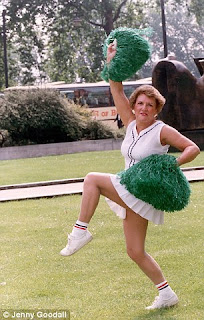
rivalled in coverage only by Teresa Gorman, the MP for Billericay whose vocal enthusiasm
for hormone replacement therapy, never knowingly understated dress sense and
tattooed eyebrows (to conceal the fact that her real ones hadn’t grown back
after being shaved) were matched only by her splendid quotability. ‘The
Conservative establishment,’ she once announced, ‘has always treated women as
nannies, grannies and fannies.’
He was
rivalled in coverage only by Teresa Gorman, the MP for Billericay whose vocal enthusiasm
for hormone replacement therapy, never knowingly understated dress sense and
tattooed eyebrows (to conceal the fact that her real ones hadn’t grown back
after being shaved) were matched only by her splendid quotability. ‘The
Conservative establishment,’ she once announced, ‘has always treated women as
nannies, grannies and fannies.’
The attempt to get Maastricht ratified in the Commons
dominated politics in the first half of 1993. In a series of votes a stubborn
group of Conservative backbenchers fought every line of the Bill, often siding
with the Labour Party in what John Major called ‘a mad-hatter coalition’. The ensuing
bitterness soured the party for years to come. ‘In the voting lobbies it was
not unknown for one Conservative MP to spit at another,’ remembered Michael
Spicer. ‘Physical violence occurred during the course of one or two crucial
votes.’ He also recalled a senior MP being dragged by his hair into the
government’s lobby.
Spicer was a key figure in the rebellion, but one who
insisted on maintaining good relations with the whips and the leadership. He
was also reluctant to attract attention to himself at a time when the open voicing
of dissent guaranteed publicity. Indeed, Maastricht made media stars of several
backbenchers who would otherwise have languished in obscurity.
Chief amongst them was Bill Cash, whose slight frame,
unflattering pinstripe suits, greying hair and glasses made him look like Major’s
Eurosceptic doppelganger. He was ‘the biggest bore in the House of Commons’,
according to his colleague Julian Critchley, though another Tory MP, Teddy
Taylor, disagreed: ‘I am the biggest Euro-bore there ever was.’ Cash managed to
vote against his government forty-seven times during the Maastricht debates, with
a further thirteen abstentions, and did what he was told just twice.
 He was
rivalled in coverage only by Teresa Gorman, the MP for Billericay whose vocal enthusiasm
for hormone replacement therapy, never knowingly understated dress sense and
tattooed eyebrows (to conceal the fact that her real ones hadn’t grown back
after being shaved) were matched only by her splendid quotability. ‘The
Conservative establishment,’ she once announced, ‘has always treated women as
nannies, grannies and fannies.’
He was
rivalled in coverage only by Teresa Gorman, the MP for Billericay whose vocal enthusiasm
for hormone replacement therapy, never knowingly understated dress sense and
tattooed eyebrows (to conceal the fact that her real ones hadn’t grown back
after being shaved) were matched only by her splendid quotability. ‘The
Conservative establishment,’ she once announced, ‘has always treated women as
nannies, grannies and fannies.’
There was an equally oddball supporting cast,
with notable contributions from the married couple Ann and Nicholas Winterton,
dismissed scornfully by Michael Heseltine as having a knack for stumbling upon ‘a
populist cause waiting for a voice’. Their fellow MP Nicholas Soames was less
restrained: ‘You’re cunts,’ he told them after one Commons rebellion, ‘and ugly
ones to boot.’
This group of mavericks and misfits – a hard core of around
twenty-five, with a similar number on the fringes – were undoubtedly motivated
by high principle, albeit in some cases only recently discovered. This,
however, was neither the first nor the lasting impression they made on a
television audience. Every time they conducted yet another round of interviews
on College Green, they came across as slightly strange, obsessed with an issue
that simply didn’t feel like a priority to most of the electorate. They were
not, for many viewers, very endearing...
Tuesday, 25 August 2015
One Nation
'Anxious as we are to reduce taxation, we have no intention of slashing the social services. We believe in them as great national and human assets, and are prepared to make sacrifices to preserve them.'


R.A. Butler, chancellor of the exchequer in the Conservative government of 1951-55, speaking in 1953.
Thursday, 30 July 2015
Up the hill backwards
The Labour Party has 232 MPs. To form a majority in the House of Commons, a party needs to have 326 MPs. So if Labour is to win the next election outright, it needs to take an additional ninety-four seats.
Of the ninety-four marginal constituencies where Labour missed out most narrowly this year, eight are currently held by the SNP, three by the Liberal Democrats, two by Plaid Cymru and one by the Greens. The other eighty are all Conservative.
It would be simplistic to say that the party needs to win these ninety-four seats to form a majority government, because it assumes that there will no boundary changes (which there will be), and that Labour should target its efforts purely on existing numbers (which isn't necessarily the case). But still, it's a rough guide to the task ahead.
So the question is: How is Labour going to take a seat like Gravesham in Kent (no. 91 on the list), where the Tories currently have a majority of over 8,000? The Lib Dems and the Greens are irrelevant here - there are no votes to be squeezed out of them. So Labour would need to take votes either directly from the Conservatives or from Ukip, who are in a strong third place with a 19 per cent share.
The same pattern is found right across the country. Not just the obvious southern constituencies of Crawley (no. 71), Milton Keynes South (83) and Thurrock (8). But also seats in the Midlands, such as Dudley South (55), Erewash (30) and Telford (11). And in the North as well: Morley & Outwood (6), Pendle (65) and Stockton South (47).
All of these and many others - most of those on the list - are held by the Conservatives, with Labour second, Ukip third, and no one else in sight. Winning these seats is Labour's only path to power.
By comparison, the general election this year was so much easier. Some four-and-a-half million Lib Dem votes went missing from the party's 2010 total. Which makes it all the more shocking that Labour's popular vote only increased by around three-quarters-of-a-million. Next time it'll be far harder.

Some things will change before 2020, of course. Ukip support may well fall away in the next couple of years, depending on how the referendum goes, which would make their votes more easily available for someone. But this is far from certain. It may be that Ukip actually increases its strength. Or it may split. Their vote is the great unknown in electoral arithmetic, but my assumption is that there's a stubborn protest vote in there that's not going to end up with either of the major parties.
Somewhat clearer than the fate of Ukip is the fact that surely the Lib Dems will do better in the next election than they did this year. In a very marginal seat, this might help Labour, since it could reduce the Tory share. But more generally, the Lib Dems will be on the rise and will be competing with Labour for new votes.
Maybe majority government is too ambitious a target for Labour right now. Maybe a minority administration, with support from other parties, is as good as it could get. But the challenge is still the same: How does the Labour Party take votes from the Conservatives and from Ukip?
Of the ninety-four marginal constituencies where Labour missed out most narrowly this year, eight are currently held by the SNP, three by the Liberal Democrats, two by Plaid Cymru and one by the Greens. The other eighty are all Conservative.
It would be simplistic to say that the party needs to win these ninety-four seats to form a majority government, because it assumes that there will no boundary changes (which there will be), and that Labour should target its efforts purely on existing numbers (which isn't necessarily the case). But still, it's a rough guide to the task ahead.
So the question is: How is Labour going to take a seat like Gravesham in Kent (no. 91 on the list), where the Tories currently have a majority of over 8,000? The Lib Dems and the Greens are irrelevant here - there are no votes to be squeezed out of them. So Labour would need to take votes either directly from the Conservatives or from Ukip, who are in a strong third place with a 19 per cent share.
The same pattern is found right across the country. Not just the obvious southern constituencies of Crawley (no. 71), Milton Keynes South (83) and Thurrock (8). But also seats in the Midlands, such as Dudley South (55), Erewash (30) and Telford (11). And in the North as well: Morley & Outwood (6), Pendle (65) and Stockton South (47).
All of these and many others - most of those on the list - are held by the Conservatives, with Labour second, Ukip third, and no one else in sight. Winning these seats is Labour's only path to power.
By comparison, the general election this year was so much easier. Some four-and-a-half million Lib Dem votes went missing from the party's 2010 total. Which makes it all the more shocking that Labour's popular vote only increased by around three-quarters-of-a-million. Next time it'll be far harder.
Some things will change before 2020, of course. Ukip support may well fall away in the next couple of years, depending on how the referendum goes, which would make their votes more easily available for someone. But this is far from certain. It may be that Ukip actually increases its strength. Or it may split. Their vote is the great unknown in electoral arithmetic, but my assumption is that there's a stubborn protest vote in there that's not going to end up with either of the major parties.
Somewhat clearer than the fate of Ukip is the fact that surely the Lib Dems will do better in the next election than they did this year. In a very marginal seat, this might help Labour, since it could reduce the Tory share. But more generally, the Lib Dems will be on the rise and will be competing with Labour for new votes.
Maybe majority government is too ambitious a target for Labour right now. Maybe a minority administration, with support from other parties, is as good as it could get. But the challenge is still the same: How does the Labour Party take votes from the Conservatives and from Ukip?
Saturday, 27 June 2015
How to leave a calling card
Next month it will be fifty years since the Conservative Party chose a new leader. Alec Douglas-Home had resigned - just ten months after losing the 1964 general election to Harold Wilson - and for the first time the party was staging a leadership election. Previously leaders had 'emerged' after informal soundings had been taken.
The front-runners this time were Reginald Maudling and Edward Heath. Maudling was a major figure, having been chancellor of the exchequer until the election defeat, while Heath was then little known to the public: his biggest jobs had mostly been behind the scenes, first as chief whip and then as Britain's chief negotiator in the country's unsuccessful attempt to join the European Community.
In the country, there would have been no doubt about the victor, but at this stage the electorate consisted solely of Tory MPs - and former chief whips tend to have a bit more sway in such circles.
So they went into the final day of campaigning with the result very much in doubt. 'Tory Big 2 Neck and Neck for Ballot No 1,' read the headline in the Daily Mirror, and the Daily Express agreed: 'It looks like a very close finish - perhaps deadlock.'
The rogue element was the third entry in the field, the former health minister Enoch Powell. No one expected him to get more than a couple of dozen votes, but that might have been enough to muddy the waters. If a candidate was to win on the first ballot, the rules required him (no one was thinking it might be 'her') to get over 50 per cent of the vote and to have a clear 15 per cent lead over the second-placed candidate. Powell's involvement might make that difficult, and mean that a second ballot could prove necessary.
It turned out that it wasn't. Heath got 150 votes (50.4 per cent) to Maudling's 133 (44.6 per cent), a result that didn't fulfill the second criterion, but was sufficient to persuade Maudling to withdraw from the contest, leaving Heath as the first grammar school-educated leader of the Conservative Party.
 And what of Powell? Well, he didn't even meet the low expectations of his supporters. Just fifteen MPs cast their votes for him, although it's worth noting that a couple of them went on to better things: Nicholas Ridley and John Biffen were later to serve in Margaret Thatcher's cabinet. Powell had, he said, 'left his calling card', put down a marker that he'd be back. It didn't seem very likely, though: he was obscure before, and his profile hadn't been raised particularly during the campaigning.
Less than three years later, however, Powell had eclipsed both Heath and Maudling and had become the best known - if most controversial - politician in the country. The 1968 'rivers of blood' speech took him to undreamt-of heights. Just before that speech an opinion poll suggested that just 1 per cent of the public thought he should become leader in the event that Heath stood down. Run again after the speech, a similar poll showed him as the front runner.
And the lesson from this? Maybe that whoever loses the Labour Party leadership election this year shouldn't lose all hope. Or maybe not.
The front-runners this time were Reginald Maudling and Edward Heath. Maudling was a major figure, having been chancellor of the exchequer until the election defeat, while Heath was then little known to the public: his biggest jobs had mostly been behind the scenes, first as chief whip and then as Britain's chief negotiator in the country's unsuccessful attempt to join the European Community.
In the country, there would have been no doubt about the victor, but at this stage the electorate consisted solely of Tory MPs - and former chief whips tend to have a bit more sway in such circles.
So they went into the final day of campaigning with the result very much in doubt. 'Tory Big 2 Neck and Neck for Ballot No 1,' read the headline in the Daily Mirror, and the Daily Express agreed: 'It looks like a very close finish - perhaps deadlock.'
The rogue element was the third entry in the field, the former health minister Enoch Powell. No one expected him to get more than a couple of dozen votes, but that might have been enough to muddy the waters. If a candidate was to win on the first ballot, the rules required him (no one was thinking it might be 'her') to get over 50 per cent of the vote and to have a clear 15 per cent lead over the second-placed candidate. Powell's involvement might make that difficult, and mean that a second ballot could prove necessary.
It turned out that it wasn't. Heath got 150 votes (50.4 per cent) to Maudling's 133 (44.6 per cent), a result that didn't fulfill the second criterion, but was sufficient to persuade Maudling to withdraw from the contest, leaving Heath as the first grammar school-educated leader of the Conservative Party.

Less than three years later, however, Powell had eclipsed both Heath and Maudling and had become the best known - if most controversial - politician in the country. The 1968 'rivers of blood' speech took him to undreamt-of heights. Just before that speech an opinion poll suggested that just 1 per cent of the public thought he should become leader in the event that Heath stood down. Run again after the speech, a similar poll showed him as the front runner.
And the lesson from this? Maybe that whoever loses the Labour Party leadership election this year shouldn't lose all hope. Or maybe not.
Wednesday, 27 May 2015
Will no one rid us of this tedious pundit?
'The Tories who witnessed the Major years still bear some scar tissue,' writes Simon Heffer in the New Statesman, as he commences his analysis of the new government's position.
Well, yes, and much of it was inflicted by him and others in the supposedly loyal Tory press, still worshipping at the shrine of the fallen idol, having never got over the emotional shock of witnessing her departure from Downing Street. When John Major was told during the 1992 election campaign that the Conservative Party was six points behind Labour in the opinion polls, he replied: 'Of those six points, three are the fault of Simon Heffer and the other three are Frank Johnson's fault.'
Heffer was then the deputy editor of the Daily Telegraph and the relentless sniping from that newspaper and from the Daily Mail did a huge amount of damage to Major's government. It'll be interesting to see how much they've learned from the experience.
Meanwhile, though, I do wonder why any publication continues to pay Heffer money for his views, given how ludicrously inept his assessments are. I know most commentators, having spent far too long reading opinion polls, called the recent election wrong, but Heffer is way beyond that. He is willfully blind to reality, his perception distorted by dogma in a way that would have caused embarrassment to a member of the Workers' Revolutionary Party in the days of Gerry Healy.
In May last year, following the European elections, Heffer wrote about the urgent need for the Tories to form an electoral pact with Ukip. In constituencies such as Nigel Farage's promised land of Thanet South, he said, 'there is nothing to be gained by putting up a novice candidate against him'. Foolishly, the Conservative party ignored his wise advice, fielded their own candidate and, er, won the seat.
Heffer's article concluded: 'If the Tories have any sense, they will start talking about such an arrangement now. For if, next week, Ukip wins the Newark by-election and the Tories descend into panic, David Cameron might find himself with no other option.' Needless to say, the Conservative Party won the Newark by-election, with a handsome 7,400 majority. In the general election, they increased that to 18,500, with Ukip beaten into third place by Labour.
But the great sage was undeterred. He still knew better, and mere facts weren't going to get in his way. This is him in August last year. 'Although they [the Tories] have doggedly refused to entertain the idea, they will have to consider an electoral pact with Ukip, or face at least five years out of government.' Consequently, 'the party's grandees will, I am convinced, make a humiliating U-turn.'
If David Cameron would only reach out to Ukip, 'he wouldn't just keep himself in Downing Street, but would reunite a conservative coalition - which, I am sure, is really what the country wants.'
All that certainty, all that absolute self-confidence, all that nonsense.
But then this is the man who backed John Redwood's bid for the Conservative leadership in 1995. He has been consistently wrong for over twenty years now. Why is he still considered employable?

Well, yes, and much of it was inflicted by him and others in the supposedly loyal Tory press, still worshipping at the shrine of the fallen idol, having never got over the emotional shock of witnessing her departure from Downing Street. When John Major was told during the 1992 election campaign that the Conservative Party was six points behind Labour in the opinion polls, he replied: 'Of those six points, three are the fault of Simon Heffer and the other three are Frank Johnson's fault.'
Heffer was then the deputy editor of the Daily Telegraph and the relentless sniping from that newspaper and from the Daily Mail did a huge amount of damage to Major's government. It'll be interesting to see how much they've learned from the experience.
Meanwhile, though, I do wonder why any publication continues to pay Heffer money for his views, given how ludicrously inept his assessments are. I know most commentators, having spent far too long reading opinion polls, called the recent election wrong, but Heffer is way beyond that. He is willfully blind to reality, his perception distorted by dogma in a way that would have caused embarrassment to a member of the Workers' Revolutionary Party in the days of Gerry Healy.
In May last year, following the European elections, Heffer wrote about the urgent need for the Tories to form an electoral pact with Ukip. In constituencies such as Nigel Farage's promised land of Thanet South, he said, 'there is nothing to be gained by putting up a novice candidate against him'. Foolishly, the Conservative party ignored his wise advice, fielded their own candidate and, er, won the seat.
Heffer's article concluded: 'If the Tories have any sense, they will start talking about such an arrangement now. For if, next week, Ukip wins the Newark by-election and the Tories descend into panic, David Cameron might find himself with no other option.' Needless to say, the Conservative Party won the Newark by-election, with a handsome 7,400 majority. In the general election, they increased that to 18,500, with Ukip beaten into third place by Labour.
But the great sage was undeterred. He still knew better, and mere facts weren't going to get in his way. This is him in August last year. 'Although they [the Tories] have doggedly refused to entertain the idea, they will have to consider an electoral pact with Ukip, or face at least five years out of government.' Consequently, 'the party's grandees will, I am convinced, make a humiliating U-turn.'
If David Cameron would only reach out to Ukip, 'he wouldn't just keep himself in Downing Street, but would reunite a conservative coalition - which, I am sure, is really what the country wants.'
All that certainty, all that absolute self-confidence, all that nonsense.
But then this is the man who backed John Redwood's bid for the Conservative leadership in 1995. He has been consistently wrong for over twenty years now. Why is he still considered employable?

Monday, 18 May 2015
Decline of a moral crusade
It's been a couple of weeks since I put a graph on this blog. So here's one showing the proportion of the electorate who voted for the Labour Party in general elections between 1950 and 2015:
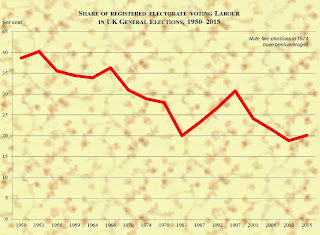 There are a couple of blips in there - down with Michael Foot in 1983, up with Tony Blair in 1997 - but the underlying, downward trend is unmistakeable. And that seems to me pretty much the key issue that Labour ought to be considering.
Obviously this decline in interest is not confined to Labour. The share achieved by both major parties has been falling fairly steadily, eroded by the growth of minor parties (Liberal and nationalist) from the 1960s onwards, and by low turnout more recently.
Here's another chart, showing the performance of both Labour and Conservative Parties.
 Like high-street shopping, politics isn't what it used to be. There's still room for a specialist, niche supplier such as the SNP, and for the purely functional Tesco Metro or Sainsbury Local represented by the Conservatives. But Labour is in danger of looking like Woolworth's - trying to do so many things, all of them adequately at best, that no one can remember why it's there.
Because the decline is, I believe, a bigger problem for Labour than it is for the Tories. Generally speaking, the Conservatives don't need to inspire their supporters in the same way; normally they can fall back on their reputation for economic competence. Despite Harold Wilson's boast that Labour had become 'the natural party of government', the default setting in British politics is Tory.
To illustrate the point: this election was not the first since 1950 in which the result was unexpected. The same was true in 1970 and again in 1992. And in all of these, the surprise was that the Conservative Party won. (Or, possibly, the Labour Party lost.)
The Labour equivalent of these surprise victories is negative: an unexpectedly unconvincing win, as in 1964 and 1974.
To find an exception, you have to go back to the Labour victory in 1945, before opinion polls were properly established. And that election was held in quite extraordinary circumstances - to start with, it was the first for a decade. It did, though, illustrate Labour's great challenge: unlike the Tories, in order to win power, it really needs to articulate a vision of a better future.
As Wilson also pointed out: 'The Labour Party is a moral crusade or it is nothing.'
The task in choosing a new leader is to find someone who can articulate a sense of hope for the future, to persuade somewhere around a quarter of the electorate that he or she can help us build a better society.
It doesn't sound too difficult, put like that. But clearly it is. And of those who have so far declared that they would like to be candidates, I can't say that any have so far inspired me.

Obviously this decline in interest is not confined to Labour. The share achieved by both major parties has been falling fairly steadily, eroded by the growth of minor parties (Liberal and nationalist) from the 1960s onwards, and by low turnout more recently.
Here's another chart, showing the performance of both Labour and Conservative Parties.

Because the decline is, I believe, a bigger problem for Labour than it is for the Tories. Generally speaking, the Conservatives don't need to inspire their supporters in the same way; normally they can fall back on their reputation for economic competence. Despite Harold Wilson's boast that Labour had become 'the natural party of government', the default setting in British politics is Tory.
To illustrate the point: this election was not the first since 1950 in which the result was unexpected. The same was true in 1970 and again in 1992. And in all of these, the surprise was that the Conservative Party won. (Or, possibly, the Labour Party lost.)
The Labour equivalent of these surprise victories is negative: an unexpectedly unconvincing win, as in 1964 and 1974.
To find an exception, you have to go back to the Labour victory in 1945, before opinion polls were properly established. And that election was held in quite extraordinary circumstances - to start with, it was the first for a decade. It did, though, illustrate Labour's great challenge: unlike the Tories, in order to win power, it really needs to articulate a vision of a better future.
As Wilson also pointed out: 'The Labour Party is a moral crusade or it is nothing.'
The task in choosing a new leader is to find someone who can articulate a sense of hope for the future, to persuade somewhere around a quarter of the electorate that he or she can help us build a better society.
It doesn't sound too difficult, put like that. But clearly it is. And of those who have so far declared that they would like to be candidates, I can't say that any have so far inspired me.
Tuesday, 12 May 2015
The priest and the pronoun
Like everyone who reads the Guardian website, I try to avoid the writings of certain contributors, safe in the knowledge that they're just trying to annoy me. In my case it's primarily Jonathan Jones and Giles Fraser. And then last night - for reasons I can't fathom - I found I'd clicked on a piece by Fraser for the first time in months.
He hasn't got any better in the interim. He still annoys me. And he still specialises in the kind of hand-wringing smugness that helped to drive the congregations out of the Church of England.
Writing on Friday, in the immediate aftermath of the election, he says he's 'ashamed to be English', to be living in a country 'that has clearly identified itself as insular, self-absorbed and apparently caring so little for the most vulnerable people among us'. And he wonders: 'Did we just vote for our own narrow concerns and sod the rest?'
Obviously no one's fooled for a second by that 'we'. This is no mea culpa. Readers are expected to understand that the fault lies with others; Fraser, and all decent-minded folk, are motivated solely by concern for 'the most vulnerable people' in our society.
This is part of an all-too-common narrative that anyone who didn't vote for an approved 'progressive' party was merely 'tick[ing] the box of our own self-interest'. (Again, that fraudulent first-person pronoun.) Apparently 'we' sold out the poor on the promise of a mess of pottage some way down the road.
By the same token, I suppose, one could argue that those in receipt of benefits, or those employed by the state, might have voted Labour in the expectation that their income would thus be better protected. They were sufficiently selfish that they demanded others pay higher taxes on their behalf.
Both positions are nonsense, of course. When casting a vote, most people (I believe) find that self-interest co-exists with other considerations, including an assessment of which of the limited alternatives on offer might be in the national interest.
And last week around half of those who voted in the United Kingdom opted for the Conservative Party or for Ukip, parties with whom Fraser has little sympathy, and of which he has little understanding.
One would have to be very arrogant indeed to conclude that - unlike oneself - those voters don't care about anyone else. It may well be that they believe 'the most vulnerable' can be better helped in a wealthy country than in a poor one, and therefore opted against parties who they felt would harm the economy. Even if you think their judgement is wrong, that doesn't mean it was made in bad faith.
Nor do people vote for the totality of a party's programme. Many, perhaps millions, who voted Conservative will have done so despite disagreeing with proposed cuts to disability benefits. Just as many, perhaps millions, will have voted Labour despite disagreeing with their promise to 'control immigration'.
 Why am I bothering with Fraser, the kind of Christian who believes that the existence of charity is an indictment of society?
Well, because I've had a couple of people tell me that my post-election pieces on this blog are unnecessarily harsh on Labour and the Greens, and unreasonably positive about the Conservatives and Ukip. Which may be true but, unlike Fraser, I'm not interested in seeking comfort by denouncing all those who stray beyond the 'progressive' pale.
The truth is that the Left lost very badly last week, and the Right won. Even if you put together the Labour and the SNP votes, they still didn't reach the total cast for the Conservatives. That needs examining and, if possible, explaining. And in pursuit of that, one should strive for objectivity, rather than settle for accusations.
To misquote Karl Marx: Some historians have tried to change the world in various ways; the point is to understand it.
He hasn't got any better in the interim. He still annoys me. And he still specialises in the kind of hand-wringing smugness that helped to drive the congregations out of the Church of England.
Writing on Friday, in the immediate aftermath of the election, he says he's 'ashamed to be English', to be living in a country 'that has clearly identified itself as insular, self-absorbed and apparently caring so little for the most vulnerable people among us'. And he wonders: 'Did we just vote for our own narrow concerns and sod the rest?'
Obviously no one's fooled for a second by that 'we'. This is no mea culpa. Readers are expected to understand that the fault lies with others; Fraser, and all decent-minded folk, are motivated solely by concern for 'the most vulnerable people' in our society.
This is part of an all-too-common narrative that anyone who didn't vote for an approved 'progressive' party was merely 'tick[ing] the box of our own self-interest'. (Again, that fraudulent first-person pronoun.) Apparently 'we' sold out the poor on the promise of a mess of pottage some way down the road.
By the same token, I suppose, one could argue that those in receipt of benefits, or those employed by the state, might have voted Labour in the expectation that their income would thus be better protected. They were sufficiently selfish that they demanded others pay higher taxes on their behalf.
Both positions are nonsense, of course. When casting a vote, most people (I believe) find that self-interest co-exists with other considerations, including an assessment of which of the limited alternatives on offer might be in the national interest.
And last week around half of those who voted in the United Kingdom opted for the Conservative Party or for Ukip, parties with whom Fraser has little sympathy, and of which he has little understanding.
One would have to be very arrogant indeed to conclude that - unlike oneself - those voters don't care about anyone else. It may well be that they believe 'the most vulnerable' can be better helped in a wealthy country than in a poor one, and therefore opted against parties who they felt would harm the economy. Even if you think their judgement is wrong, that doesn't mean it was made in bad faith.
Nor do people vote for the totality of a party's programme. Many, perhaps millions, who voted Conservative will have done so despite disagreeing with proposed cuts to disability benefits. Just as many, perhaps millions, will have voted Labour despite disagreeing with their promise to 'control immigration'.

Well, because I've had a couple of people tell me that my post-election pieces on this blog are unnecessarily harsh on Labour and the Greens, and unreasonably positive about the Conservatives and Ukip. Which may be true but, unlike Fraser, I'm not interested in seeking comfort by denouncing all those who stray beyond the 'progressive' pale.
The truth is that the Left lost very badly last week, and the Right won. Even if you put together the Labour and the SNP votes, they still didn't reach the total cast for the Conservatives. That needs examining and, if possible, explaining. And in pursuit of that, one should strive for objectivity, rather than settle for accusations.
To misquote Karl Marx: Some historians have tried to change the world in various ways; the point is to understand it.
Monday, 11 May 2015
David Cameron: chillaxing to victory
In 2005, following a third successive election defeat, the Conservative Party staged a beauty contest for those who wished to succeed Michael Howard as leader. Up until that morning, the front-runner had been David Davis, but by the time all five candidates had made their 20-minute speeches, he'd been overtaken by David Cameron.
Amongst those who had their minds changed was me. I rated Davis highly at this stage, largely on the strength of a gig he did with Tony Benn at the Royal Albert Hall in 2002. Benn was then at the peak of his popularity as a lovable elder statesman, and for a Conservative to have the nerve to go head-to-head with him in front of an audience that was guaranteed to be 99 per cent anti-Tory showed, I thought, considerable bottle and self-confidence. He was also very good on the night.
Unfortunately he wasn't very good at that 2005 conference, while Cameron was brilliant. Maybe - I've often had cause to think in the last ten years - I was dazzled by a smoke-and-mirrors act, but my immediate response was to predict to the person with whom I was watching on TV that Cameron would win the leadership and would go on to win the next two general elections.
As I say, maybe I was caught up in the heat of the moment. In the final poll, the party members voted for Cameron over Davis in a ratio of two to one, but come 2010 the country did not. He failed to win the election, despite facing only a badly wounded Gordon Brown, a man whose most noteworthy contribution to the campaign was to insult a supporter for her alleged bigotry.
Now, however, Cameron has actually won an election, and I feel my original judgement was sort of vindicated.
This has been a spectacular victory, though not quite as wondrous as some are claiming. The Conservatives' share of the vote went up, but turnout was still poor and Cameron persuaded just 24.4 per cent of the registered electorate to vote for him. This was, however, better than the 23.5 per cent he achieved last time round (itself an improvement on Labour's 21.6 per cent in 2005).
So I wanted to make a couple of points about Cameron.
The first is something that I explored at greater length in an article on the twenty-first anniversary of Black Wednesday. This is a photograph of Norman Lamont, then chancellor of the exchequer, announcing Britain's humiliating withdrawal from the exchange rate mechanism in September 1992:
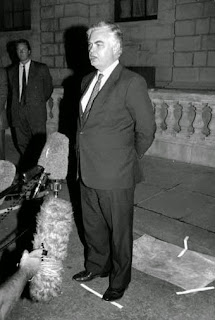 And there, off to one side, is his 25-year-old adviser and speech writer, David Cameron.
Cameron, I wrote, 'witnessed at close quarters the spectacular implosion of a party that once believed it was predestined to power'. I suggested that this is perhaps why he always seems so relaxed in a crisis. Similarly George Osborne, who was at Douglas Hogg's side in the BSE disaster of 1996. These people had experienced such dreadful political depths in their early years that very little was going to faze them.
Ed Miliband and Ed Balls, on the other hand were New Labour advisers in the 1990s, at a time when the party was already coasting into government. They had no such baptism of fire.
When Cameron became leader in 2005, it was clear that his job was, in the cliché of the time, to 'decontaminate the Tory brand'. The early efforts were clumsy and gimmicky: hugging hoodies and huskies, demonstrating his green credentials by installing a windmill on his roof and cycling to work (followed by a car, carrying his papers).
Then he got blown off course by the bankers' recession. No longer, it appeared, was sunshine going to win the day. The concept of the Big Society withered on the vine (though it's actually very good and the Labour Party should take it back).
Instead, the attempt to modernise the party seemed to consist of little more than the sudden, unpromised introduction of same-sex marriages. It didn't seem like very much - essentially a new name for civil partnerships - but actually it turned out to do the job really rather well.
Because the success of same-sex marriages lay not in the legislation itself, but in the way that it provoked a mass exodus from the party. Some constituency organisations claimed to have lost up to half their members as a result of the policy.
This was, most commentators agreed, disastrous for Cameron. But it wasn't. In one fell blow he'd cleared out large numbers of the 'fruitcakes, loonies and closet racists', as he'd described Ukip back in 2006. Many of them, of course, went straight over to Ukip, giving that party a huge boost in membership and popularity.
Less noticed was the effect on the Conservative Party itself, now smaller but - from Cameron's perspective - much better looking. It has become difficult to denounce the Tories as racist, sexist, homophobic and still retain any credibility as a political observer. The party that embraced economic liberalism in the 1980s has accepted the social liberalism that spread across Britain in the 1990s.
The election results this week saw Cameron increase the Conservative share of the vote, largely at the expense of the Liberal Democrats. All those right-wing commentators like Simon Heffer and Charles Moore who had insisted that the Cameron project was misguided, that he shouldn't be trying to appeal to the liberal vote (sometimes even suggesting he form an electoral pact with Ukip) - they turned out to be completely wrong.
There are many other commentators for whom the Tory brand cannot ever be sufficiently decontaminated, but it turns out that he's done enough. Not enough for those in the long-derided 'metropolitan elite' of course, those who follow in the pioneering footsteps of the delegate to the 1982 SDP conference, excitedly proclaiming: 'There may be minorities we have not yet discovered.' But enough for the rest of the country.
The achievement of Tony Blair in the mid-1990s was to make the Labour Party a safe home for ex-Tory voters. If Cameron hasn't quite reciprocated that achievement, he has gone some way towards it. There were many disillusioned Liberal Democrats, and even some lifelong Labour supporters, who simply couldn't countenance Ed Miliband and who felt just about safe enough to turn to vote Conservative for the first time ever, despite grave reservations over Tory policy.
As all the polls showed, Cameron's ratings outstripped his party's; Miliband's trailed his.
The Left need to get used to the idea that Cameron and Osborne have changed the Conservative Party for good. A new line of attack is needed.
One final thought. There is much talk of this election resembling 1992 when John Major won a slender majority and then ran into trouble with his own party over Europe. And look what's coming next, say the columnists: it's a European referendum and history could repeat itself.
I think this unlikely. If Ukip had got, say, five MPs they might have formed a rival pole of attraction for Eurosceptic Tory members, and there might have been defections over the referendum arrangements. Then Cameron would have had trouble. That might still happen if there are a few by-elections that allow Ukip to boost their numbers, but I doubt it. And Douglas Carswell does not in himself constitute a rival pole of attraction.
In any event, Cameron is much more in tune with the mood of his party than Major was. He remembers all too well the damage that Europe did to the Tories in the 1990s. Most importantly, he doesn't face the same problem that afflicted his predecessor.
Because Major's real grief over Europe was not to be found amongst the 'bastards' on his own backbenches; it lay in the House of Lords. There lurked the malign influence of Margaret Thatcher, the deposed but still powerful ex-leader, constitutionally unable to keep herself from interfering, from stirring up trouble, from seeking to undermine her successor as he tried to get the Maastricht Treaty through Parliament.
As I wrote in my book A Classless Society:
Amongst those who had their minds changed was me. I rated Davis highly at this stage, largely on the strength of a gig he did with Tony Benn at the Royal Albert Hall in 2002. Benn was then at the peak of his popularity as a lovable elder statesman, and for a Conservative to have the nerve to go head-to-head with him in front of an audience that was guaranteed to be 99 per cent anti-Tory showed, I thought, considerable bottle and self-confidence. He was also very good on the night.
Unfortunately he wasn't very good at that 2005 conference, while Cameron was brilliant. Maybe - I've often had cause to think in the last ten years - I was dazzled by a smoke-and-mirrors act, but my immediate response was to predict to the person with whom I was watching on TV that Cameron would win the leadership and would go on to win the next two general elections.
As I say, maybe I was caught up in the heat of the moment. In the final poll, the party members voted for Cameron over Davis in a ratio of two to one, but come 2010 the country did not. He failed to win the election, despite facing only a badly wounded Gordon Brown, a man whose most noteworthy contribution to the campaign was to insult a supporter for her alleged bigotry.
Now, however, Cameron has actually won an election, and I feel my original judgement was sort of vindicated.
This has been a spectacular victory, though not quite as wondrous as some are claiming. The Conservatives' share of the vote went up, but turnout was still poor and Cameron persuaded just 24.4 per cent of the registered electorate to vote for him. This was, however, better than the 23.5 per cent he achieved last time round (itself an improvement on Labour's 21.6 per cent in 2005).
So I wanted to make a couple of points about Cameron.
The first is something that I explored at greater length in an article on the twenty-first anniversary of Black Wednesday. This is a photograph of Norman Lamont, then chancellor of the exchequer, announcing Britain's humiliating withdrawal from the exchange rate mechanism in September 1992:

Cameron, I wrote, 'witnessed at close quarters the spectacular implosion of a party that once believed it was predestined to power'. I suggested that this is perhaps why he always seems so relaxed in a crisis. Similarly George Osborne, who was at Douglas Hogg's side in the BSE disaster of 1996. These people had experienced such dreadful political depths in their early years that very little was going to faze them.
Ed Miliband and Ed Balls, on the other hand were New Labour advisers in the 1990s, at a time when the party was already coasting into government. They had no such baptism of fire.
When Cameron became leader in 2005, it was clear that his job was, in the cliché of the time, to 'decontaminate the Tory brand'. The early efforts were clumsy and gimmicky: hugging hoodies and huskies, demonstrating his green credentials by installing a windmill on his roof and cycling to work (followed by a car, carrying his papers).
Then he got blown off course by the bankers' recession. No longer, it appeared, was sunshine going to win the day. The concept of the Big Society withered on the vine (though it's actually very good and the Labour Party should take it back).
Instead, the attempt to modernise the party seemed to consist of little more than the sudden, unpromised introduction of same-sex marriages. It didn't seem like very much - essentially a new name for civil partnerships - but actually it turned out to do the job really rather well.
Because the success of same-sex marriages lay not in the legislation itself, but in the way that it provoked a mass exodus from the party. Some constituency organisations claimed to have lost up to half their members as a result of the policy.
This was, most commentators agreed, disastrous for Cameron. But it wasn't. In one fell blow he'd cleared out large numbers of the 'fruitcakes, loonies and closet racists', as he'd described Ukip back in 2006. Many of them, of course, went straight over to Ukip, giving that party a huge boost in membership and popularity.
Less noticed was the effect on the Conservative Party itself, now smaller but - from Cameron's perspective - much better looking. It has become difficult to denounce the Tories as racist, sexist, homophobic and still retain any credibility as a political observer. The party that embraced economic liberalism in the 1980s has accepted the social liberalism that spread across Britain in the 1990s.
The election results this week saw Cameron increase the Conservative share of the vote, largely at the expense of the Liberal Democrats. All those right-wing commentators like Simon Heffer and Charles Moore who had insisted that the Cameron project was misguided, that he shouldn't be trying to appeal to the liberal vote (sometimes even suggesting he form an electoral pact with Ukip) - they turned out to be completely wrong.
There are many other commentators for whom the Tory brand cannot ever be sufficiently decontaminated, but it turns out that he's done enough. Not enough for those in the long-derided 'metropolitan elite' of course, those who follow in the pioneering footsteps of the delegate to the 1982 SDP conference, excitedly proclaiming: 'There may be minorities we have not yet discovered.' But enough for the rest of the country.
The achievement of Tony Blair in the mid-1990s was to make the Labour Party a safe home for ex-Tory voters. If Cameron hasn't quite reciprocated that achievement, he has gone some way towards it. There were many disillusioned Liberal Democrats, and even some lifelong Labour supporters, who simply couldn't countenance Ed Miliband and who felt just about safe enough to turn to vote Conservative for the first time ever, despite grave reservations over Tory policy.
As all the polls showed, Cameron's ratings outstripped his party's; Miliband's trailed his.
The Left need to get used to the idea that Cameron and Osborne have changed the Conservative Party for good. A new line of attack is needed.
One final thought. There is much talk of this election resembling 1992 when John Major won a slender majority and then ran into trouble with his own party over Europe. And look what's coming next, say the columnists: it's a European referendum and history could repeat itself.
I think this unlikely. If Ukip had got, say, five MPs they might have formed a rival pole of attraction for Eurosceptic Tory members, and there might have been defections over the referendum arrangements. Then Cameron would have had trouble. That might still happen if there are a few by-elections that allow Ukip to boost their numbers, but I doubt it. And Douglas Carswell does not in himself constitute a rival pole of attraction.
In any event, Cameron is much more in tune with the mood of his party than Major was. He remembers all too well the damage that Europe did to the Tories in the 1990s. Most importantly, he doesn't face the same problem that afflicted his predecessor.
Because Major's real grief over Europe was not to be found amongst the 'bastards' on his own backbenches; it lay in the House of Lords. There lurked the malign influence of Margaret Thatcher, the deposed but still powerful ex-leader, constitutionally unable to keep herself from interfering, from stirring up trouble, from seeking to undermine her successor as he tried to get the Maastricht Treaty through Parliament.
As I wrote in my book A Classless Society:
Thatcher's behaviour during Major's premiership was even worse than that of Edward Heath during her own time in office. Heath had been unstinting in his disapproval as he remained stubbornly on the backbenches ('like a sulk made flesh,' in the words of journalist Edward Pearce), but he hadn't actively engaged in plotting against her. But then, as a minister told the BBC's John Cole: 'She was always criticising the government when she led it, so why expect her to change now?'The EU referendum won't all be smooth sailing, but it'll be less choppy than Major's trip back from Maastricht. And easier than Cameron's rite of passage on Black Wednesday.
Friday, 8 May 2015
General Election results
With a large number of seats still to be declared, it's clear that all the opinion polls were wrong. But I would like to point out my own prediction just over a month ago: 'There will be a Conservative government with a small majority.' This may yet prove to be accurate.
Wednesday, 29 April 2015
The Emperor's New Troosers
I've mentioned before (here and here) that the level of hyperbole in this general election campaign is getting a little silly on all sides. Sometimes this has become a story in its own right. Such was the case with Theresa May's claim in an interview with the Mail on Sunday that a post-election deal between the Labour Party and the Scottish National Party would provoke 'the biggest constitutional crisis since the abdication of Edward VIII'.
Now this is obviously over-the-top, and I'm disappointed that a politician of May's standing has clearly forgotten all about Gough Whitlam. (She must once have known about him; she was at Oxford University at the time of the Dismissal and surely even geography students were vaguely aware of what was happening in Australia.)
Nonetheless, there is a clear problem in the position adopted by the SNP. The party's manifesto is a mix (less charitably, a mess) of policies, some of which relate simply to Scotland, others to the whole of the United Kingdom.
So, for example, the SNP will 'seek an explicit exemption ... from the terms of the proposed Trans-Atlantic Trade and Investment Partnership' for Scottish Water. But not for Thames Water or any of the other suppliers. On the other hand, the very first page of the policy proposals (after the usual fatuous photographs of the leader) says that the party will 'vote for an increase in NHS spending across the UK of £24 billion by 2020-21'.
This seems to me to be at best impolite. Health is a devolved matter already, even without the additional shift of power to Holyrood that would presumably accompany the SNP having any say in the Westminster government. One doesn't have to accept the Conservative proposal of English votes for English laws to feel that a party with no candidates in England should not be announcing how much money they want to make England spend on its health service.
Nor, even if - as a voter in England - one believes in increased funding for the NHS, should one look to the SNP to deliver this.
Because it's not actually their business.
The manifesto of the Democratic Unionist Party, by contrast, has not a single word to say on the subject of the NHS, though it does mention the devolved health service. Instead the document is rooted entirely in the hope of a hung parliament, allowing 'an opportunity for Northern Ireland's voice to be heard in London like never before'.
The same bifocal approach runs through the whole of the SNP manifesto. The idea that the Scottish Parliament should be given the right to decide which sporting events are reserved for free-to-view television - that seems pleasingly parochial. Telling the rest of the UK how many houses we have to build is rude and wrong.
There is a constitutional issue here. Something to do with representation and taxation, since spending relies on taxes, whether now or in the future to pay today's borrowing.
And the problem is exacerbated by the voting system (which, incidentally, the SNP are proposing to scrap in favour of the Single Transferable Vote). The latest opinion poll, published yesterday, shows the SNP on 54 per cent in Scotland, which is predicted to translate into 96.5 per cent of Scottish seats.
Or, to put it another way, 1.3 million votes (assuming a similar turnout to last time) would yield 57 MPs. Meanwhile, as I've said before, Ukip - effectively the English equivalent of the SNP - will register over two-and-a-half times that vote for a total of maybe three MPs.
I don't think that, despite May's argument, the emergence of a minority Labour administration propped up by SNP votes will spark a constitutional crisis as such, since the rules of Parliament are perfectly clear about how governments are chosen by MPs. But it will provoke a crisis of confidence in the system of government. I don't know how that will manifest itself, but it cannot simply be wished away. Not in a country where there is already deep dissatisfaction with our version of representative democracy.
The answer, in the short term, can surely only be the introduction of proportional representation. The Lib Dems and Plaid Cymru, like the SNP, favour the Single Transferable Vote, while Ukip also support reform.
But whatever the outcome of this election - even if the Tories do get a majority in the Commons (a prediction to which I cling, despite all the evidence) - a reform of the voting system is an urgent necessity. It would be absurd to have another election fought like this.
Postscript: Since posting this three hours ago, a new poll has been published showing the SNP still on 54 per cent, but with Labour sliding still further - projections now suggest the SNP would win every seat in Scotland.
Now this is obviously over-the-top, and I'm disappointed that a politician of May's standing has clearly forgotten all about Gough Whitlam. (She must once have known about him; she was at Oxford University at the time of the Dismissal and surely even geography students were vaguely aware of what was happening in Australia.)
Nonetheless, there is a clear problem in the position adopted by the SNP. The party's manifesto is a mix (less charitably, a mess) of policies, some of which relate simply to Scotland, others to the whole of the United Kingdom.
So, for example, the SNP will 'seek an explicit exemption ... from the terms of the proposed Trans-Atlantic Trade and Investment Partnership' for Scottish Water. But not for Thames Water or any of the other suppliers. On the other hand, the very first page of the policy proposals (after the usual fatuous photographs of the leader) says that the party will 'vote for an increase in NHS spending across the UK of £24 billion by 2020-21'.
This seems to me to be at best impolite. Health is a devolved matter already, even without the additional shift of power to Holyrood that would presumably accompany the SNP having any say in the Westminster government. One doesn't have to accept the Conservative proposal of English votes for English laws to feel that a party with no candidates in England should not be announcing how much money they want to make England spend on its health service.
Nor, even if - as a voter in England - one believes in increased funding for the NHS, should one look to the SNP to deliver this.
Because it's not actually their business.
The manifesto of the Democratic Unionist Party, by contrast, has not a single word to say on the subject of the NHS, though it does mention the devolved health service. Instead the document is rooted entirely in the hope of a hung parliament, allowing 'an opportunity for Northern Ireland's voice to be heard in London like never before'.
The same bifocal approach runs through the whole of the SNP manifesto. The idea that the Scottish Parliament should be given the right to decide which sporting events are reserved for free-to-view television - that seems pleasingly parochial. Telling the rest of the UK how many houses we have to build is rude and wrong.
There is a constitutional issue here. Something to do with representation and taxation, since spending relies on taxes, whether now or in the future to pay today's borrowing.
And the problem is exacerbated by the voting system (which, incidentally, the SNP are proposing to scrap in favour of the Single Transferable Vote). The latest opinion poll, published yesterday, shows the SNP on 54 per cent in Scotland, which is predicted to translate into 96.5 per cent of Scottish seats.
Or, to put it another way, 1.3 million votes (assuming a similar turnout to last time) would yield 57 MPs. Meanwhile, as I've said before, Ukip - effectively the English equivalent of the SNP - will register over two-and-a-half times that vote for a total of maybe three MPs.
I don't think that, despite May's argument, the emergence of a minority Labour administration propped up by SNP votes will spark a constitutional crisis as such, since the rules of Parliament are perfectly clear about how governments are chosen by MPs. But it will provoke a crisis of confidence in the system of government. I don't know how that will manifest itself, but it cannot simply be wished away. Not in a country where there is already deep dissatisfaction with our version of representative democracy.
The answer, in the short term, can surely only be the introduction of proportional representation. The Lib Dems and Plaid Cymru, like the SNP, favour the Single Transferable Vote, while Ukip also support reform.
But whatever the outcome of this election - even if the Tories do get a majority in the Commons (a prediction to which I cling, despite all the evidence) - a reform of the voting system is an urgent necessity. It would be absurd to have another election fought like this.
Postscript: Since posting this three hours ago, a new poll has been published showing the SNP still on 54 per cent, but with Labour sliding still further - projections now suggest the SNP would win every seat in Scotland.
Monday, 27 April 2015
Who gets my vote: part 3
Moving on from the Green Party and the Liberal Democrats, I come to the right-wing parties who are fielding candidates in my constituency, Holborn & St Pancras.
Ukip are sticking with Maxine Spencer, a 51-year-old former immigration officer. She got all of 587 votes last time round, when she was beaten into sixth place by the BNP. (In an area not short of luvvies, it is possible that the BNP benefitted from having a candidate named Robert Carlyle).
Since the BNP aren't standing this time, and since Ukip have been receiving much more national media attention, Spencer will presumably improve on her 1.1 per cent share of the vote and might even (though it's unlikely) save her deposit.
 I think it's fair to say that - even though Spencer claims she's getting less abuse than in the last campaign - this isn't natural Ukip territory. It's also fair to say that the party won't be getting my vote.
I've probably written too much about Ukip on this blog and its predecessor (most recently here), but I would just make one further point: I'm really rather glad that Ukip exist.
The ex-communist turned Tory MP Eric Forth used to say: 'There are millions of people in this country who are white, Anglo-Saxon and bigoted, and they need to be represented.' He was quite correct on both counts. Any decent democracy worthy of the name needs to allow minority voices to be heard, because the alternative - of suppressing dissent - is immoral and dangerous.
Just to be clear, I'm obviously not suggesting that the Ukip vote is solely comprised of bigoted white Anglo-Saxons: Spencer herself, for example, is the child of a Trinidadian mother and a Welsh father. But it would be daft to deny that there's a strong element of Forth's section of the Conservative Party in there, having been made to feel unwelcome by David Cameron. And, sadly, they're not going to be represented.
Because I think one of the big stories of the coming election may well be a wave of dissatisfaction with a system that rewards the Scottish National Party so disproportionately when compared to Ukip. On current polls, and assuming a similar turnout to 2010, the SNP are in line to secure around 1.1 million votes and are predicted to get somewhere around forty-five seats; Ukip, on the other hand, will receive twice that level of support and will be doing well to win three seats.
This is palpably unjust. But it still doesn't make me want to vote Ukip.
 For the last general election, the Conservative Party had a very strong candidate in George Lee. His election address made great play of his back story: Hong Kong Chinese, born in a semi-converted pigsty, child labourer in a toy factory at the age of five, came to Britain, joined the Metropolitan Police, rose to rank of chief inspector, subsequently became vice-president of T-Mobile - this was compelling stuff. He had no hope of winning, of course, but he cut a convincing figure and he got the Tory vote back into five figures for the first time since 1992.
He was so good (the Labour Party had reportedly been chasing him as well) that I assumed he was working his political apprenticeship, and that he'd move on and get a winnable constituency this time to become Britain's first Chinese MP. Regrettably I can find no trace of him having done so.
Maybe Lee was a bit too exciting for the local Conservative Party, because this time they've got a much blander looking candidate:
 I'm probably being unfair to judge him solely on his looks, but I know very little more about him, apart from what I read in his literature and in a single newspaper interview. He's thirty years old, he grew up in Dorset, he joined the Conservatives at the age of fourteen, he studied history at Oxford, he's worked for an MP, he lives in Kentish Town, he's gay, he looks pleasant enough.
Oh, and he's called Will Blair. That's Will Blair. Doesn't stand a chance with a name like that. But I bet he turns up in another constituency next time.
Ukip are sticking with Maxine Spencer, a 51-year-old former immigration officer. She got all of 587 votes last time round, when she was beaten into sixth place by the BNP. (In an area not short of luvvies, it is possible that the BNP benefitted from having a candidate named Robert Carlyle).
Since the BNP aren't standing this time, and since Ukip have been receiving much more national media attention, Spencer will presumably improve on her 1.1 per cent share of the vote and might even (though it's unlikely) save her deposit.
I've probably written too much about Ukip on this blog and its predecessor (most recently here), but I would just make one further point: I'm really rather glad that Ukip exist.
The ex-communist turned Tory MP Eric Forth used to say: 'There are millions of people in this country who are white, Anglo-Saxon and bigoted, and they need to be represented.' He was quite correct on both counts. Any decent democracy worthy of the name needs to allow minority voices to be heard, because the alternative - of suppressing dissent - is immoral and dangerous.
Just to be clear, I'm obviously not suggesting that the Ukip vote is solely comprised of bigoted white Anglo-Saxons: Spencer herself, for example, is the child of a Trinidadian mother and a Welsh father. But it would be daft to deny that there's a strong element of Forth's section of the Conservative Party in there, having been made to feel unwelcome by David Cameron. And, sadly, they're not going to be represented.
Because I think one of the big stories of the coming election may well be a wave of dissatisfaction with a system that rewards the Scottish National Party so disproportionately when compared to Ukip. On current polls, and assuming a similar turnout to 2010, the SNP are in line to secure around 1.1 million votes and are predicted to get somewhere around forty-five seats; Ukip, on the other hand, will receive twice that level of support and will be doing well to win three seats.
This is palpably unjust. But it still doesn't make me want to vote Ukip.
He was so good (the Labour Party had reportedly been chasing him as well) that I assumed he was working his political apprenticeship, and that he'd move on and get a winnable constituency this time to become Britain's first Chinese MP. Regrettably I can find no trace of him having done so.
Maybe Lee was a bit too exciting for the local Conservative Party, because this time they've got a much blander looking candidate:
Oh, and he's called Will Blair. That's Will Blair. Doesn't stand a chance with a name like that. But I bet he turns up in another constituency next time.
Sunday, 26 April 2015
Over-egging the pudding
In Peter Hitchens's Mail on Sunday column today, he makes a great deal of Norman Tebbit's contribution to the general election debate.
In case you missed Tebbit's comments, he argued that since the Conservative Party wasn't going to get anywhere in Scotland, then Tory supporters might have to choose between Labour and the Scottish National Party. And since he is in favour of the Union, the conclusion is obvious. So was he advising Tories to vote Labour in Scotland? 'I hesitate to say that. But it is logical from where I stand.'
This, Hitchens says, is 'the most amazing development in politics since another former Tory giant, Enoch Powell, urged his supporters to vote Labour in February 1974'.
Er, no, it's not. I fear that Hitchens's longstanding hatred of the Conservative Party is clouding his judgement a little.
In the first place, Powell did not 'urge' people to vote Labour in 1974. He hinted heavily that this was the best option, in order to secure a referendum on membership of the European Community, and he revealed - a few days before the day of the election - that he himself had already done so in a postal vote. But that's not the same thing as 'urging'.
More importantly, this is not Tebbit's first offence in this territory. Back in 1997 he was asked if he would support James Goldsmith's short-lived Referendum Party. 'I would not go that far,' he said. 'Not yet. But I can understanding why many people who do not have such a strong attachment to the Conservative Party are doing so.'
In more recent times, he has repeatedly implied in his blog on the Telegraph site that his heart is with Ukip and that it's only force of habit that keeps him in the Conservative Party.
Hitchens writes: 'Lord Tebbit's outburst was astonishing.' And he asks: 'why hasn't the Tory Party expelled, or at least suspended him, for this blatant defiance of his leader?'
Well, it's not really that astonishing - it's not out of character for Tebbit at all. It is. however, a good story, and Hitchens is right that it should have attracted more attention. But - just like Owen Jones - Hitchens damages his case with this kind of hyperbole.
In case you missed Tebbit's comments, he argued that since the Conservative Party wasn't going to get anywhere in Scotland, then Tory supporters might have to choose between Labour and the Scottish National Party. And since he is in favour of the Union, the conclusion is obvious. So was he advising Tories to vote Labour in Scotland? 'I hesitate to say that. But it is logical from where I stand.'
This, Hitchens says, is 'the most amazing development in politics since another former Tory giant, Enoch Powell, urged his supporters to vote Labour in February 1974'.
Er, no, it's not. I fear that Hitchens's longstanding hatred of the Conservative Party is clouding his judgement a little.
In the first place, Powell did not 'urge' people to vote Labour in 1974. He hinted heavily that this was the best option, in order to secure a referendum on membership of the European Community, and he revealed - a few days before the day of the election - that he himself had already done so in a postal vote. But that's not the same thing as 'urging'.
More importantly, this is not Tebbit's first offence in this territory. Back in 1997 he was asked if he would support James Goldsmith's short-lived Referendum Party. 'I would not go that far,' he said. 'Not yet. But I can understanding why many people who do not have such a strong attachment to the Conservative Party are doing so.'
In more recent times, he has repeatedly implied in his blog on the Telegraph site that his heart is with Ukip and that it's only force of habit that keeps him in the Conservative Party.
Hitchens writes: 'Lord Tebbit's outburst was astonishing.' And he asks: 'why hasn't the Tory Party expelled, or at least suspended him, for this blatant defiance of his leader?'
Well, it's not really that astonishing - it's not out of character for Tebbit at all. It is. however, a good story, and Hitchens is right that it should have attracted more attention. But - just like Owen Jones - Hitchens damages his case with this kind of hyperbole.
Tuesday, 14 April 2015
Houses of the Holy
The Conservative Party is attempting (yet again) to revive the concept of a property-owning democracy, as they launch their manifesto today. And there are already voices on the Left denouncing their proposals. So here are some figures taken from the Office for National Statistics showing the UK housing stock by tenure in the period 1980-2012:

It's hard to see any real changes as a result of changing government. The rise in owner-occupied housing (the blue line) continued steadily, right up to the credit crunch in 2008, while the quantity of social housing (yellow) continued to decline. The only new development in this period is the rise of privately rented accommodation (red): in 2001 the number of private rents was pretty much the same as it had been in 1980 - over the following decade that number doubled.
Just for completion, this is a breakdown of those social housing figures into the two component elements of housing association (green) and council housing (purple):

It's hard to see any real changes as a result of changing government. The rise in owner-occupied housing (the blue line) continued steadily, right up to the credit crunch in 2008, while the quantity of social housing (yellow) continued to decline. The only new development in this period is the rise of privately rented accommodation (red): in 2001 the number of private rents was pretty much the same as it had been in 1980 - over the following decade that number doubled.
Just for completion, this is a breakdown of those social housing figures into the two component elements of housing association (green) and council housing (purple):
Subscribe to:
Posts (Atom)