Showing posts with label David Cameron. Show all posts

Tuesday, 18 August 2015

You don't give up: a portrait of Liz Kendall

When Liz Kendall was asked recently if she would step down from the Labour leadership election in an attempt to unify the anti-Jeremy Corbyn forces, she bristled at the very suggestion. 'You don't give up fighting for what you believe in,' she insisted. 'I love the party too much to see us lose again.' The echoes of Hugh Gaitskell's 'Fight, fight and fight again' were presumably not unconscious.

Born in 1971, Liz Kendall (not to be confused with the similarly named girlfriend of American serial killer Ted Bundy) studied history at Cambridge. She then followed the conventional path and - like David Miliband and James Purnell - went to work for the Institute for Public Policy Research, one of the many left-wing think tanks of the time that between them produced more ministers manqué than government initiatives.

While there, she co-wrote a 1994 pamphlet on the virtue of citizens' juries, a kind of state-approved focus group that would 'bring the voice and experience of ordinary citizens into the political process'. It was a neat idea for expanding democracy, borrowed from Germany, but of course it never materialised, and I can't find a reference to it in the last twenty years.

As soon as Labour was elected in 1997, she was recruited to become a special adviser (alongside John McTernan) to Harriet Harman at the department of social security, where she concentrated 'on women's issues especially lone mothers'. Unfortunately, it was a cut to single parent benefits, ordered by Downing Street, that precipitated the first great rebellion of the Tony Blair government, and cost Harman her job. Kendall left Whitehall at the same time and went back to the IPPR and to work in the charity sector.

She was put on the national list of candidates, but failed to secure the nomination to succeed Tony Benn in Chesterfield, where the Labour candidate was, said the Guardian, 'virtually guaranteed a seat in Parliament' in the 2001 election. (Actually it fell to the Liberal Democrats.)

She moved on to the charity Maternity Alliance and became in due course a special adviser to the health secretary, Patricia Hewitt, perhaps the only politician to be name-checked in a David Bowie song (in 'The Gospel According to Tony Day', the 1967 B-side to 'The Laughing Gnome').

In 2010 she was finally elected to the House of Commons, taking over Hewitt's old seat in Leicester West. She was thirty-eight, which by New Labour standards was getting on a bit, but she was singled out by John Curtice in the Sunday Telegraph as one of the party's rising stars of the new Parliament, along with Tristram Hunt, Rachel Reeves, Chuka Umuna and Gloria De Piero.

She did have a position under Ed Miliband, as shadow spokesperson for care and older people, but you'd be hard pushed to notice her make any public impact. Nonetheless, when Miliband resigned following his election disaster in May, she was the first to declare her candidacy, the speed of her decision seeming to wrongfoot others who might be considered to be on the Blairite wing of the party.

She herself, for obvious reasons, tends to disown the Blairite tag, but there is something in it. As Blair himself admitted, he never came close to completing his public sector reforms, to achieving a reorientation towards users; Kendall talks a strong case on the subject. She's also spoken of the need to meet the Nato target of 2 per cent of GDP to be allocated to defence. And she's almost as harsh on Jeremy Corbyn as Blair himself, suggesting that, even if he were to win the leadership, she wouldn't want to see him as prime minister.

The implication of that, of course, is that she would rather see a Conservative government than a Corbynite Labour one. And that has attracted a great deal of abuse from the left. It is, though, a legitimate argument for any but the most tribal. If you believe that it is essential to have a strong economy in order to provide public services, and if you believe that Corbyn would severely damage the nation's economy, then it is logical to conclude that you'd rather wait your turn, in the expectation that there would still be something worth taking over in five years time.

If that seems silly, then it's indicative of the foolishness of the current party alignment. Somewhere, in a parallel universe, the Tories lost the general election badly and Bill Cash is currently the front-runner to become Conservative leader. He's a man of principle, not afraid to speak his mind, offers hope for the future, at least you know what he believes in etc etc. And Ken Clarke and Michael Heseltine are issuing statements that he'd rather see a pro-EU Labour government than for their own party to win under Cash.

Since her abrupt arrival on centre stage, Kendall has been profiled often enough in the papers for us to learn that she went to school with Geri Halliwell, that she's a fan of Public Enemy, Dr Dre and Eminem, that's she's a keen runner, and that she had a lengthy relationship with the comedian Greg Davies. None of which has done a single thing to project a personality, or to change the public perception of her as something of an enigma: someone who clearly wishes to be the leader, but exhibits no obvious sign of leadership.

In person, it's acknowledged, she is warm and charismatic. (Mind you, that's what they always said about Ed Miliband, as well.) She is also reckoned to be extremely determined, steely and committed, though this hasn't come across at all in the hustings thus far. Presumably, however, it explains why she considered it appropriate to stand for the leadership at all, with only five years in Parliament behind her and no time in government.

In that lack of experience, as in much else, she resembles nothing so much as a Labour version of David Cameron. Both have the same desire to accept aspects of the modern world that don't sit easily with traditionalists in their parties, in her case in relation to the public sector and social security. And perhaps if Kendall were in the same position as Cameron in 2005 - if her party were coming off the back of three election defeats, rather than just the two - she might have been better heard and made more impact.

But that's not where Labour is right now and, though she may well be back, it wouldn't be surprising if she left Parliament altogether. She could probably have far more impact campaigning outside than she would in a shadow cabinet led by Yvette Cooper, and certainly more than she would grimacing on the backbenches behind Jeremy Corbyn.

In 1974 Margaret Stewart wrote a fine book titled Protest or Power? A Study of the Labour Party. In that divide, there is little doubt about which side Kendall stands on.


This is the second in a series of profiles of the four candidates in the Labour Party leadership election. Yesterday: Andy Burnham. Tomorrow: Yvette Cooper.

Friday, 14 August 2015

An indie kid: a portrait of Stella Creasy

'She's incredibly impressive,' according to one anonymous Labour MP. 'The problem is that she lets everyone know that she thinks she's incredibly impressive.'

Born in 1977, the child of a head teacher and an opera singer, Stella Creasy later attributed her youthful interest in politics to the family's move to Colchester when she was fourteen years old. 'It was a big shock for me to move from Manchester, which was very nice, liberal and middle class, to small-town Essex and have people who suddenly didn't agree that we needed to do more to help people and that poverty was a bad thing.'

Thus began her unlikely crusade to convert the Thatcherite working class of the South to the community spirit of the Northern middle class. She joined the Labour Party and while still at Cambridge University (where she studied social and political sciences) stood for election to Colchester council. She failed that time, but went on to be elected as the youngest councillor in Walham Forest. By the age of twenty-five she was deputy mayor of the borough.

She insisted that she was fully committed to fighting for her beliefs in local government: 'If I'm going to make a difference,' she said, 'it will be at the town hall.' But she kept her networking options open, just in case, by working as an adviser in Westminster for Douglas Alexander and Charles Clarke. And in 2009, now with a doctorate in psychology from the London School of Economics, she was selected to inherit the safe parliamentary seat of Walthamstow. She was already being referred to in the press as 'a career politician'.

Duly elected in 2010, she was swiftly identified as being 'tribal, loyal and dogged' and having 'the ambition and the hidden wiring to go far'. Certainly she demonstrated an impressive ability to generate media coverage, helped by her own extensive use of Twitter.

Indeed it was Twitter that brought her to many people's attention. In 2013 she called for the website to take firmer action when users were abused, particularly when women were threatened with sexual violence. This was in response to a sustained assault on a female journalist, but Creasy's intervention ensured that she too was soon receiving tweets threatening her with rape and death.

She was seen early on by journalists and broadcasters as a Labour equivalent of Louise Mensch: young, media-friendly and articulate, particularly good when you needed a comment on issues relating to women in public life.

So when David Cameron appropriated the language of a television commercial and told Angela Eagle to 'calm down, dear' in the Commons, Creasy was quick out of the blocks. 'His saying "calm down, dear" is symptomatic of a culture in which the contribution of women isn't valued but dismissed. We'll all be better for it when women don't "calm down" but get stuck in to helping change the world.'

The rent-a-quote image was unfortunate, because Creasy is much better than might be suggested by hackneyed platitudes fed to a grateful media. She's a serious politician, whose thinking and values evoke an old version of Labour - the version that emphasised voluntary societies, cooperatives and workers' education groups, the one that celebrated collective endeavour and mutual help.

Her most impressive contribution as a newly elected MP, for example, was taking an early lead in the campaign to regulate payday loans companies - but she did so by trumpeting the virtues of credit unions as an alternative. She argues more persuasively than most about the need for a democracy of participation.

In what may be the least likely political comparison you'll read this month, she reminds me a little of Frank Field, though obviously without the awkward, austere nature that has made him such a difficult figure. But there is something there of the willingness to find new solutions and of the restless campaigning spirit. 'I absolutely want to change the world,' she said. 'That's why I do politics, that's why I got involved.'

Elsewhere, the newspaper profiles told us, she supports Manchester United, thinks Fifty Shades of Grey was 'boring and repetitive', and has an absurdly exaggerated estimation of the music of the Wedding Present. 'I'm a bit of an indie kid,' she says: 'I get right down in the mosh pit when I go to gigs.'

With only five years in Parliament, and at the age of just thirty-eight, she has far less experience than her rivals for the deputy leadership. Even so, no one was much surprised when she put herself forward as a candidate. It seemed such a natural career move for a politician who The Times described as coming 'from Labour central casting'.


This is the last in a series of posts looking at each of the candidates in the current elections for deputy leader of the Labour Party , with portraits drawn entirely from their media coverage. Tomorrow I shall decide who to vote for.

Monday, 20 July 2015

Why don't you do it again?

Following Labour's  massive defeat in the 1983 general election, the party began the long, painful march back to electoral success. A new leader, Neil Kinnock, was elected, senior figures stepped back from the front-line, and policies associated with the 1983 manifesto began gradually to be dropped.

And, just fourteen years later, the Conservative Party was finally removed from government.

The election defeats in 2010 and this year are not on the scale of 1983. Not quite. But there are, I think, echoes of the 1980s to be heard. In particular, there is an attitude within Labour that harks back to that long period of opposition.

In my book Rejoice! Rejoice! (available in paperback from all good retailers), I argued that the radicalism of Margaret Thatcher 'threw the left on the defensive, so that the Labour Party seemed constantly to be fighting rearguard actions, seeking to protect a status quo from which support was fast draining away.'

Every change made by the government, I said, was 'opposed until it had been implemented and had been seen to win popular approval, at which stage Labour accepted it. The impression given was that the party was hidebound and dogmatic, and yet paradoxically lacking in principle.'

And that, I fear, has been the impression that the party has again given in recent years. Because, under David Cameron, the Conservatives have rediscovered a Thatcherite zeal for reform, and Labour still hasn't worked out how to respond.

Those on the left often cite the achievements of Clement Attlee's government, the great changes that were wrought even at a time when the nation was in massive debt and struggling to cope with the aftermath of the Second World War. Against all the odds, and against conventional political wisdom, a new world was built. 'We were, as Winston Churchill said, a bankrupt nation,' reflected Nye Bevan, 'but nonetheless we did these things.'

The same may one day be said of Cameron's governments. In the face of a huge economic recession, the coalition set about the radical restructuring of the NHS, of education and of the benefits system. And Labour's reaction has been, as in the 1980s, simply to oppose every change that is mooted, to denounce it as unnecessary, vindictive and wrong, possibly evil. After which, the truth is gradually acknowledged - too late to be of any use - that maybe change was necessary after all.

Put another way: If a Labour government were to be elected in 2020, how many of the Tory reforms to education and welfare would it actually reverse? Precisely.

As acting leader, Harriet Harman (elected to Parliament in 1982) has at least tried another tack: of accepting large swathes of the government's benefits agenda as soon it was announced. Inevitably this has caused some tension in the party, with both the front-runners for the leadership - Yvette Cooper and Andy Burnham - distancing themselves from her approach.

They're probably right to do so. Apart from any question of morality and principle that Labour might wish to articulate, this isn't normally a successful political course to steer. When in opposition, the cry of 'me too' does not tend to get heard, no matter how loud you shout. This is particularly the case in the immediate aftermath of an election defeat, when no one is listening.

But there is an alternative. It starts by recognising that change is necessary, that there are no sacred cows and that things are going wrong. Which can be controversial, but shouldn't be.

To suggest that the NHS is failing to deliver the service that it should deliver is not the same as demanding that we abandon the institution entirely. It's merely to point to an obvious, if not often articulated, truth: the NHS isn't good enough. It really isn't. Its efficiency and patient care could be considerably improved, and the public has a right to expect better.

And the same is true elsewhere. Educational standards in the state sector are not high enough, and the public has a right to want improvement in the performance of Britain's schools. The benefit system has developed too many flaws to be allowed to continue unchallenged, and the public has a right to feel that its tax contributions could be better targeted.

When William Beveridge and the other great reformers of the 1940s set out to change society, they identified the five giant evils as squalor, ignorance, want, idleness and disease. Progress has been made, but you'd be hard pushed to claim that these giants have been slain.

Reform is necessary and inevitable. But by simply adopting a defensive position, Labour has - in the post-Attlee years - chosen not to participate in shaping that reform.

There have been exceptions, of course. There was James Callaghan as prime minister, for example, launching his great education debate in the 1970s, though it was a subsequent Tory government that actually made all the running, culminating in the Education Reform Act of 1988. Better yet, there was Frank Field, with his thinking-the-unthinkable transformation of the welfare state, which Gordon Brown point-blank refused to fund.

That latter case illustrates Labour's problem. If the entire system of benefits needed to be re-examined - and it did and does - then it's important to have the Labour Party coming up with some ideas. Because if it doesn't do so, then it simply hands over the whole thing to the Tories to make whatever changes they deem necessary. And the Conservatives may not have the same priorities. Which leaves Labour bleating on about Iain Duncan Smith's 'hated bedroom tax'.

The problem with not accepting the need for change - and therefore failing to initiate new thinking - is that it passes the agenda to your opponents. And it can take an awfully long time to recover from that.

I don't know if you remember Ed Miliband's speech to the 2011 Labour conference. Possibly not, though it was said to be enormously significant at the time: 'the most radical analysis of Britain's plight offered by any Labour leader since 1945,' according to the post-match punditry of Patrick Wintour in the Guardian. It was the speech that was going to reframe the public debate of capitalism, with its distinction between predators and producers.

But perhaps the most striking section of that speech was when Miliband dwelt on the past. There had been speculation that he was going to apologise for the mistakes made by the last Labour government. But he had much older fish to fry. 'Some of what happened in the 1980s was right,' he told conference. 'It was right to let people buy their council houses. It was right to cut taxes of 60, 70, 80 per cent. And it was right to change the rules on the closed shop, on strikes before ballots.'

Thirty years on, and Labour was still trying to get over its failed strategy in the 1980s. Before straightening its tie and going out to make the same mistakes all over again.

Wednesday, 27 May 2015

Will no one rid us of this tedious pundit?

'The Tories who witnessed the Major years still bear some scar tissue,' writes Simon Heffer in the New Statesman, as he commences his analysis of the new government's position.

Well, yes, and much of it was inflicted by him and others in the supposedly loyal Tory press, still worshipping at the shrine of the fallen idol, having never got over the emotional shock of witnessing her departure from Downing Street. When John Major was told during the 1992 election campaign that the Conservative Party was six points behind Labour in the opinion polls, he replied: 'Of those six points, three are the fault of Simon Heffer and the other three are Frank Johnson's fault.'

Heffer was then the deputy editor of the Daily Telegraph and the relentless sniping from that newspaper and from the Daily Mail did a huge amount of damage to Major's government. It'll be interesting to see how much they've learned from the experience.

Meanwhile, though, I do wonder why any publication continues to pay Heffer money for his views, given how ludicrously inept his assessments are. I know most commentators, having spent far too long reading opinion polls, called the recent election wrong, but Heffer is way beyond that. He is willfully blind to reality, his perception distorted by dogma in a way that would have caused embarrassment to a member of the Workers' Revolutionary Party in the days of Gerry Healy.

In May last year, following the European elections, Heffer wrote about the urgent need for the Tories to form an electoral pact with Ukip. In constituencies such as Nigel Farage's promised land of Thanet South, he said, 'there is nothing to be gained by putting up a novice candidate against him'. Foolishly, the Conservative party ignored his wise advice, fielded their own candidate and, er, won the seat.

Heffer's article concluded: 'If the Tories have any sense, they will start talking about such an arrangement now. For if, next week, Ukip wins the Newark by-election and the Tories descend into panic, David Cameron might find himself with no other option.' Needless to say, the Conservative Party won the Newark by-election, with a handsome 7,400 majority. In the general election, they increased that to 18,500, with Ukip beaten into third place by Labour.

But the great sage was undeterred. He still knew better, and mere facts weren't going to get in his way. This is him in August last year. 'Although they [the Tories] have doggedly refused to entertain the idea, they will have to consider an electoral pact with Ukip, or face at least five years out of government.' Consequently, 'the party's grandees will, I am convinced, make a humiliating U-turn.'

If David Cameron would only reach out to Ukip, 'he wouldn't just keep himself in Downing Street, but would reunite a conservative coalition - which, I am sure, is really what the country wants.'

All that certainty, all that absolute self-confidence, all that nonsense.

But then this is the man who backed John Redwood's bid for the Conservative leadership in 1995. He has been consistently wrong for over twenty years now. Why is he still considered employable?

Thursday, 14 May 2015

Revealed: those British values in full

The new government has wasted no time in announcing that it's going to crack down on 'extremism'. Yesterday David Cameron said that it's time to end a culture of 'passive tolerance', in which people have been allowed to think that: 'as long as you obey the law, we will leave you alone.'

Now, we're told, the state should become more interventionist in its promotion of 'British values'.

We've been here before, of course. Back in 2011 Cameron made a speech on exactly the same lines: 'Frankly, we need a lot less of the passive tolerance of recent years and much more active, muscular liberalism.'

It would appear from this that Cameron really has no idea what the phrase 'passive tolerance' means. Maybe his advisers think they've coined it themselves, and are seeking to echo 'passive smoking', in the same way that 'muscular liberalism' echoes 'muscular Christianity'.

But what are these British values that we need to defend with such non-passive muscularity? The following definitions and checklists of Britishness are all quoted in Richard Weight's magnificent book Patriots: National Identity in Britain 1940-2000 (available in paperback).

Michael Balcon, head of Ealing Studios, said in 1945 that his films tried to promote: 'Britain as a leader in social reform, in the defeat of social injustices and a champion of social liberties; Britain as a patron and parent of great writing, painting and music; Britain as a questing explorer, adventurer and trader; Britain as a the home of great industry and craftsmanship; Britain as a mighty military power standing alone and undaunted against terrifying aggression.'
The Festival of Britain programme in 1951 celebrated: 'the fight for religious and civil freedom [and] the idea of parliamentary government; the love of sport and the home; the love of nature and travel; pride in craftsmanship and British eccentricity and humour.'

T.S. Eliot in 1948 suggested: 'Derby Day, Henley Regatta, Cowes, the Twelfth of August, a cup final, the dog races, the pin table, the dart board, Wensleydale cheese, boiled cabbage cut into sections and the music of Elgar.'

Will Cameron's government's initiatives defend these values? No, of course they won't. Social liberties? Civil freedom? Eccentricity? Never heard such nonsense.

Anyway, the truth is that our values are not in the gift of government. We decide them for ourselves.

Monday, 11 May 2015

David Cameron: chillaxing to victory

In 2005, following a third successive election defeat, the Conservative Party staged a beauty contest for those who wished to succeed Michael Howard as leader. Up until that morning, the front-runner had been David Davis, but by the time all five candidates had made their 20-minute speeches, he'd been overtaken by David Cameron.

Amongst those who had their minds changed was me. I rated Davis highly at this stage, largely on the strength of a gig he did with Tony Benn at the Royal Albert Hall in 2002. Benn was then at the peak of his popularity as a lovable elder statesman, and for a Conservative to have the nerve to go head-to-head with him in front of an audience that was guaranteed to be 99 per cent anti-Tory showed, I thought, considerable bottle and self-confidence. He was also very good on the night.

Unfortunately he wasn't very good at that 2005 conference, while Cameron was brilliant. Maybe - I've often had cause to think in the last ten years - I was dazzled by a smoke-and-mirrors act, but my immediate response was to predict to the person with whom I was watching on TV that Cameron would win the leadership and would go on to win the next two general elections.

As I say, maybe I was caught up in the heat of the moment. In the final poll, the party members voted for Cameron over Davis in a ratio of two to one, but come 2010 the country did not. He failed to win the election, despite facing only a badly wounded Gordon Brown, a man whose most noteworthy contribution to the campaign was to insult a supporter for her alleged bigotry.

Now, however, Cameron has actually won an election, and I feel my original judgement was sort of vindicated.

This has been a spectacular victory, though not quite as wondrous as some are claiming. The Conservatives' share of the vote went up, but turnout was still poor and Cameron persuaded just 24.4 per cent of the registered electorate to vote for him. This was, however, better than the 23.5 per cent he achieved last time round (itself an improvement on Labour's 21.6 per cent in 2005).

So I wanted to make a couple of points about Cameron.

The first is something that I explored at greater length in an article on the twenty-first anniversary of Black Wednesday. This is a photograph of Norman Lamont, then chancellor of the exchequer, announcing Britain's humiliating withdrawal from the exchange rate mechanism in September 1992:
And there, off to one side, is his 25-year-old adviser and speech writer, David Cameron.

Cameron, I wrote, 'witnessed at close quarters the spectacular implosion of a party that once believed it was predestined to power'. I suggested that this is perhaps why he always seems so relaxed in a crisis. Similarly George Osborne, who was at Douglas Hogg's side in the BSE disaster of 1996. These people had experienced such dreadful political depths in their early years that very little was going to faze them.

Ed Miliband and Ed Balls, on the other hand were New Labour advisers in the 1990s, at a time when the party was already coasting into government. They had no such baptism of fire.

When Cameron became leader in 2005, it was clear that his job was, in the cliché of the time, to 'decontaminate the Tory brand'. The early efforts were clumsy and gimmicky: hugging hoodies and huskies, demonstrating his green credentials by installing a windmill on his roof and cycling to work (followed by a car, carrying his papers).

Then he got blown off course by the bankers' recession. No longer, it appeared, was sunshine going to win the day. The concept of the Big Society withered on the vine (though it's actually very good and the Labour Party should take it back).

Instead, the attempt to modernise the party seemed to consist of little more than the sudden, unpromised introduction of same-sex marriages. It didn't seem like very much - essentially a new name for civil partnerships - but actually it turned out to do the job really rather well.

Because the success of same-sex marriages lay not in the legislation itself, but in the way that it provoked a mass exodus from the party. Some constituency organisations claimed to have lost up to half their members as a result of the policy.

This was, most commentators agreed, disastrous for Cameron. But it wasn't. In one fell blow he'd cleared out large numbers of the 'fruitcakes, loonies and closet racists', as he'd described Ukip back in 2006. Many of them, of course, went straight over to Ukip, giving that party a huge boost in membership and popularity.

Less noticed was the effect on the Conservative Party itself, now smaller but - from Cameron's perspective - much better looking. It has become difficult to denounce the Tories as racist, sexist, homophobic and still retain any credibility as a political observer. The party that embraced economic liberalism in the 1980s has accepted the social liberalism that spread across Britain in the 1990s.

The election results this week saw Cameron increase the Conservative share of the vote, largely at the expense of the Liberal Democrats. All those right-wing commentators like Simon Heffer and Charles Moore who had insisted that the Cameron project was misguided, that he shouldn't be trying to appeal to the liberal vote (sometimes even suggesting he form an electoral pact with Ukip) - they turned out to be completely wrong.

There are many other commentators for whom the Tory brand cannot ever be sufficiently decontaminated, but it turns out that he's done enough. Not enough for those in the long-derided 'metropolitan elite' of course, those who follow in the pioneering footsteps of the delegate to the 1982 SDP conference, excitedly proclaiming: 'There may be minorities we have not yet discovered.' But enough for the rest of the country.

The achievement of Tony Blair in the mid-1990s was to make the Labour Party a safe home for ex-Tory voters. If Cameron hasn't quite reciprocated that achievement, he has gone some way towards it. There were many disillusioned Liberal Democrats, and even some lifelong Labour supporters, who simply couldn't countenance Ed Miliband and who felt just about safe enough to turn to vote Conservative for the first time ever, despite grave reservations over Tory policy.

As all the polls showed, Cameron's ratings outstripped his party's; Miliband's trailed his.

The Left need to get used to the idea that Cameron and Osborne have changed the Conservative Party for good. A new line of attack is needed.

One final thought. There is much talk of this election resembling 1992 when John Major won a slender majority and then ran into trouble with his own party over Europe. And look what's coming next, say the columnists: it's a European referendum and history could repeat itself.

I think this unlikely. If Ukip had got, say, five MPs they might have formed a rival pole of attraction for Eurosceptic Tory members, and there might have been defections over the referendum arrangements. Then Cameron would have had trouble. That might still happen if there are a few by-elections that allow Ukip to boost their numbers, but I doubt it. And Douglas Carswell does not in himself constitute a rival pole of attraction.

In any event, Cameron is much more in tune with the mood of his party than Major was. He remembers all too well the damage that Europe did to the Tories in the 1990s. Most importantly, he doesn't face the same problem that afflicted his predecessor.

Because Major's real grief over Europe was not to be found amongst the 'bastards' on his own backbenches; it lay in the House of Lords. There lurked the malign influence of Margaret Thatcher, the deposed but still powerful ex-leader, constitutionally unable to keep herself from interfering, from stirring up trouble, from seeking to undermine her successor as he tried to get the Maastricht Treaty through Parliament.

As I wrote in my book A Classless Society:
Thatcher's behaviour during Major's premiership was even worse than that of Edward Heath during her own time in office. Heath had been unstinting in his disapproval as he remained stubbornly on the backbenches ('like a sulk made flesh,' in the words of journalist Edward Pearce), but he hadn't actively engaged in plotting against her. But then, as a minister told the BBC's John Cole: 'She was always criticising the government when she led it, so why expect her to change now?'
The EU referendum won't all be smooth sailing, but it'll be less choppy than Major's trip back from Maastricht. And easier than Cameron's rite of passage on Black Wednesday.

Friday, 8 May 2015

Ed Miliband: an obituary

In early 2013 I was part of a panel event under the banner of Crunch the News, alongside the excellent New Statesman writer Helen Lewis and the equally excellent comedian Josie Long.

The country was then just about halfway through the Coalition parliament, but already it was evident that an initial burst of activism - centred on tuition fees and UK Uncut - was flagging a little. Indeed Long had written a piece on precisely this subject only a month or so earlier, talking about how 2012 has been 'tiring and saddening'.

I was there to plug Things Can Only Get Bitter, an e-book I'd written about the devastating impact of the 1992 general election, and my message that day was that the anti-Tory opposition needed to learn from the crushed hopes of my generation. It had to recognise that it was in for the long haul, because in 2015 the Conservative Party was going to win a majority in the election.

Despite my best intentions, I'm sure I came over as irritating, pompous and patronising. And none of that will have been ameliorated by the fact that I turned out to be right.

There were two main reasons why I was always convinced that the Conservatives would win: one of them was David Cameron, to whom I shall return in a future post, and the other was Ed Miliband.

In 2010 I went to the first hustings for the Labour leadership, having been invited by Sam Harrison (the best editor a boy could have). As we were coming out of the hall, I ended my assessment of the five candidates with the words: 'What's the point of Ed Miliband?' and Sam dug me in the ribs. A couple of paces in front of us was the man himself with a sidekick.

My immediate feeling was: 'Oh no, I hope I haven't upset him.' And my second feeling was: That's not the response one ought to have for a man who wants to be prime minister. Fear possibly, respect certainly, but not concern over hurting his feelings.

Nothing I saw subsequently convinced me that he was up to the job. In July 2011, I wrote: 'Ed Miliband was - to be generous - only the third best candidate in the leadership election last year, and he's been going downhill ever since he won.' Later that year, I pointed out that the Labour Party's poll ratings of 40 to 42 per cent were inadequate, that at a similar point in Margaret Thatcher's first term, Labour was touching 50 per cent.

In 2012 I wrote that Miliband 'still doesn't look like a serious candidate to be prime minister', and a year ago, I returned to the theme: 'I've never believed Ed Miliband was capable of winning the general election. I still don't believe he will.'

The key problem, I argued in August last year, was nothing to do with his image as being a nerdy policy wonk. Precisely the opposite, it was that his appeal was purely to the emotions. His line on the economy (all his early forecasts of mass unemployment having proved wrong) was simply that Cameron didn't 'get it' and wasn't listening to 'hard working families' and 'the most vulnerable in our society'. My point was: 'A potential prime minister should aspire to being more than a sympathetic ear in times of trouble.'

Policy did come eventually, but it was piecemeal, on a small scale, and it didn't hang together, except by that thread of 'the Tories are out of touch'. And that was pathetically inadequate, just like everything else about Miliband's ill-fated leadership.

And again I'm experiencing that same sensation from 2010. How can I be so mean to a nice young man like Ed Miliband? It feels almost as if I were bullying him, even though I so obviously don't have the power, status or ability so to do.

My criticism, however, is not really of him at all. I thought - like everyone else - that he fought quite a good election campaign, given that he's Ed Miliband. But he was trying to make bricks without straw. The real criticism is of a Labour Party that was stupid enough to elect him leader in the first place.

Beyond that, the sadness is that the vacuity of Miliband's leadership was perfectly in tune with Labour in recent times.

One of the great mistakes of the Left in the years since 1992 has been the belief that the Conservative brand was fatally and permanently toxic.

In some circles, of course, this is how it appears. In Scotland, for example, where Nicola Sturgeon's call to 'lock the Tories out of Downing Street' was so successful over the last month. More significantly, this is the perception in London, that multicultural, cosmopolitan city of the world that has so little to do with the rest of England, let alone the United Kingdom.

There was a certain irony that the day before Cameron's great triumph, the death was announced of the Hot Chocolate singer Errol Brown. Apart from anything else, Brown was famous for having sung John Lennon's 'Imagine' at a Tory rally during the 1987 election campaign. In my book Rejoice! Rejoice! I joked that this 'might well have been an act of subversive irony', but the truth is that Brown was perhaps the last credible celebrity honest enough to admit in public that his interests were best represented by the Conservatives.

Nowadays musicians and writers, actors and comedians, in fact almost everyone who wants to hang on to a showbiz career, is careful to let us know that their sympathies are with the Left. Since this doesn't match their material interests, one can only assume that there are an awful lot of 'shy Tories' in Luvvie Land.

But the anti-Tory attitude that is common currency in the cultural, broadcasting and new media circles of London is not universal. The fury that has been directed at newspapers like the Sun, the Mail and the Telegraph over the last week or so, as the election campaign got personal and unpleasant, never quite acknowledged just how successful these titles are.

Listen to phone-in programmes on the radio and a different picture emerges. One in which the Conservative Party can persuade two million more people to cast a vote than can the Labour Party. One in which Ukip can out-poll both the Liberal Democrats and the Scottish National Party put together, attracting more than three times the support of the Green Party.

In short, the United Kingdom is still a conservative-minded country.

If the Labour Party is to get over this setback in England and Wales, it needs to recognise this fact. Being against the evil Tories is simply not enough. Admittedly, that feeling sustained Tony Blair through three election victories (albeit with terribly diminishing returns), but that moment has passed, killed by Cameron.

The pre-Blair Labour Party was essentially built on power. It understood that there was a class war (even if the conduct of the conflict was often quite civilised) and it took its stand alongside the power of the organised working class. That tradition died in the miners' strike of 1984-85.

A new Left emerged at the same time, symbolised by the Greater London Council under Ken Livingstone: an inclusive rainbow coalition of interest groups and identity politics. Primarily this socially liberal tendency had its great successes in the cultural field, though Blair was more than happy to hitch a ride on the bandwagon. So too was Cameron.

With success came obsolescence. There are obviously battles still to be fought on the grounds of gender, disability, race and so on. But compared with the culture wars of thirty years ago, these feel more like mopping-up operations than a fight to the death.

So what remains for the Left? A residual rant against 'the hated Tories' does not constitute a philosophy. And nor, it is clear from yesterday, is it effective, Even against an Old Etonian prime minister with an agenda of cutting the welfare state, the charge of being out of touch, irrelevant in modern Britain, simply didn't work.

To put it another way, the old Clause IV of the Labour Party constitution - the one demanding 'the common ownership of the means of production, distribution and exchange' - was a call to arms.

The new version, introduced by Blair in 1995 is not. There's vague waffling about 'the strength of our common endeavour', there's talk of 'duties' as well as 'rights', there's an espousal of 'solidarity, tolerance and respect'. There is literally nothing here with which Cameron would disagree, save for the unsubstantiated claim that Labour is 'a democratic socialist party'.

As long ago as the 1950s, of course, people had stopped believing that the old Clause IV would ever be implemented by Labour. But it remained as a statement of ultimate faith. Its removal left a great gaping hole where once there had been the heart of the movement.

That absence is what the Labour Party has now to address. It's what Miliband failed so comprehensively to do. He did try from time to time, but it was unconvincing and half-hearted. At the 2012 conference, for example, he tried out the slogan 'One-Nation Socialism' (as used by John Prescott in 1995), but who remembers that now?

The consequence was Miliband took the party down to a humiliating defeat. It was a dreadful performance. Forget the parallels with 1992, Labour yesterday secured fewer votes and a smaller share of the vote than did Neil Kinnock when losing to Margaret Thatcher in 1987. That was when the SDP-Liberal Alliance was still a major force, splitting the Left. This time it was supposed to be the Right that was split.

The Miliband leadership has been a complete waste of five years, and still the question has yet to be answered: What is the Labour Party for?

Wednesday, 6 May 2015

The general election campaign, 2015

Just in case my publishers are reading this (which they're not - they don't talk to me anymore), I should stress that I'm not intending to write a history of these times. But if I were, who and what would I take out of this election campaign as being worthy of note?

Possibly the sheer resilience of Nick Clegg, the thickest-skinned politician ever. Probably Natalie Bennett, with her brain-fades and advocacy of polyamorous marriages. Definitely Grant Shapps in all his gormless glory.
What else? Russell Brand would be in there. Maybe Ed Miliband and the hen party? Maybe David Cameron forgetting which football club he's supposed to support? That's the kind of thing I normally record.

The one event that would certainly be included - even though it'll fade from the collective memory - would be the BBC Question Time last week, in which the audience accused successively Miliband, Cameron and Clegg of being liars. More than anything else, that seemed to nail this campaign and the state of modern politics.

Before, during and after the manifesto launches, we've had - from all parties - a relentless series of what columnists nowadays like to call 'offers', but which we used to call policies. Or bribes, to be more precise. Each day there's been a new proposal to reduce tax or to increase spending or, more frequently, to tell other people what things they should be doing differently.

Employers, housing associations, landlords, fuel companies, rail operators, bankers, tobacco firms: all of them, ministers manqué claim, could be regulated more stringently or made to reduce their profitability. This is all perfectly fine and legitimate - only the libertarian fringes object on principle to all intervention in 'the market' - but it's hard not to see it as being an alternative to government action.

One party suggests they'll build x number of houses, and another chips in with x x 2 (or x x 3, if x x 2 has already been taken). None of the contenders actually intend to build any houses themselves, of course: these are just figures plucked out of thin air and magically transformed into targets.

Because we are still, sadly, in a political world of targets. Lord know it's not as bad as during the first government of Tony Blair when, as I wrote in my book A Classless Society:
There were targets for the quantity of cars, cycles and pedestrians on the road, as well as for traffic casualties and dog mess; for the numbers of smokers, heroin addicts and pregnant teenagers; for the incidence of robberies and building-fires; for how many children visited museums and galleries, and for the proportion of school-leavers going on to higher education. There was even a target for the number of otters to be found in the wild...
But even without this excess of zeal, the thinking behind the target culture still dominates political thinking; the stated intention to do something is believed to be just as good - and certainly much easier - than actually doing it. As Blair himself once put it: 'It's the signals that matter, not the policy.'

This time the signals extend to cover the behaviour of foreigners.

The Tory manifesto promises to deliver '100,000 more UK companies exporting in 2020 than in 2010' with a 'target of £1 trillion in exports' - presumably whether or not people want to buy our stuff.

It also says: 'We will set challenging targets for Visit Britain and Visit England to ensure more visitors travel outside the capital' - whether or not that was in the holiday plans made by those tourists.

Meanwhile, the Labour manifesto promises to 'push for global targets to tackle inequality and promote human rights' - whether or not... well, you get the idea on that one.

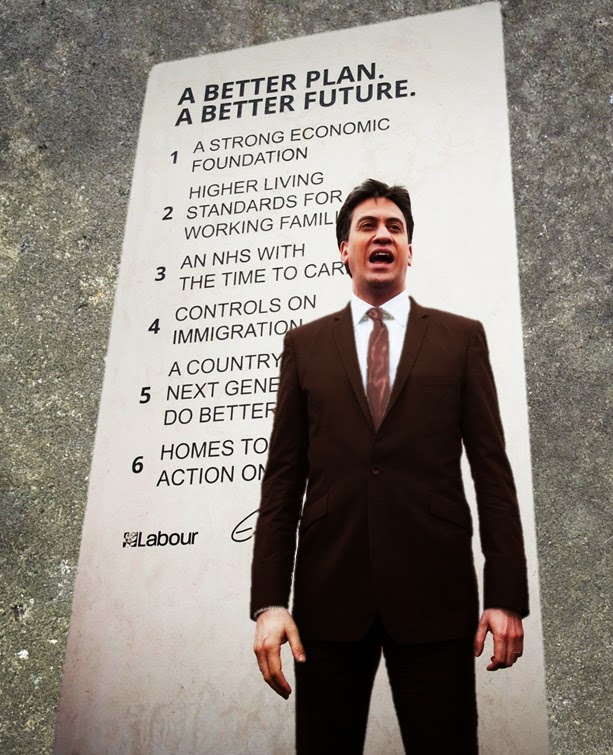
And since we don't believe these silly statements, however solemnly intoned they are, we then get the absurd spectacle of Cameron pledging to enshrine in law a promise not to increase income tax, VAT or national insurance. Followed by the even more absurd Miliband gimmick of having his vague, waffly pledges literally carved in stone.

I genuinely thought that this last one was a joke when I heard it. I still do.

But no matter how feverish the promises, how apocalyptic the denunciations of the other side(s), the electorate - as that Question Time audience illustrated - resolutely refuses to be convinced. We still think they're all lying. And they are.

Just to be clear: this was not always the case. There was a time when politicians told us grown-ups if things were going wrong. This is Edward Heath's message to the country in December 1973, telling us that we were in for the hardest Christmas since the war and that our standard of living was going to fall:


I'm not sure I can envisage Cameron or Miliband making that kind of broadcast. 

Mind you, it didn't do Heath much good; two months later, he was thrown out of office. Maybe that's why telling the truth fell out of fashion. Or maybe it was John Smith as shadow chancellor in 1992, telling us that if we wanted better services - which we said we did - we would have to see tax rises, which we decided was beyond the pale. Or possibly it was Blair winning three consecutive elections by peddling his PFI fantasy of 'investment' on the never-never. 

In any event, everyone now knows that there are serious problems coming, yet no politician is prepared to say so.

Despite all of which, I remain mostly optimistic about the future. 

Primarily this is because I don't believe the current settlement can survive, since it is so clearly dysfunctional. 

As many have pointed out, the principal justification for a first-past-the-post electoral system has always been that it provides strong, stable government. This no longer looks like a clinching argument. 

The inherent distortions are about to be revealed in the starkest manner ever. It is almost certain that Ukip will win the third largest share of the vote, and yet could end up tenth in the share of seats (the position it was in at the dissolution of the last Parliament).

Similarly, Nicola Sturgeon has talked a great deal about 'shutting the Tories out of Downing Street' with an anti-Tory majority in the Commons. This may well be the result, but the majority of the popular vote is likely at the same time to be right-of-centre; the Conservatives, Ukip and the Liberal Democrats will probably get more than 50 per cent between them. (I'm assuming that the Lib Dems' more left-inclined supporters will have abandoned them.)

There is also the fact that we no longer have any national parties, just a fraying patchwork of regional and nationalist groups. Those that still pretend to be national are self-evidently not fit for purpose.

And then there's Scotland. Some commentators are berating the Conservatives for jeopardising the Union with their apparent encouragement of the Scottish National Party; others are berating the Labour Party for their complacency in letting the SNP outflank them on the left.

But it doesn't matter much who's to blame; the fact is that there aren't very many passionate Unionists left, on either side of the border. Those who do claim to believe in the Union seem incapable of making out a case for it that goes beyond sentiment and slogan.

Whatever happens tomorrow, large numbers of people are going to feel not merely unhappy - that's normal - but cheated.

Back in 2012, I wrote that 'things are about to change quite radically'. I think we're edging ever nearer a critical moment.

Saturday, 2 May 2015

Those we have loved: Labour leavers

It's at this stage of a election campaign that my thoughts turn to the dear departed. There are two categories of MPs who don't return to the Commons after a general election: those who have decided to step down, and those who've been kicked out on their ear by the electorate.

We'll have to wait to see who falls into the latter category, but looking through the list of the voluntary redundancies, it is striking how many big (or biggish) names are leaving from the Parliamentary Labour Party.

At the top of the list is obviously Gordon Brown, accompanied by a clutch of former cabinet ministers: David Blunkett, Alistair Darling, Jack Straw, Tessa Jowell, Hazel Blears, Frank Dobson and Peter Hain. (The latter was the man on whom I once placed a bet that he would become Labour leader.)

Oh yes, and there's Bob Ainsworth, remembered as the defence secretary who was humiliated by Joanna Lumley into treating retired Gurkhas a little bit better. (Many would pay good money to be humiliated by Joanna Lumley.)

Then there some less elevated but still significant figures - Glenda Jackson (my original choice for London mayor), 'Red' Dawn Primarolo, Nick Raynsford, Joan Ruddock and my own favourite Austin Mitchell, whose book Four Years in the Death of the Labour Party is still the best account of the 1983 election campaign.

This is a hell of a lot of experience that's being lost, particularly in the event that Labour form the next government. Not that any of these would have served in such an administration, but it doesn't do any harm to have some people in the vicinity who've knocked around a bit. And, more widely, there's a loss to the Commons more generally.

That's in the world of politics, of course. Outside, the truth is that hardly anyone has noticed any of this lot, as a 2013 episode of Pointless made clear; asked to name cabinet ministers who served under Tony Blair or Gordon Brown, only seven in a hundred people named Straw, seven Darling and four Blunkett.

But mostly I wanted to take this opportunity to note the passing of Shaun Woodward, sometime secretary of state for Northern Ireland and one of the oddities of modern politics.

He was the Conservative Party's director of communications during the shock election victory of 1992, and was briefly a Tory MP for Witney, though he was sacked from the frontbench for supporting the repeal of Section 28. He then re-emerged as a Labour MP for the safe seat of St Helens South, despite attracting much mockery when the story got out that he retained the services of a butler.

His successor as MP for Witney was David Cameron who paid tribute to his predecessor in his maiden speech in 2001. 'He remains a constituent and a most significant local employer, not least in the area of domestic service,' Cameron said on that occasion. 'We are in fact quite close neighbours and on a clear day, from the hill behind my cottage, I can almost see some of the glittering spires of his great house.'

I think this makes Woodward the only Labour MP to be derided by Cameron for being too posh. We may not see his like again.

Friday, 1 May 2015

...like the leaving of it

Seven days from now, we may well be getting the first resignation of a party leader. Presumably the Scottish National Party, Plaid Cymru and the Green Party of England and Wales will stick with their incumbent leaders, but for the others, nothing is certain. Quite possibly Nigel Farage and/or Nick Clegg will fail to be elected in the first place, while either David Cameron or Ed Miliband - whichever doesn't get to be prime minister - won't be long for the leadership.

As an object lesson in how not to leave the job of party leader, you'd have to go a long way to beat Gordon Brown.

Following the indecisive result of the general election in 2010, he hung around in Downing Street for a few days - as he was constitutionally bound to do, since he was still prime minister - but then abruptly walked out, a few hours before the deal between Cameron and Clegg was concluded: and on that he was constitutionally wrong.

The real problem, though, was what followed. Brown resigned the Labour leadership and sulked off to Scotland, leaving Harriet Harman to mind the shop for the next few months while the long process of choosing a new leader played itself out. It was during that period that the narrative of the financial crash and crisis was firmly fixed in the public consciousness by the coalition government.

Brown was badly damaged by then, but he should still have been capable of articulating an alternative view, of defending the economic growth figures bequeathed to the new government. He didn't do so. And the legacy of Brown's self-indulgence could be seen on Question Time last night, as Ed Miliband squirmed in the face of questions on Labour's economic record. The ground lost in 2010 has never been recovered.

Compare and contrast Michael Howard departure from the Conservative Party leadership in 2005. He announced immediately after losing the election that he would be standing down, but not for another six months, not till a new leader had been chosen. He then reshuffled his front-bench team and promoted George Osborne to shadow chancellor and David Cameron to shadow education secretary, thereby setting up the new generation to inherit the leadership. It worked perfectly (though Howard would probably have preferred Osborne).

It is possible in retrospect to conclude that Howard didn't ultimately do his party any favours in the short term, that David Davis would have been a sounder choice in 2005 and might well have won a majority in 2010. But even if one accepted this, Howard was at least doing what he genuinely believed was in his party's interests. Unlike Brown, who simply abandoned his party.

Friday, 24 April 2015

Who gets my vote: part 2

Continuing my ruminations about who to vote for in the coming election, the Liberal Democrats in my constituency of Holborn & St Pancras are fielding Jill Fraser.
This is a good choice - Fraser (she's the one in the middle) is a popular figure. In 2003 she won a shock by-election to be elected to Camden Council (this was against the backdrop of the invasion of Iraq), and went on to become mayor of the borough in 2006. She stood for parliament in the Holborn & St Pancras constituency in 2005, achieving an 11 per cent swing from Labour to Lib Dem, and she's very active and visible in local campaigning.

Her son is a university lecturer (which is surely a good thing), but most famously she works in a local chip-shop and has done for over two decades. This is not necessarily the image conjured up by the words 'North London Liberal'.

She didn't stand in 2010, but the Lib Dem candidate came in second again, for the third election running. The candidate then, Jo Shaw, got a shade under 28 per cent of the vote. Even with the personal standing of Fraser, it's unlikely to get much better this time. Last year the Lib Dems were all but wiped out in the local elections, and Fraser lost her council seat (as did all but one of their candidates).

The reality, of course, is that it doesn't really matter who the candidate is. This is nobody's idea of a target seat (even assuming that the Lib Dems enjoyed the luxury of having target seats) and the party isn't exactly pouring resources into the constituency campaign. Fraser could promise free chips to every voter without it making any real difference.

I've long thought that the Lib Dems would do better in this election than was being predicted. And my reasoning was that they had quite a decent story to tell. Nick Clegg made the right decision in 2010 to enter a coalition government. Coalitions are what the party had been talking about for my entire adult life, and it would have been absurd to turn down the opportunity when it arose. Further, I have no doubt that the presence of the Lib Dems made the government a better one than it would have been had the Tories governed alone. Those were the two options that existed after the nation had voted, and we got the better of the two.

Now, though, I'm not so sure about the Lib Dem prospects. I think that as the choice between David Cameron and Ed Miliband becomes starker, there is a very real possibility that the Lib Dems will get squeezed. Clegg seems to me to be playing a limited hand pretty well, but for most of this campaign it's been as though the party hardly exists. No one appears to care in the slightest what they have to say.

And that's a bit of a shame, because I think the country benefits from having a moderately strong Lib Dem presence. It provides an alternative where none would otherwise exist, and it can sometimes spring a surprise. Eastbourne, for example, where the Labour Party stands no chance, was Tory for eighty years solid until the IRA murdered Ian Gow in 1990; now it's a Lib Dem constituency and likely to remain so.

I mean, obviously we have no idea what they stand for or what they believe. Lord knows they haven't actually been liberal for a long time, save for the occasional outbreak of concern over civil liberties. But believing in stuff isn't really their thing. Their job is to represent the don't knows. Which isn't intended as a criticism: there are an awful lot of don't knows, and they're entitled to have their uncertain voice heard, just as much as those who think they know everything.

And maybe I'm wrong about them being squeezed. Their best post-war performance came in 1983, in their incarnation as the SDP-Liberal Alliance. The country was then offered the choice of Margaret Thatcher or Michael Foot, and a very large number of people decided that they're rather have neither. The same could hold true for the party this time. Except that I don't think it will.

More than the state of the party at a national level, however, the problem for Jill Fraser is that she's rather wasted on Holborn & St Pancras. She'd make someone a good MP. But not us.

Tuesday, 21 April 2015

If you hate me after what I say...

Worse than the politician who knows nothing about popular culture is the politician who claims to know something about popular culture and gets it wrong. There's something horribly embarrassing about, say, David Cameron urging 'his' club Aston Villa to 'go for it' and hoping that they achieve some 'gains'.

On the other hand, there are times when Cameron is clearly telling the truth. When he chose Benny Hill's song 'Ernie (The Fastest Milkman in the West)' as one of his records on Desert Island Discs, that was surely an honest man speaking,

Last week, Cameron filled in a little more of his childhood listening. Pointing out that the numbers of people claiming unemployment benefit were at their lowest since 1975, he said: 'I can't even remember 1975 - I think I bought a Bay City Rollers album, it's that long ago.'

When Cameron praised the Smiths, Johnny Marr famously banned him from ever liking the group. I feel the nation now needs to hear from Les McKeown on his attitude to the prime minister's seal of approval for the Rollers. We know that Les supported the Yes campaign in the devolution referendum ('England and Scotland would be better friends separated than together'), which may give us a hint. But we should know for certain before we're asked to cast our votes.

Incidentally, if you are thinking of buying a Bay City Rollers album, may I suggest that you don't bother with the three records that were available in 1975. Instead I'd recommend Dedication, their 1976 masterpiece, produced by Jimmy Ienner.

Friday, 10 April 2015

Where's Willie?

In November 1990, the Conservative MP Emma Nicholson asked Brian Griffiths, the head of the policy unit at 10 Downing Street, to pass on a message to Margaret Thatcher. The message was that Nicholson would not be supporting the prime minister in the forthcoming leadership election, in which she was being challenged by Michael Heseltine.

Griffiths's response to this request was one of genuine surprise: 'Are you telling me that this election actually matters?'

At the same time, a loyalist MP, Alan Clark, went to see Peter Morrison, the 'noted pederast' who was running Thatcher's election campaign, and found him fast asleep and 'sozzled' at three o'clock in the afternoon.

The Conservative Party often struggles to tell the difference between confidence and complacency. There are times when it works: Harold Macmillan exuded self-contentment to great effect as prime minister. And then there are times - such as the fall of Thatcher - when it all goes very wrong indeed. The current campaign is beginning to look as though it might fall into the latter category.

Obviously the key message is meant to be steady-as-she-goes. And perhaps the strategists are thinking that, with nearly four weeks to go, they don't want to peak too early. But some sign of life would be sensible.

We all know that this election isn't about policy (it's the greatest cliche in modern politics, but there really is very little to choose between what the two main parties would actually do in government). We all know as well, however, that it's part of the game to try to catch the eye of the media - and maybe even the electorate.

And so far, I'm struggling to remember what the Tories have come up with. There was something reported on Radio 5 Live with the curious phrasing: 'Primary school children who fail their SATS will have to retake them under a Conservative government.' Which raised the image of five years of Labour government, after which a new Tory administration would summon back 16-year-olds for their re-sits. And that's about all that sticks with me. Oh, and they want to do something about internet porn.

Meanwhile David Cameron's lack of preparation for his TV appearances seems to have continued. His campaigning style brings to mind Willie Whitelaw's great comment about Harold Wilson 'going round the country stirring up apathy'.

But then, as Thatcher rightly pointed out, every prime minister needs a Willie.

Monday, 6 April 2015

Election predictions

This is, according to David Cameron, the most important election in a generation. And, according to all commentators, it's the most unpredictable election since 1945.

The first claim is simply wrong, at least in the sense that Cameron means. The second is undeniably true. But that merely invites the making of predictions. There's no fun in predicting the inevitable; much more entertaining to commit oneself when there's every chance of being completely wrong. So, to launch this new incarnation of my blog, here is my prediction for the result of the forthcoming election:

There will be a Conservative government with a small majority.

And some more predictions... After the election, things get really interesting. That Conservative majority will wither on the vine in the heat of the EU referendum, and Ukip - having won fewer than five seats in the election - will blossom, fed by a steady stream of Tory defectors. And that will skew the balance of power within Ukip towards Douglas Carswell and away from Paul Nuttall, to the ultimate detriment of the party's fortunes. The defections will sufficiently panic the Conservatives that when Cameron steps down (having won the referendum), they will opt for Boris Johnson as leader, thereby ensuring that they lose the subsequent election.

Meanwhile, the Labour Party will decide it ought to have a woman as leader, and will choose Rachel Reeves over Yvette Cooper, thereby ensuring that they also lose the subsequent election.

Also choosing a new leader will be the Liberal Democrats. They won't perform disastrously in the election (though they'll win fewer seats than the SNP), but - finding they're not needed in government - they will go for a change anyway. The new leader will be Tim Farron, thereby ensuring that they do rather well in the subsequent election.

PS I would like to point out that on the day of the 2001 general election, I correctly predicted - against all conventional wisdom - that Iain Duncan Smith would take over as Tory leader. Since then, however, I've been wrong on almost every occasion. So if any of this turns out to be correct, I'll be trumpeting it for years to come.