Sunday, 10 May 2015

A tale of some minor parties

A week or so back, I predicted that one consequence of the election would be the resignations of Nigel Farage and Nick Clegg as the leaders of, respectively, Ukip and the Liberal Democrats. I also predicted that Natalie Bennett would not resign as leader of the Green Party of England and Wales.

These things having now come to pass, it's time to evaluate them.

Starting with the last first, Bennett should have the decency to go immediately. She has proved herself to be completely useless as a leader. The Greens had a dreadful election, and much of the blame for that rests with her.

The party achieved less than 4 per cent of the vote. Under most sensible forms of proportional representation, the bar for securing seats is set at 5 per cent. Frankly they're fortunate that first-past-the-post came to their rescue and gave them an MP.

Yet the opportunity was unquestionably there for the Greens: lots of airtime and visibility, a weak Labour leadership, a widespread dissatisfaction with mainstream politics. A breakthrough of sorts was possible. Obviously not in terms of winning large numbers of seats, but even without representation, a minor party can still have an influence, can help to shape the political agenda.

You only need look to Ukip. At a time when they had no MPs at all, they were still capable of scaring the British prime minister into promising a referendum when he didn't want one, and panicking the Labour Party into saying they'd 'get tough' on immigration, when we knew they wouldn't.
So what did Bennett do? She joined in the chorus of 'the Tories are mean and nasty'. Well, if you believed that, then you should have done the sensible thing and voted for a party capable of removing the Conservatives from office. Which is, indeed, what the vast majority of those opposed to the Tories actually did.

At a constituency level, things may have been different, but on the national stage Bennett offered nothing at all that was distinctive. One brief mention in a leaders' debate of climate change and vanishing species, and that was it. At a time when fracking offers a perfect way of linking the local with the global, there was only silence.

It is, of course, more difficult to get attention for environmental issues at a time of economic hardship, but this is far from a new problem. I wrote about it in Crisis? What Crisis?, my book on the 1970s. There's been plenty of time to work out a strategy for such a situation.

The Greens are one of the few parties who actually have a USP. Yet they didn't exploit it. Instead there was a manifesto and a platform full of policies on an absurd range of issues that were entirely irrelevant, including the stupidity over copyright, to which I drew attention a while back. (And which subsequently annoyed the hell out of a lot of creative people who were sympathetic to the party.)

Why? Where's the benefit in burying your brand? Why allow your core message to be lost amidst a welter of questions about a tax policy you will never have a chance to implement?

One other point, which most people are (quite rightly) too polite and decent to say out loud: the voice was wrong. The British public didn't warm to being waffled at in an Australian accent. Obviously it shouldn't matter, but it does.

In short, Bennett should go.

So too should Farage. He's left open the possibility of coming back from his holidays and standing again for the Ukip leadership, but he should resist the temptation. The party is better off without him now.

He has been an extraordinary figure who has over-achieved on a spectacular scale. In many ways, he was the story of the Coalition years, conducting a brilliant guerrilla campaign against Westminster. (Do I need to point out that I'm talking about technique not policies? I do hope not.) I went to one of his EU debates with Nick Clegg and he was a superb performer - committed Europhiles were coming out of the hall saying how good he was.

But he still has to go.

When Ukip won the elections for the European Parliament a year ago, I wrote that they'd reached their high-water mark. If they were ever to go any further, I suggested, they needed to thank Farage for all his work and ask him to step down. He'd taken them as far as he possibly could. My comparison was with Ian Holloway, a colourful, charming and competent manager who got Blackpool Football Club to the Premier League, but couldn't keep them there.

My argument was that if Ukip wanted to secure - let alone go beyond - the 4.4 million votes they achieved last year, they had to make serious inroads into Labour heartlands, and Farage was probably not the man for that. He did pretty well this week, but the party fell to 3.9 million votes on a far higher turnout. It could have been better if he'd gone last year. Now it's probably too late, and decline is (I think) inevitable.

Ukip are, as normal with third parties, an odd coalition of the disgruntled and the idealistic from all points of the political compass.

There are two broad bases of support: the Eurosceptic deserters from the Conservative Party and the disillusioned white working-class who feel abandoned by Labour. These are represented by Douglas Carswell and Paul Nuttall respectively, and I assume that they will be the two candidates in a leadership election. I also assume that Carswell will win, to the detriment of the party's electoral interests.

The alternative is Suzanne Evans, currently the acting leader, who would be their best choice of all. And since I think that, I don't expect her to get the job on a permanent basis.

Their moment has passed, but they leave behind an example of how to make a difference. Why is there no Left party that can do this?

And so, finally, to Nick Clegg.

What can one say? Well, firstly, that he made exactly the right decision in 2010. The Lib Dems, and before them the Liberals, had always banged on about coalition government being a good thing. They were offered it, and they accepted. To do otherwise would have been foolish.

Some people complained that Clegg would have sold his own mother to get power, but that judgement seemed a little harsh. After all, he did join the Lib Dems, which isn't traditionally the way to achieve high office. Given the state of modern politics, he could have fitted perfectly comfortably into the modern Conservative or Labour Parties, but he chose the road less travelled.

As the junior partner in the Coalition, the Lib Dems proved surprisingly effective at government. They got through key policies like the pupil premium and raising the threshold for income tax; even the tuition fees increase - damaging though it was - had a logic, if they'd only had the sense to call it a time-limited graduate tax.

Most of their members and (probably) their supporters would have preferred a coalition with Labour, but that wasn't available in 2010. In the circumstances, I thought they played a difficult hand rather well and could justifiably be proud of their record.

But over recent months, and particularly during the campaign itself, they decided to distance themselves from their Coalition partners and, in so doing, they thoroughly ruined the good story they had to tell.

The final straw came when Danny Alexander decided to reveal the contents of private government papers in an attack on the Tories. The effect was to make the party look incompetent and untrustworthy. Who would want to work with people who go telling tales out of school? The first rule of Coalition Club is you don't talk about what goes on behind the scenes at Coalition Club.

Before the election, it was widely assumed that Tim Farron would become the next leader. Now that looks like such a nailed-on certainty that the party's going to have to twist someone's arm to stand against him, so that it least has the formal structure of a contest. Norman Lamb, possibly; or that bloke up in Scotland, whose constituency is so remote that not even SNP canvassers could find it.

Farron is the obvious and correct choice. He's as close as they've got to an old-fashioned Liberal, and since the parliamentary party is down to the numbers last seen under Jeremy Thorpe, they might as well adopt an old-fashioned approach.

But it's an absurdly uphill struggle now. The thing is this: if the Lib Dems didn't exist, who would bother to invent them?

Friday, 8 May 2015

Ed Miliband: an obituary

In early 2013 I was part of a panel event under the banner of Crunch the News, alongside the excellent New Statesman writer Helen Lewis and the equally excellent comedian Josie Long.

The country was then just about halfway through the Coalition parliament, but already it was evident that an initial burst of activism - centred on tuition fees and UK Uncut - was flagging a little. Indeed Long had written a piece on precisely this subject only a month or so earlier, talking about how 2012 has been 'tiring and saddening'.

I was there to plug Things Can Only Get Bitter, an e-book I'd written about the devastating impact of the 1992 general election, and my message that day was that the anti-Tory opposition needed to learn from the crushed hopes of my generation. It had to recognise that it was in for the long haul, because in 2015 the Conservative Party was going to win a majority in the election.

Despite my best intentions, I'm sure I came over as irritating, pompous and patronising. And none of that will have been ameliorated by the fact that I turned out to be right.

There were two main reasons why I was always convinced that the Conservatives would win: one of them was David Cameron, to whom I shall return in a future post, and the other was Ed Miliband.

In 2010 I went to the first hustings for the Labour leadership, having been invited by Sam Harrison (the best editor a boy could have). As we were coming out of the hall, I ended my assessment of the five candidates with the words: 'What's the point of Ed Miliband?' and Sam dug me in the ribs. A couple of paces in front of us was the man himself with a sidekick.

My immediate feeling was: 'Oh no, I hope I haven't upset him.' And my second feeling was: That's not the response one ought to have for a man who wants to be prime minister. Fear possibly, respect certainly, but not concern over hurting his feelings.

Nothing I saw subsequently convinced me that he was up to the job. In July 2011, I wrote: 'Ed Miliband was - to be generous - only the third best candidate in the leadership election last year, and he's been going downhill ever since he won.' Later that year, I pointed out that the Labour Party's poll ratings of 40 to 42 per cent were inadequate, that at a similar point in Margaret Thatcher's first term, Labour was touching 50 per cent.

In 2012 I wrote that Miliband 'still doesn't look like a serious candidate to be prime minister', and a year ago, I returned to the theme: 'I've never believed Ed Miliband was capable of winning the general election. I still don't believe he will.'

The key problem, I argued in August last year, was nothing to do with his image as being a nerdy policy wonk. Precisely the opposite, it was that his appeal was purely to the emotions. His line on the economy (all his early forecasts of mass unemployment having proved wrong) was simply that Cameron didn't 'get it' and wasn't listening to 'hard working families' and 'the most vulnerable in our society'. My point was: 'A potential prime minister should aspire to being more than a sympathetic ear in times of trouble.'

Policy did come eventually, but it was piecemeal, on a small scale, and it didn't hang together, except by that thread of 'the Tories are out of touch'. And that was pathetically inadequate, just like everything else about Miliband's ill-fated leadership.

And again I'm experiencing that same sensation from 2010. How can I be so mean to a nice young man like Ed Miliband? It feels almost as if I were bullying him, even though I so obviously don't have the power, status or ability so to do.

My criticism, however, is not really of him at all. I thought - like everyone else - that he fought quite a good election campaign, given that he's Ed Miliband. But he was trying to make bricks without straw. The real criticism is of a Labour Party that was stupid enough to elect him leader in the first place.

Beyond that, the sadness is that the vacuity of Miliband's leadership was perfectly in tune with Labour in recent times.

One of the great mistakes of the Left in the years since 1992 has been the belief that the Conservative brand was fatally and permanently toxic.

In some circles, of course, this is how it appears. In Scotland, for example, where Nicola Sturgeon's call to 'lock the Tories out of Downing Street' was so successful over the last month. More significantly, this is the perception in London, that multicultural, cosmopolitan city of the world that has so little to do with the rest of England, let alone the United Kingdom.

There was a certain irony that the day before Cameron's great triumph, the death was announced of the Hot Chocolate singer Errol Brown. Apart from anything else, Brown was famous for having sung John Lennon's 'Imagine' at a Tory rally during the 1987 election campaign. In my book Rejoice! Rejoice! I joked that this 'might well have been an act of subversive irony', but the truth is that Brown was perhaps the last credible celebrity honest enough to admit in public that his interests were best represented by the Conservatives.

Nowadays musicians and writers, actors and comedians, in fact almost everyone who wants to hang on to a showbiz career, is careful to let us know that their sympathies are with the Left. Since this doesn't match their material interests, one can only assume that there are an awful lot of 'shy Tories' in Luvvie Land.

But the anti-Tory attitude that is common currency in the cultural, broadcasting and new media circles of London is not universal. The fury that has been directed at newspapers like the Sun, the Mail and the Telegraph over the last week or so, as the election campaign got personal and unpleasant, never quite acknowledged just how successful these titles are.

Listen to phone-in programmes on the radio and a different picture emerges. One in which the Conservative Party can persuade two million more people to cast a vote than can the Labour Party. One in which Ukip can out-poll both the Liberal Democrats and the Scottish National Party put together, attracting more than three times the support of the Green Party.

In short, the United Kingdom is still a conservative-minded country.

If the Labour Party is to get over this setback in England and Wales, it needs to recognise this fact. Being against the evil Tories is simply not enough. Admittedly, that feeling sustained Tony Blair through three election victories (albeit with terribly diminishing returns), but that moment has passed, killed by Cameron.

The pre-Blair Labour Party was essentially built on power. It understood that there was a class war (even if the conduct of the conflict was often quite civilised) and it took its stand alongside the power of the organised working class. That tradition died in the miners' strike of 1984-85.

A new Left emerged at the same time, symbolised by the Greater London Council under Ken Livingstone: an inclusive rainbow coalition of interest groups and identity politics. Primarily this socially liberal tendency had its great successes in the cultural field, though Blair was more than happy to hitch a ride on the bandwagon. So too was Cameron.

With success came obsolescence. There are obviously battles still to be fought on the grounds of gender, disability, race and so on. But compared with the culture wars of thirty years ago, these feel more like mopping-up operations than a fight to the death.

So what remains for the Left? A residual rant against 'the hated Tories' does not constitute a philosophy. And nor, it is clear from yesterday, is it effective, Even against an Old Etonian prime minister with an agenda of cutting the welfare state, the charge of being out of touch, irrelevant in modern Britain, simply didn't work.

To put it another way, the old Clause IV of the Labour Party constitution - the one demanding 'the common ownership of the means of production, distribution and exchange' - was a call to arms.

The new version, introduced by Blair in 1995 is not. There's vague waffling about 'the strength of our common endeavour', there's talk of 'duties' as well as 'rights', there's an espousal of 'solidarity, tolerance and respect'. There is literally nothing here with which Cameron would disagree, save for the unsubstantiated claim that Labour is 'a democratic socialist party'.

As long ago as the 1950s, of course, people had stopped believing that the old Clause IV would ever be implemented by Labour. But it remained as a statement of ultimate faith. Its removal left a great gaping hole where once there had been the heart of the movement.

That absence is what the Labour Party has now to address. It's what Miliband failed so comprehensively to do. He did try from time to time, but it was unconvincing and half-hearted. At the 2012 conference, for example, he tried out the slogan 'One-Nation Socialism' (as used by John Prescott in 1995), but who remembers that now?

The consequence was Miliband took the party down to a humiliating defeat. It was a dreadful performance. Forget the parallels with 1992, Labour yesterday secured fewer votes and a smaller share of the vote than did Neil Kinnock when losing to Margaret Thatcher in 1987. That was when the SDP-Liberal Alliance was still a major force, splitting the Left. This time it was supposed to be the Right that was split.

The Miliband leadership has been a complete waste of five years, and still the question has yet to be answered: What is the Labour Party for?

General Election results

With a large number of seats still to be declared, it's clear that all the opinion polls were wrong. But I would like to point out my own prediction just over a month ago: 'There will be a Conservative government with a small majority.' This may yet prove to be accurate.

Thursday, 7 May 2015

Who gets my vote: the final verdict

Having checked out the claims of the various candidates in my constituency - Labour, Tory, Lib Dem, Green and others - I find I still have to make a decision about who to vote for.

Ed Miliband tells me to put my family first when voting. Well, my parents are retired and have had a better deal on their pensions from the coalition than from the last Labour government. (You may remember Peter Mandelson saying there was 'no mileage' to be gained from chasing the pensioner vote.) And my brother will be hit by the mansion tax.

Personally, I won't be affected (now or ever) by a mansion tax. Nor will I be affected (now or ever) by an increase in the top rate of tax to 50 per cent. Or by a levy on bankers or tobacco companies.

On the other hand, Miliband adds that, as prime minister, he would 'put working families first'. So it doesn't sound as though there's much there for those of us who are childless.

And indeed I know perfectly well that my taxes will go up. But that's regardless of who gets in. Even before we get round to paying for those election bribes, current expenditure has to be funded and no one really believes that the shortfall is going to be made up by investment bankers and Starbucks.

I like the argument put forward by Russell Brand and, more coherently, by Owen Jones that: 'Campaigners can put pressure on the Labour leadership, and they can extract concessions that could transform lives'. But that does assume that campaigners are on the 'right' side. And photographs of a gender-segregated public meeting for the Labour Party (in Britain, in 2015) suggest that that's not necessarily to be taken for granted. Miliband's susceptibility to pressure may simply be weakness.

In any event, this position implies that 'this time' we must vote Labour in order to keep out the evil Tories.

I've heard this argument in every general election since I became entitled to vote. But this time it feels as though the two-party state is teetering on the brink of collapse, and I'm inclined to think that this is the key issue, since most of the parties as they currently stand are close to being meaningless.

The existence of the SNP and Plaid Cymru make sense; none of the others do. It's time to change the system of representative democracy, and to start again. Proportional representation would at least be a start.

Maybe this isn't an occasion for short-term calculation.

I should add that I'm not a card-carrying member of any political party (though back in the 1980s I did once stand in a council election for the Humanist Party), so I have no direct calls on my allegiance. As a pompous self-proclaimed historian, I think this is probably a good thing.

I do, however, have a loyalty, an interest that I ought to declare. I once wrote the election manifesto for one of the established parties. But not because I was a member - just because I was a jobbing writer.

So - full disclosure, as journalists like to say - back in 1996 I was asked to write As Sutch: The Political Manifesto of the Official Monster Raving Loony Party.
Much of this was based on Screaming Lord Sutch's previous press releases, and with the passage of time I've now lost track of which bits were mine and which were existing pledges. The Flying Squad being equipped with Space Hoppers - was that my idea? The introduction of selection and streaming to evening classes? The building of pram lanes?

I'm fairly sure that the abolition of Jeffrey Archer, Damien Hirst and Mystic Meg were my suggestions. And fixing the minimum wage and the state pension at 100 per cent of an MP's salary. And making it illegal for adverts to use the sound of doorbells and telephones ringing.

Certainly the running gag about Tony Blair going bald, the questioning of whether Vinnie Jones really was Welsh, and the jokes based on scurrilous (and untrue) rumours about Michael Portillo and Peter Lilley - I'll hold my hand up to those ones.

The idea of the publisher, McNaughty Books, was to exploit the coming general election campaign to get some sales on a joke gift-book. It didn't work. Lord Sutch's beloved mother fell and broke her hip in March 1997, and he withdrew from the election in order to nurse her. 'The is the first time I have missed a general election,' he said, 'but when you have family, they come first.'

He did contest two further by-elections later in 1997, taking his total number of candidacies to forty, but his heart wasn't really in it. His mother died the following year and, unable to cope with the ensuing depression, Sutch committed suicide in 1999.

The Official Monster Raving Loony Party survives, but it's not fielding any candidates in my constituency, so I can't vote for them. Unless I spoil my ballot paper by adding their name to it...

Wednesday, 6 May 2015

The general election campaign, 2015

Just in case my publishers are reading this (which they're not - they don't talk to me anymore), I should stress that I'm not intending to write a history of these times. But if I were, who and what would I take out of this election campaign as being worthy of note?

Possibly the sheer resilience of Nick Clegg, the thickest-skinned politician ever. Probably Natalie Bennett, with her brain-fades and advocacy of polyamorous marriages. Definitely Grant Shapps in all his gormless glory.
What else? Russell Brand would be in there. Maybe Ed Miliband and the hen party? Maybe David Cameron forgetting which football club he's supposed to support? That's the kind of thing I normally record.

The one event that would certainly be included - even though it'll fade from the collective memory - would be the BBC Question Time last week, in which the audience accused successively Miliband, Cameron and Clegg of being liars. More than anything else, that seemed to nail this campaign and the state of modern politics.

Before, during and after the manifesto launches, we've had - from all parties - a relentless series of what columnists nowadays like to call 'offers', but which we used to call policies. Or bribes, to be more precise. Each day there's been a new proposal to reduce tax or to increase spending or, more frequently, to tell other people what things they should be doing differently.

Employers, housing associations, landlords, fuel companies, rail operators, bankers, tobacco firms: all of them, ministers manqué claim, could be regulated more stringently or made to reduce their profitability. This is all perfectly fine and legitimate - only the libertarian fringes object on principle to all intervention in 'the market' - but it's hard not to see it as being an alternative to government action.

One party suggests they'll build x number of houses, and another chips in with x x 2 (or x x 3, if x x 2 has already been taken). None of the contenders actually intend to build any houses themselves, of course: these are just figures plucked out of thin air and magically transformed into targets.

Because we are still, sadly, in a political world of targets. Lord know it's not as bad as during the first government of Tony Blair when, as I wrote in my book A Classless Society:
There were targets for the quantity of cars, cycles and pedestrians on the road, as well as for traffic casualties and dog mess; for the numbers of smokers, heroin addicts and pregnant teenagers; for the incidence of robberies and building-fires; for how many children visited museums and galleries, and for the proportion of school-leavers going on to higher education. There was even a target for the number of otters to be found in the wild...
But even without this excess of zeal, the thinking behind the target culture still dominates political thinking; the stated intention to do something is believed to be just as good - and certainly much easier - than actually doing it. As Blair himself once put it: 'It's the signals that matter, not the policy.'

This time the signals extend to cover the behaviour of foreigners.

The Tory manifesto promises to deliver '100,000 more UK companies exporting in 2020 than in 2010' with a 'target of £1 trillion in exports' - presumably whether or not people want to buy our stuff.

It also says: 'We will set challenging targets for Visit Britain and Visit England to ensure more visitors travel outside the capital' - whether or not that was in the holiday plans made by those tourists.

Meanwhile, the Labour manifesto promises to 'push for global targets to tackle inequality and promote human rights' - whether or not... well, you get the idea on that one.

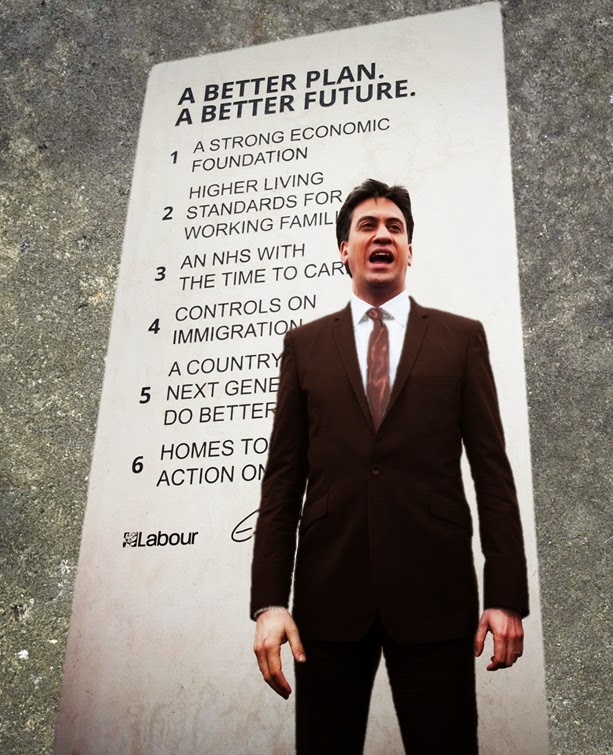
And since we don't believe these silly statements, however solemnly intoned they are, we then get the absurd spectacle of Cameron pledging to enshrine in law a promise not to increase income tax, VAT or national insurance. Followed by the even more absurd Miliband gimmick of having his vague, waffly pledges literally carved in stone.

I genuinely thought that this last one was a joke when I heard it. I still do.

But no matter how feverish the promises, how apocalyptic the denunciations of the other side(s), the electorate - as that Question Time audience illustrated - resolutely refuses to be convinced. We still think they're all lying. And they are.

Just to be clear: this was not always the case. There was a time when politicians told us grown-ups if things were going wrong. This is Edward Heath's message to the country in December 1973, telling us that we were in for the hardest Christmas since the war and that our standard of living was going to fall:


I'm not sure I can envisage Cameron or Miliband making that kind of broadcast. 

Mind you, it didn't do Heath much good; two months later, he was thrown out of office. Maybe that's why telling the truth fell out of fashion. Or maybe it was John Smith as shadow chancellor in 1992, telling us that if we wanted better services - which we said we did - we would have to see tax rises, which we decided was beyond the pale. Or possibly it was Blair winning three consecutive elections by peddling his PFI fantasy of 'investment' on the never-never. 

In any event, everyone now knows that there are serious problems coming, yet no politician is prepared to say so.

Despite all of which, I remain mostly optimistic about the future. 

Primarily this is because I don't believe the current settlement can survive, since it is so clearly dysfunctional. 

As many have pointed out, the principal justification for a first-past-the-post electoral system has always been that it provides strong, stable government. This no longer looks like a clinching argument. 

The inherent distortions are about to be revealed in the starkest manner ever. It is almost certain that Ukip will win the third largest share of the vote, and yet could end up tenth in the share of seats (the position it was in at the dissolution of the last Parliament).

Similarly, Nicola Sturgeon has talked a great deal about 'shutting the Tories out of Downing Street' with an anti-Tory majority in the Commons. This may well be the result, but the majority of the popular vote is likely at the same time to be right-of-centre; the Conservatives, Ukip and the Liberal Democrats will probably get more than 50 per cent between them. (I'm assuming that the Lib Dems' more left-inclined supporters will have abandoned them.)

There is also the fact that we no longer have any national parties, just a fraying patchwork of regional and nationalist groups. Those that still pretend to be national are self-evidently not fit for purpose.

And then there's Scotland. Some commentators are berating the Conservatives for jeopardising the Union with their apparent encouragement of the Scottish National Party; others are berating the Labour Party for their complacency in letting the SNP outflank them on the left.

But it doesn't matter much who's to blame; the fact is that there aren't very many passionate Unionists left, on either side of the border. Those who do claim to believe in the Union seem incapable of making out a case for it that goes beyond sentiment and slogan.

Whatever happens tomorrow, large numbers of people are going to feel not merely unhappy - that's normal - but cheated.

Back in 2012, I wrote that 'things are about to change quite radically'. I think we're edging ever nearer a critical moment.

Tuesday, 5 May 2015

Grooming in Rotherham

It's now clear that the authorities in Rotherham were told about the large-scale sexual abuse of children in 2003 and in 2006 by men of Pakistani origin, and yet chose to do nothing.

Attempting to understand the inactivity, the South Yorkshire police commissioner, Alan Billings, says: 'The only sense I can make of it is that at that time, police were prioritising other things ... I don't think anyone understood what grooming was.'

This is, at best, arrant nonsense and it really shouldn't be allowed to stand. The concept of grooming was understood well before this period, even if the word was not. Here's Anne Bannister from Manchester, an expert in the field, talking to Andy Beckett in the Independent on Sunday in 1996:
'Paedophiles rarely pick off children at random ... Instead abusers identify likely victims and draw them closer by "grooming", offering gifts, favours and friendly company over what may be weeks or even months.'
Whatever the reason for the complacency of the authorities in Rotherham and elsewhere, it certainly wasn't ignorance of how abusers operate.

Who gets my vote: Part 5

So finally, having looked out the Tory, Lib Dem, Green and fringe candidates for the constituency where I live, Holborn & St Pancras, I come to the person who will - barring acts of God - become the next MP. And that person is the Labour Party's candidate, Keir Starmer. Or Sir Keir Starmer, as he became last year.

Now Starmer starts with a slight advantage, as far as I'm concerned. I've got used to the idea that people offering themselves for the highest political office are younger than me (I once wrote an e-book on the subject). But Starmer was born just six months after I was, which is well within the margin of error.

According to a profile in the Guardian a decade or so back, he was born into a working-class family in South London and went to Reigate grammar school, where he had violin lessons alongside Fatboy Slim. His parents, after retiring, ran a donkey sanctuary.

He made his name in the 1990s as a defence lawyer, specialising in civil rights and representing everyone from the families of British soldiers killed by 'friendly fire' in the Kuwaiti War, through to Arthur Pendragon. (The latter, in case you've forgotten, was the official sword-bearer of the Secular Order of Druids and was accused of trespassary assembly at Stonehenge on the summer solstice.)

He was also involved in the epic McLibel case, and acted for Death Row prisoners in the Caribbean. In 2000 he was named Human Rights Lawyer of the Year by the two pressure groups Liberty and Justice.

In 2008 he became Director of Public Prosecutions. The Daily Telegraph called his appointment a case of 'poacher turned gamekeeper'; the Guardian said it was 'bold' (resisting the temptation to add 'very bold', in approved Jules and Sandy manner); while the Sun summed it up with the headline: 'New prosecutor defends paedos'. He left office five years later, and was subsequently selected as the Labour candidate for Holborn & St Pancras.
All of this is perfectly sound; you might say impressive. And the man even lives in the constituency. So why am I suspicious of Starmer?

Well, Wikipedia points out that as DPP he was responsible for the non-prosecution of the police officer involved in the death of Ian Tomlinson, and was subsequently keen on pursuing the Twitter Joke case. But I don't think that's the real cause of my distrust. Those decisions certainly besmirch his image as a liberal lawyer (Judge John Deed wouldn't have made them), but his broad record as DPP stands scrutiny with pretty much anyone else's.

No, I think my problem comes from a feeling that he is at heart a believer in the state as the solution to our woes. This is characteristic of many civil rights lawyers; a sense that they are the guardians of truth, freedom, progress, and that these things are therefore determined by action from the top down.

Back in 1990, for example, Starmer was quoted as saying that 'morality was a question for Parliament, not the judges'. I don't think it's a question for either, particularly. I think morality is a question for the people, with both Parliament and the judges following behind.

Or perhaps my problem is that he represents the new-look Labour Party. 'Labour has changed, with just 13 per cent of our MPs from skilled manual backgrounds,' said the union leader Ken Jackson in 1999. 'Barristers, academics and doctors have taken their place. Parliament is fast becoming the preserve of the professional.'

In Andy McSmith's excellent book Faces of Labour, he recounts the story of Tony Blair being introduced to Greg Dyke in 1983, at a time when Blair was looking for a safe constituency to fight. Dyke's response was: 'Not another fucking London barrister!'

Maybe that's it.